


Page 1569 - Hall et al (2015) Principles of Critical Care-McGraw-Hill
P. 1569
1088     PART 10: The Surgical Patient


                 years,  some organ transplants  (eg,  kidney  and  pancreas)  no longer   Therefore, each center has specific transplant protocols. However, as
                 require routine postoperative admission and monitoring in an inten-  a consequence of the resultant modulation of the immune system’s
                 sive care unit. Lung, liver, and heart transplantation, however, remain   surveillance and response functions, the transplant recipient is placed at
                 challenging from a surgical and anesthesia perspective with risk for   risk of developing infections and neoplasms.
                 hemodynamic and respiratory complications intraoperatively and in the   Immunosuppressive therapy can be divided into three phases: induc-
                 perioperative period. Their long-term outcome depends on the imme-  tion, maintenance, and the treatment of acute rejection. The induction
                 diate postoperative management in the intensive care unit and recent   phase commences in the immediate postoperative period and involves
                 advances in survival have been directly due to improvements in early   intense immunosuppression that is usually continued for 2 to 4 weeks.
                 postoperative care.                                   Although the regimens used at different centers vary, most typically
                   Given  the  burden  of  immunosuppression  that  these  patients  face   include the use of systemic corticosteroids in conjunction with a calci-
                 throughout their posttransplant lives, they are at increased risk of   neurin inhibitor and a proliferation inhibitor (see below).  These agents
                                                                                                                 1
                                https://kat.cr/user/tahir99/
                 developing severe standard and opportunistic infections prompting   may be started intravenously, but are switched to oral formulations to
                 admission to an intensive care unit. Their lives are further complicated   minimize toxicity once the patient is tolerating and absorbing enteral
                 by acute and chronic rejection that could necessitate intensive care sup-  medications and feeds. To avoid some of the renal toxicity associated
                 port. Knowledge of unique presentations of common illnesses or unique   with the calcineurin inhibitors, antithymocyte immunoglobulin or anti–
                 illnesses that present with common clinical syndromes is imperative for   interleukin-2-receptor antibodies (IL-2R Abs) may be substituted in the
                 the early recognition and timely initiation of appropriate treatment. The   early postoperative period.
                 consequences of missing rejection or infection include death, or graft   The maintenance phase follows the induction period and is heralded
                 failure  and  return  of  the  patient  back  to  a  state  characterized  by  the   by a reduction in the intensity of immunosuppression. Typically the
                 sequelae of end-organ dysfunction.                    maintenance phase incorporates components of the planned regimen
                   This chapter focuses on the indications, outcomes, postoperative   that will be used to suppress the immune response to the allograft and
                 management, and postoperative complications of lung, liver, and heart   thus prevent rejection over a more prolonged period. Most patients will
                 transplant. For the transplant intensivist, optimization of the postop-  be  maintained  on  either  oral  prednisone  and  cyclosporine  or  tacroli-
                 erative care and knowledge of the potential complications are necessary   mus, although it appears that in some patients receiving tacrolimus for
                 to enhance outcome. For the nontransplant intensivist, knowledge of   maintenance the steroid component may be discontinued completely.
                                                                                                                          2
                 indications for transplant, supportive care, and optimization of function    Azathioprine or mycophenolate mofetil is often used during the main-
                 prior to transplant is important. An understanding of bridging tech-  tenance phase to permit dose reduction of the other immunosuppressive
                 niques and having an approach to the management of immunosup-  drugs in order to minimize side effects.
                 pressed transplant patients and their unique presentations are imperative   The remaining phase of immunosuppressive therapy is not planned
                 to optimizing their care and long-term outcome.       but it is anticipated and involves the treatment of acute rejection. Despite
                                                                       improvements that have been made in immunosuppressive strategies,
                 IMMUNOSUPPRESSION                                     episodes of acute rejection still commonly occur in the postoperative
                                                                       period,  typically between  1  week  and  1  year  following  the  operation.
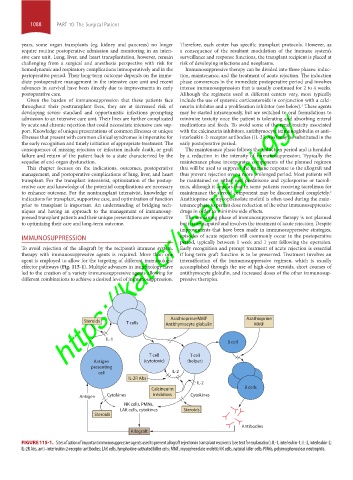
                 To avoid rejection of the allograft by the recipient’s immune system,   Early recognition and prompt treatment of acute rejection is essential
                 therapy with immunosuppressive agents is required. More than one   if long-term graft function is to be preserved. Treatment involves an
                 agent is employed to allow for the targeting of different immunologic   intensification of the immunosuppressive regimen, which is usually
                 effector pathways (Fig. 115-1). Multiple advances in immunology have   accomplished through the use of high-dose steroids, short courses of
                 led to the creation of a variety immunosuppressive agents allowing for   antithymocyte globulin, and increased doses of the other immunosup-
                 different combinations to achieve a desired level of immunosuppression.   pressive therapies.


                                                                    Azathioprine/MMF          Azathioprine
                                       Steroids      T cells      Antithymocyte globulin        MMF

                                              IL-1
                                                                                       B cell

                                                             T cell        T cell
                                          Antigen          (cytotoxic)    (helper)
                                         presenting
                                           cell                     IL-2
                                                      IL-2R Abs
                                                                             IL-2
                                                             Calcineurin                     B cells
                                     Antigen  Cytokines       inhibitors   Cytokines
                                                    NK cells, PMNs,
                                                   LAK cells, cytokines  Steroids
                                          Steroids

                                                                                            Antibodies
                                                      Allograft
                 FIGURE 115-1.  Sites of action of important immunosuppressive agents used to prevent allograft rejection in transplant recipients (see text for explanation). IL-1, interleukin-1; IL-2, interleukin-2;
                 IL-2R Abs, anti–interleukin-2-receptor antibodies; LAK cells, lymphokine-activated killer cells; MMF, mycophenolate mofetil; NK cells, natural killer cells; PMNs, polymorphonuclear neutrophils.


            section10.indd   1088                                                                                      1/20/2015   9:19:52 AM

