


Page 1571 - Hall et al (2015) Principles of Critical Care-McGraw-Hill
P. 1571
1090     PART 10: The Surgical Patient


                 of viral infections (particularly cytomegalovirus) and posttransplant   and quality of life across a range of lung conditions. The number of
                 malignancy. Other less common complications of therapy include    procedures reported annually by the International Society of Heart and
                 seizures (especially when concomitant hypocalcemia is present) and   Lung Transplant (ISHLT) has reached 2100.  The fifth decade of the
                                                                                                        28
                 the acute respiratory distress syndrome (ARDS), possibly due to increased   procedure celebrates significant advancements in the technique and in
                 pulmonary capillary permeability arising from lymphokine stimulation.  organ preservation, bridging patients prior to transplantation, mini-
                     ■  SYSTEMIC CORTICOSTEROIDS                       mizing complications immediately posttransplantation and optimizing
                                                                       immunosuppression and surveillance in the longer term. Despite these
                                                                                                                 29
                 Systemic corticosteroids remain a key component of each phase of   advances, early postoperative mortality remains high at 12%.  In addition,
                 immunosuppression, and are received by over 95% of patients with   these patients can present significant challenges to the intensivist. We
                 pancreas, heart, lung, and heart-lung transplants.  They have multiple   are entering an era where previous limits are being revisited in order to
                                                     1
                 effects on the immune response. Importantly, steroids block T-cell pro-  provide this potential lifesaving technique to more patients. As a result,
                                https://kat.cr/user/tahir99/
                 liferation and IL-2 synthesis. The phagocytic function of macrophages   we are transplanting an older population and using methods to salvage
                 is inhibited, and in high doses, corticosteroids prevent neutrophil   grafts that would have previously been deemed unacceptable in order
                 degranulation.                                        to  accommodate  the  expanding  recipient  pool.  These  two  extremes
                   Though they effectively attenuate the immune response and help   heighten the challenges that are inherent to the care of the lung trans-
                 prevent allograft rejection, corticosteroids also significantly increase   plant recipient. This section will provide an overview of the common
                 the recipient’s susceptibility to infection. In particular, viral and fun-  critical care issues that face this unique patient population.
                 An important consideration is that steroids can also mask the typical   ■  INDICATIONS AND OUTCOMES
                 gal infections appear to be associated with the use of corticosteroids.
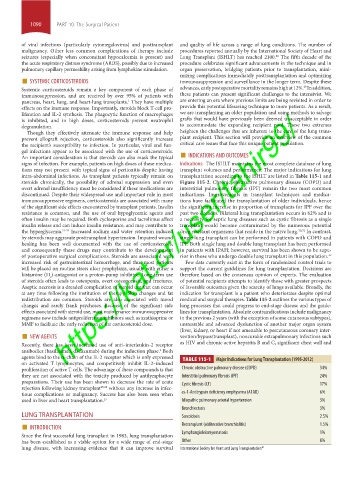
                 signs of infection. For example, patients on high doses of these medica-  Indications:  The ISHLT maintains the most complete database of lung
                 tions may not present with typical signs of peritonitis despite having   transplant volumes and performance. The major indications for lung
                 intra-abdominal infections. As transplant patients typically remain on   transplantation according to the ISHLT are listed in Table 115-1 and
                 steroids chronically, the possibility of adrenal suppression and even   Figure 115-2. Chronic obstructive pulmonary disease (COPD) and
                 overt adrenal insufficiency must be considered if these medications are   interstitial pulmonary fibrosis (IPF) remain the two most common
                 discontinued. Despite their widespread use and important role in most   indications. Improvements in transplant techniques and medica-
                 immunosuppressive regimens, corticosteroids are associated with many   tions have facilitated the transplantation of older individuals, hence
                 of the  significant side effects encountered by transplant patients. Insulin   the significant increase in proportion of transplants for IPF over the
                 resistance is common, and the use of oral hypoglycemic agents and   past two decades. Bilateral lung transplantation occurs in 62% and is
                 often insulin may be required. Both cyclosporine and tacrolimus affect   a necessity for septic lung diseases such as cystic fibrosis as a single
                 insulin release and can induce insulin resistance, and may contribute to   transplant would become contaminated by the numerous potential
                 the hyperglycemia. 21-24  Increased sodium and water retention induced   drug resistant organisms that reside in the native lung. 30,31  In contrast,
                 by steroids may aggravate posttransplant hypertension. Impaired wound   single lung transplant can be performed in patients with COPD and
                 healing has been well documented with the use of corticosteroids,    IPF. Both single lung and double lung transplant has been performed
                 and consequently these drugs may contribute to the development   in patients with IPAH; however, survival has been shown to be supe-
                 of postoperative surgical complications. Steroids are associated with   rior in those who undergo double lung transplant in this population. 32
                 increased risk of gastrointestinal hemorrhage, and thus most patients   Few data currently exist in the form of randomized control trials to
                 will be placed on routine stress ulcer prophylaxis, usually with either a   support the current guidelines for lung transplantation. Decisions are
                 histamine (H )-antagonist or a proton-pump inhibitor. Long-term use   therefore based on the consensus opinion of experts. The evaluation
                           2
                 of steroids often leads to osteopenia, overt osteoporosis, and fractures.   of potential recipients attempts to identify those with greater prospects
                 Aseptic necrosis is a dreaded complication of steroid use that can occur   of favorable outcomes given the scarcity of lungs available. Broadly, the
                 at any time following the institution of therapy. Skin changes and fat   indication for transplant is a patient who deteriorates despite optimal
                 redistribution  are  common.  Steroids  are  also  associated  with  mood   medical and surgical therapies. Table 115-2 outlines the various types of
                 changes and rarely frank psychoses. Because of the significant side   lung processes that could progress to end-stage disease and the guide-
                 effects associated with steroid use, most maintenance immunosuppressive   lines for transplantation. Absolute contraindications include malignancy
                 regimens now include antiproliferation inhibitors such as azathioprine or   in the previous 2 years (with the exception of some cutaneous subtypes),
                 MMF to facilitate the early reduction of the corticosteroid dose.  untreatable and advanced dysfunction of another major organ system
                     ■  NEW AGENTS                                     (liver, kidney, or heart if not amenable to percutaneous coronary inter-
                                                                       vention/bypass/transplant), noncurable extrapulmonary infections such
                 Recently, there has been increased use of anti–interleukin-2 receptor   as HIV and chronic active hepatitis B and C, significant chest wall and
                 antibodies (basiliximab, daclizumab) during the induction phase.  Both
                                                                1
                 agents bind to the α-chain of the IL-2 receptor which is only expressed     TABLE 115-1    Major indications for Lung Transplantation (1995-2012)
                 on activated T lymphocytes, and competitively inhibit IL-2–induced
                 proliferation of active T cells. The advantage of these compounds is that   Chronic obstructive pulmonary disease (COPD)  34%
                 they are not associated with the toxicity produced by antilymphocyte   Interstitial pulmonary fibrosis (IPF)  24%
                 preparations. Their use has been shown to decrease the rate of acute   Cystic fibrosis (CF)           17%
                 rejection following kidney transplant 25,26  without any increase in infec-
                 tious complications or malignancy. Success has also been seen when   α-1-Antitrypsin deficiency emphysema (A1AD)  6%
                 used in liver and heart transplantation. 27            Idiopathic pulmonary arterial hypertension     3%
                                                                        Bronchiectasis                                 3%
                 LUNG TRANSPLANTATION                                   Sarcoidosis                                    2.5%
                     ■  INTRODUCTION                                    Retransplant (obliterative bronchiolitis)      1.5%

                 Since the first successful lung transplant in 1983, lung transplantation   Lymphangioleiomyomatosis   1%
                 has been established as a viable option for a wide range of end-stage   Other                         8%
                 lung disease, with increasing evidence that it can improve survival   International Society for Heart and Lung Transplantation 30


            section10.indd   1090                                                                                      1/20/2015   9:19:53 AM

