


Page 1598 - Hall et al (2015) Principles of Critical Care-McGraw-Hill
P. 1598
CHAPTER 117: Priorities in Multisystem Trauma  1117


                    identified. Therefore, assessment and resuscitation must proceed simul-  are all very simple maneuvers that should be undertaken in the initial
                    taneously. The initial goal in managing the trauma patient is to provide   care of the multiply injured patient. The patient who is fully conscious,
                    adequate oxygenation and perfusion. This goal is achieved by approach-  vocalizing, and breathing adequately, and who is not in shock does not
                    ing assessment and treatment so that abnormalities in the injured patient   require an artificial airway.
                    that affect oxygenation and perfusion take top priority. It is not essential   The underlying principle of establishing an airway in the trauma
                    to establish a definitive diagnosis of the cause of the decreased perfusion   victim is to institute the simplest technique that allows effective oxy-
                    or hypoxemia. For instance, airway obstruction may occur as a result   genation and ventilation. Over 90% of patients do not require endo-
                    of a head injury, hypoperfusion from hemorrhagic shock or secretions   tracheal intubation. Measures short of endotracheal intubation include
                    in the airway. In the initial resuscitative phase, airway compromise is   the insertion of oropharyngeal or nasopharyngeal tubes, if these can
                    treated in the same fashion regardless of what specific injury leads to this   be tolerated without stimulating gagging or vomiting. However, when
                    airway compromise. It is also of prime importance to recognize findings   endotracheal intubation is necessary, it should be performed promptly
                    that suggest a need for emergent lifesaving surgical intervention so that   and expeditiously. Prolonged unsuccessful attempts at endotracheal
                    appropriate personnel could be alerted as early as possible.  intubation without oxygenation and ventilation should be avoided.
                                                                          Mask ventilation with oxygen and an oropharyngeal airway should be
                    PRIORITIES                                            performed intermittently to avoid hypoxia during prolonged attempts
                                                                          at endotracheal intubation. All multiply injured patients should have
                    The order of priorities is a key feature for successful management of the   oxygen administered by the most appropriate means as early as possible.
                    multiply injured patient and should adhere to the following sequence:  A pulse oximeter should be attached to monitor O 2 saturation, which
                                                                          should be maintained at 95% or greater. A definitive airway, defined as
                      1.  Identification and correction of airway compromise and mainte-  a cuffed tube securely placed in the trachea, is required if the patient is
                       nance of oxygenation and ventilation with cervical spine precaution.  unable to maintain patency of the airway.
                      3.  Identification and correction of other sources of inadequate tissue   ■  SURGICAL AIRWAY
                      2.  Identification and control of hemorrhage.

                       perfusion.                                         In very rare circumstances, the patient’s airway may not be patent and
                      4.  Identification and correction of neurologic abnormalities and     it may be impossible to establish an airway nasally or orally. In such
                       prevention of secondary brain injury.              situations, cricothyroidotomy is required. This procedure should only
                      5.  Total exposure of the patient to allow complete assessment while     be done when an airway cannot be established by other, nonsurgical
                                                                               6
                       preventing hypothermia by minimizing the duration of this exposure.  means.  The landmarks for the cricothyroid membrane are indicated
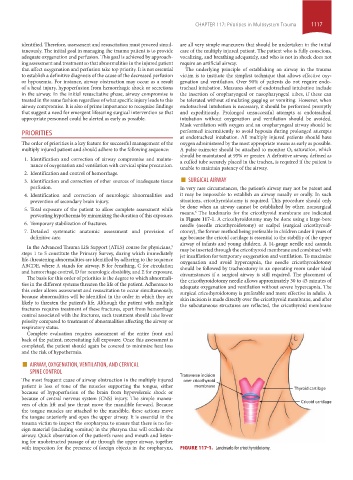
                                                                          in Figure 117-1. A cricothyroidotomy may be done using a large-bore
                      6.  Temporary stabilization of fractures.           needle (needle cricothyroidotomy) or scalpel (surgical cricothyroid-
                      7.  Detailed systematic anatomic assessment and provision of    otomy), the former method being preferable in children under 8 years of
                       definitive care.                                   age because the cricoid cartilage is essential to the stability of the upper
                                                                          airway of infants and young children. A 14-gauge needle and cannula
                     In the Advanced Trauma Life Support (ATLS) course for physicians,    may be inserted through the cricothyroid membrane and combined with
                                                                       5
                    steps 1 to 5 constitute the Primary Survey, during which immediately   jet insufflation for temporary oxygenation and ventilation. To maximize
                    life-threatening abnormalities are identified by adhering to the sequence   oxygenation and avoid hypercapnia, the needle cricothyroidotomy
                    ABCDE, where A stands for airway, B for breathing, C for circulation   should be followed by tracheostomy in an operating room under ideal
                    and hemorrhage control, D for neurologic disability, and E for exposure.  circumstances if a surgical airway is still required. The placement of
                     The basis for this order of priorities is the degree to which abnormali-  the cricothyroidotomy needle allows approximately 30 to 45 minutes of
                    ties in the different systems threaten the life of the patient. Adherence to   adequate oxygenation and ventilation without severe hypercapnia. The
                    this order allows assessment and resuscitation to occur simultaneously,   surgical cricothyroidotomy is preferable and more effective in adults. A
                    because abnormalities will be identified in the order in which they are   skin incision is made directly over the cricothyroid membrane, and after
                    likely to threaten the patient’s life. Although the patient with multiple   the subcutaneous structures are reflected, the cricothyroid membrane
                    fractures requires treatment of these fractures, apart from hemorrhage
                    control associated with the fractures, such treatment should take lower
                    priority compared to treatment of abnormalities affecting the airway or
                    respiratory status.
                     Complete evaluation requires assessment of the entire front and
                    back of the patient, necessitating full exposure. Once this assessment is
                    completed, the patient should again be covered to minimize heat loss
                    and the risk of hypothermia.
                        ■  AIRWAY, OXYGENATION, VENTILATION, AND CERVICAL

                      SPINE CONTROL
                    The most frequent cause of airway obstruction in the multiply injured   Transverse incision
                                                                           over cricothyroid
                    patient is loss of tone of the muscles supporting the tongue, either   membrane             Thyroid cartilage
                    because of  hypoperfusion of  the  brain from  hypovolemic  shock  or
                    because  of  central  nervous  system  (CNS)  injury.  The  simple  maneu-
                    vers of chin lift and jaw thrust move the mandible forward. Because                            Cricoid cartilage
                    the tongue muscles are attached to the mandible, these actions move
                    the tongue anteriorly and open the upper airway. It is essential in the
                    trauma victim to inspect the oropharynx to ensure that there is no for-
                    eign material (including vomitus) in the pharynx that will occlude the
                    airway. Quick observation of the patient’s nares and mouth and listen-
                    ing for unobstructed passage of air through the upper airway, together
                    with inspection for the presence of foreign objects in the oropharynx,   FIGURE 117-1.  Landmarks for cricothyroidotomy.


            section10.indd   1117                                                                                      1/20/2015   9:20:09 AM

