


Page 1607 - Hall et al (2015) Principles of Critical Care-McGraw-Hill
P. 1607
1126     PART 10: The Surgical Patient


                   Mechanical ventilation causes positive intrathoracic pressure and higher   are no studies performed to date that support a particular target blood
                 pressures can cause decreased venous return and a rise in jugular venous   pressure.  An analysis  of  the relationship  between  admission  SBP and
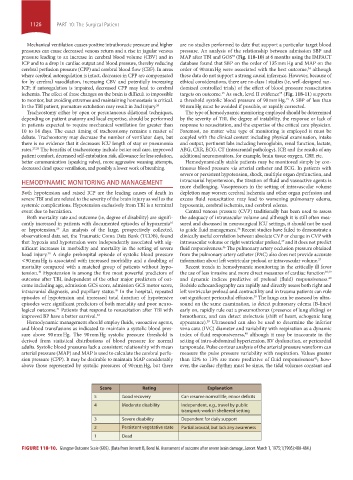
                 pressure leading to an increase in cerebral blood volume (CBV) and in   MAP after TBI and GOS  (Fig. 118-10) at 6 months using the IMPACT
                                                                                         33
                 ICP and to a drop in cardiac output and blood pressure, thereby reducing   database found that SBP on the order of 135 mm Hg and MAP on the
                 cerebral perfusion pressure (CPP) and cerebral blood flow (CBF). In areas   order of 90 mm Hg were associated with the best outcome,  although
                                                                                                                   34
                 where cerebral autoregulation is intact, decreases in CPP are compensated   these data do not support a strong causal inference. However, because of
                 for by cerebral vasodilation, increasing CBV and potentially increasing   ethical considerations, there are no class I studies (ie, well-designed ran-
                 ICP; if autoregulation is impaired, decreased CPP may lead to cerebral   domized controlled trials) of the effect of blood pressure resuscitation
                 ischemia. The effect of these changes on the brain is difficult to impossible   targets on outcome.  As such, level II evidence  (Fig. 118-11) supports
                                                                                                         35
                                                                                     15
                 to monitor, but avoiding extremes and maintaining homeostasis is critical.   a threshold systolic blood pressure of 90 mm Hg.  A SBP of less than
                                                                                                           15
                 In the TBI patient, premature extubation may result in 2nd injury. 26  90 mm Hg must be avoided if possible, or rapidly corrected.
                   Tracheostomy either by open or percutaneous dilational techniques,   The type of hemodynamic monitoring employed should be determined
                 depending on patient anatomy and local expertise, should be performed   by the severity of TBI, the degree of instability, the response or lack of
                 in patients expected to require mechanical ventilation for greater than   response to resuscitation, and the expertise of the critical care physician.
                 10 to 14 days. The exact timing of tracheostomy remains a matter of   Foremost, no matter what type of monitoring is employed it must be
                 debate. Tracheostomy may decrease the number of ventilator days, but   coupled with the clinical context including physical examination, intake
                 there is no evidence that it decreases ICU length of stay or pneumonia   and output, pertinent labs including hemoglobin, renal function, lactate,
                 rates. 27,28  The benefits of tracheostomy include better oral care, improved   ABG, CXR, ECG, CT (intracranial pathology), ICP, and the results of any
                 patient comfort, decreased self-extubation risk, allowance for less sedation,     additional neuromonitors, for example, brain tissue oxygen, CBF, etc.
                 better communication (speaking valve), more aggressive weaning attempts,   Hemodynamically stable patients may be monitored simply by con-
                 decreased dead space ventilation, and possibly a lower work of breathing.  tinuous blood pressure via arterial catheter and ECG. In patients with
                                                                       severe or persistent hypotension, shock, multiple organ dysfunction, and
                 HEMODYNAMIC MONITORING AND MANAGEMENT                 intracranial hypertension, the titration of fluid and vasoactive agents is
                                                                       more challenging. Vasopressors in the setting of intravascular volume
                 Both hypotension and raised ICP are the leading causes of death in   depletion may worsen cerebral ischemia and other organ perfusion and
                 severe TBI and are related to the severity of the brain injury as well as the   excess fluid resuscitation may lead to worsening pulmonary edema,
                 systemic complications. Hypotension exclusively from TBI is a terminal   hypoxemia, cerebral ischemia, and cerebral edema.
                 event due to herniation.                                Central venous pressure (CVP) traditionally has been used to assess
                   Both mortality rate and outcome (ie, degree of disability) are signifi-  the adequacy of intravascular volume and although it is still often mea-
                 cantly increased in patients with documented episodes of hypoxemia    sured and discussed in neurosurgical ICU settings, it should not be used
                                                                    16
                 or hypotension.  An analysis of the large, prospectively collected,   to guide fluid management.  Recent studies have failed to demonstrate a
                             29
                                                                                           36
                 observational data set, the Traumatic Coma Data Bank (TCDB), found   clinically useful correlation between absolute CVP or change in CVP with
                 that hypoxia and hypotension were independently associated with sig-  intravascular volume or right ventricular preload,  and it does not predict
                                                                                                          37
                 nificant increases in morbidity and mortality in the setting of severe   fluid responsiveness.  The pulmonary artery occlusion pressure obtained
                                                                                      36
                 head injury.  A single prehospital episode of systolic blood pressure   from the pulmonary artery catheter (PAC) also does not provide accurate
                          30
                 <90 mm Hg is associated with increased morbidity and a doubling of   information about left ventricular preload or intravascular volume. 37
                 mortality compared with a matched group of patients without hypo-  Recent trends in hemodynamic monitoring in the critically ill favor
                 tension.  Hypotension is among the five most powerful predictors of   the use of less invasive and more direct measures of cardiac function 38,39
                       30
                 outcome after TBI, independent of the other major predictors of out-  and dynamic indices predictive of preload (fluid) responsiveness.
                                                                                                                          40
                 come including age, admission GCS score, admission GCS motor score,   Bedside echocardiography can rapidly and directly assess both right and
                 intracranial diagnosis, and pupillary status.  In the hospital, repeated   left ventricular preload and contractility and in trauma patients can rule
                                                 30
                 episodes of hypotension and increased total duration of hypotensive   out significant pericardial effusion.  The lungs can be assessed by ultra-
                                                                                                39
                 episodes were significant predictors of both mortality and poor neuro-  sound on the same examination, to detect pulmonary edema (B-lines)
                 logical outcome.  Patients that respond to resuscitation after TBI with   early on, rapidly rule out a pneumothorax (presence of lung sliding) or
                             31
                 improved BP have a better survival. 32                hemothorax, and can detect atelectasis (shift of heart, echogenic lung
                   Hemodynamic management should employ fluids, vasoactive agents,   appearance).  Ultrasound can also be used to determine the inferior
                                                                                39
                 and blood transfusions as indicated to maintain a systolic blood pres-  vena cava (IVC) diameter and variability with respiration as a dynamic
                 sure  above  90 mm Hg.  The  90 mm Hg  systolic  pressure  threshold  is   index  of  fluid  responsiveness,   although  it  may  be  inaccurate  in  the
                                                                                             40
                 derived from statistical distributions of blood pressure for normal   setting of intra-abdominal hypertension, RV dysfunction, or pericardial
                 adults. Systolic blood pressures lack a consistent relationship with mean   tamponade. Pulse contour analysis of the arterial pressure waveform can
                 arterial pressure (MAP) and MAP is used to calculate the cerebral perfu-  measure the pulse pressure variability with respiration. Values greater
                 sion pressure (CPP). It may be desirable to maintain MAP considerably   than 12% to 13% are more predictive of fluid responsiveness ; how-
                                                                                                                     41
                 above  those  represented  by  systolic  pressures  of  90 mm Hg,  but  there   ever, the cardiac rhythm must be sinus, the tidal volumes constant and
                                            Score         Rating                 Explanation
                                          5        Good recovery        Can resume normal life, minor deficits
                                          4        Moderate disability  Independent, e.g., travel by public
                                                                        transport; work in sheltered setting
                                          3        Severe disability    Dependent for daily support
                                          2        Persistent vegetative state  Partial arousal, but lack any awareness
                                          1        Dead
                 FIGURE 118-10.  Glasgow Outcome Scale (GOS). (Data from Jennett B, Bond M. Assessment of outcome after severe brain damage, Lancet. March 1, 1975;1(7905):480-484.)


            section10.indd   1126                                                                                      1/20/2015   9:20:16 AM

