


Page 1620 - Hall et al (2015) Principles of Critical Care-McGraw-Hill
P. 1620
CHAPTER 119: Spinal Injuries  1139


                       Patient Name
                       Examiner Name                              Date/Time of Exam                                    C2
                                           INTERNATIONAL STANDARDS FOR NEUROLOGICAL
                      American Spinal Injury Association  CLASSIFICATION OF SPINAL CORD INJURY          C2            C3
                                                                                                        C3
                                             MOTOR          LIGHT  PIN           SENSORY                C4              C4
                                            KEY MUSCLES     TOUCH  PRICK       KEY SENSORY POINTS  T2        T2
                               R  L        (scoring on reverse side)  R  L  R  L                        T3
                            C5      Elbow flexors        C2                                    C5       T4       C5
                            C6      Wrist extensors      C3                0 = absent                   T5
                            C7      Elbow extensors      C4                1 = altered                  T6
                                                                           2 = normal
                            C8      Finger flexors (distal phalanx of middle finger)  C5  NT = not testable  T7
                            T1      Finger abductors (little finger)  C6                                T8
                       UPPER LIMB                        C7                                    T1       T9       T1
                        TOTAL   +  =                                                        C6          T10         C6
                       (MAXIMUM)  (25)  (25)  (50)       C8                                             T11
                                                         T1                  S 3
                                                         T2                                             T12
                        Comments:
                                                         T3                         S4-5     Palm    L1    L1     Palm
                                                         T4
                                                         T5
                                                         T6                  2 L  L 2
                                                         T7                  L  L                    L2    L2
                                                         T8               S2  3  3  S2
                                                         T9
                                                        T10
                                                        T11                                          L3    L3           C8
                                                        T12                            C8 C7  C6                      C6
                                                         L1                                                             C7
                                                         L2                 L 4  L 4      Dorsum                   Dorsum
                                                         L3                S1   S1
                           L2     Hip flexors            L4              L5       L5                  L4  L4
                           L3     Knee extensors         L5                                          L5    L5
                           L4     Ankle dorsiflexors     S1
                           L5     Long toe extensors     S2                                                          Key
                           S1     Ankle plantar flexors                                                              Sensory
                                                         S3
                                (VAC) Voluntary anal contraction  S4-5       (DAP) Deep anal pressure (yes/No)       Points
                                      (Yes/No)
                                                                    +  =     PIN PRICK SCORE  (max: 112)
                       LOWER LIMB                                                                 S1          S1
                        TOTAL   +  =                  TOTALS  +        =     LIGHT TOUCH SCORE  (max: 112)
                       (MAXIMUM)  (25)  (25)  (50)    (MAXIMUM) (56)  (56)  (56)  (56)                  S1
                                                                                                 (In complete injuries only)
                       NEUROLOGICAL       R   L       SINGLE           COMPLETE OR INCOMPLETE?  ZONE OF PARTIAL     R   L
                          LEVEL    SENSORY          NEUROLOGICAL     Incomplete = Any sensory or motor function in s4-s5  PRESERVATION  SENSORY
                        The most caudal segment        LEVEL                                      Most caudal level
                        with normal function  MOTOR                    ASIA IMPAIRMENT SCALE (AIS)  with any innervation  MOTOR
                                            This form may be copied freely but should not be altered without permission from the American Spinal Injury Association.  REV 04/11
                                                                ASIA IMPAIRMENT SCALE
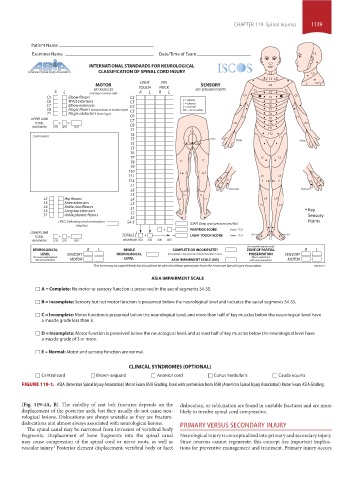
                          A = Complete: No motor or sensory function is preserved in the sacral segments S4-S5.
                          B = Incomplete: Sensory but not motor function is preserved below the neurological level and includes the sacral segments S4-S5.
                          C = Incomplete: Motor function is preserved below the neurological level, and more than half of key muscles below the neurological level have
                          a muscle grade less than 3.

                          D = Incomplete: Motor function is preserved below the neurological level, and at least half of key muscles below the neurological level have
                          a muscle grade of 3 or more.

                          E = Normal: Motor and sensory function are normal.

                                                        CLINICAL SYNDROMES (OPTIONAL)
                          Central cord       Brown-sequard        Anterior cord      Conus medullaris      Cauda equina
                    FIGURE 119-1.  ASIA (American Spinal Injury Association) Motor Exam ASIA Grading. Used with permission from ASIA (American Spinal Injury Association) Motor Exam ASIA Grading.


                    (Fig. 119-4A, B). The stability of seat belt fractures depends on the   dislocation, or subluxation are found in unstable fractures and are more
                    displacement of the posterior arch, but they usually do not cause neu-  likely to involve spinal cord compression.
                    rological lesions. Dislocations are always unstable as they are fracture-
                    dislocations and almost always associated with neurological lesions.  PRIMARY VERSUS SECONDARY INJURY
                     The spinal canal may be narrowed from intrusion of vertebral body
                    fragments. Displacement of bone fragments into the spinal canal   Neurological injury is conceptualized into primary and secondary injury.
                    may cause compression of the spinal cord or nerve roots, as well as     Since neurons cannot regenerate, this concept has important implica-
                    vascular injury.  Posterior element displacement, vertebral body or facet   tions for preventive management and treatment. Primary injury occurs
                              1


            section10.indd   1139                                                                                      1/20/2015   9:20:25 AM

