


Page 1624 - Hall et al (2015) Principles of Critical Care-McGraw-Hill
P. 1624
CHAPTER 119: Spinal Injuries  1143


                    under controlled circumstances is preferred to avoid secondary injuries   noncardiogenic pulmonary edema (acute respiratory distress syndrome
                    resulting from hypoxemia or respiratory system-induced hemodynamic   [ARDS]) leading to hypoxemic respiratory failure, and decreased sym-
                    failure. Evidence of respiratory failure includes altered mental status,   pathetic tone (with increased relative parasympathetic tone) leading
                    hypoxemia, rapid, shallow, or irregular breathing with associated respi-  to bronchoconstriction and increased airway secretions. Sympathetic
                                                 (late) or a progressive decline in   (bronchodilatory) innervation of the lungs arises from the T1-T6 level so
                    ratory alkalosis (early) or elevated P CO 2
                    serial vital capacity (VC), or VC <1.0 L.             that tetraplegic (ie, cervical) SCI leads to loss of sympathetic innervation
                     In critically ill patients in general, and trauma and SCI patients in     to the lungs and unopposed or increased parasympathetic vagal activity
                    particular, tracheal intubation is significantly more difficult due to factors   that can result in decreased baseline airway caliber.  The use of anti-
                                                                                                                27
                    such as the need for precautionary neck stabilization, bleeding, vomiting,    cholinergic bronchodilators such as ipratropium may be considered ;
                                                                                                                            28
                    oropharyngeal secretions, respiratory dysfunction, airway edema,   however, it is not known if the baseline bronchoconstriction in
                    hemodynamic instability, and encephalopathy. Halo traction devices are   tetraplegia contributes to respiratory symptoms.  Aggressive suctioning
                                                                                                            27
                    not readily removable and also limit the ability to position the airway for   of secretions can result in bronchial stimulation and increased para-
                    intubation, increasing difficulties. Bradycardia and hypotension during   sympathetic output resulting in bradyarrhythmia or conduction blocks.
                    endotracheal  intubation  are  more  common  in  the  tetraplegic  patient.   Cervical and upper thoracic cord injury disrupts neuronal output
                    Complications such as hypoxemia, aspiration, bradycardia, and cardiac   to the diaphragm, intercostal muscles, accessory respiratory muscles,
                    arrest increase significantly  as the number of laryngoscopic intubation   and abdominal muscles (Fig. 119-9) causing reduction in spirometric
                                       21
                    attempts increases. A first year anesthesia resident performing direct   and lung volume parameters.  The phrenic nerves innervating the
                                                                                                27
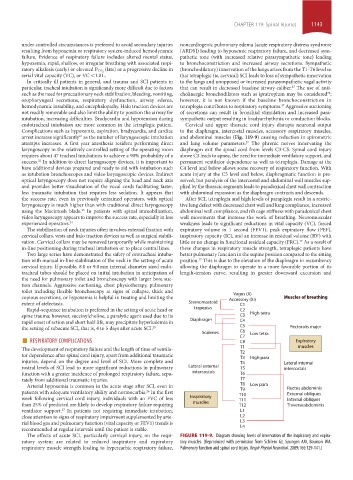
                    laryngoscopy in the relatively controlled setting of the operating room   diaphragm exit the spinal cord from levels C3-C5. Spinal cord injury
                    requires about 47 tracheal intubations to achieve a 90% probability of a   above C3 leads to apnea, the need for immediate ventilatory support, and
                    success.  In addition to direct laryngoscopy devices, it is important to   permanent ventilator dependence as well as tetraplegia. Damage at the
                         22
                    have additional devices prepared and ready to aid with intubation such   C4 level and below allows some recovery of respiratory function. With
                    as intubation bronchoscopes and video laryngoscopic devices. Indirect   acute injury at the C5 level and below, diaphragmatic function is pre-
                    optical laryngoscopy does not require aligning the head and neck axis   served, but paralysis of the intercostal and abdominal wall muscles sup-
                    and provides better visualization of the vocal cords facilitating faster,   plied by the thoracic segments leads to paradoxical chest wall contraction
                    less traumatic intubation that requires less sedation. It appears that   with abdominal expansion as the diaphragm contracts and descends.
                    the success rate, even in previously untrained operators, with optical   After SCI, tetraplegia and high levels of paraplegia result in a restric-
                    laryngoscopy is much higher than with traditional direct laryngoscopy   tive lung defect with decreased chest wall and lung compliance, increased
                    using the Macintosh blade.  In patients with spinal immobilization,   abdominal wall compliance, and rib cage stiffness with paradoxical chest
                                        23
                    video laryngoscopy appears to improve the success rate, especially in less   wall movements that increase the work of breathing. Neuromuscular
                    experienced operators. 24                             weakness leads to significant reductions in vital capacity (VC), forced
                     The stabilization of neck injuries often involves external fixation with   expiratory  volume  in  1  second  (FEV1),  peak  expiratory  flow  (PEF),
                    cervical collars, vests and halo traction devices as well as surgical stabili-  inspiratory capacity (IC), and an increase in residual volume (RV) with
                    zation. Cervical collars may be removed temporarily while maintaining   little or no change in functional residual capacity (FRC).  As a result of
                                                                                                                  27
                    in-line positioning during tracheal intubation or to place central lines.  these changes in respiratory muscle strength, tetraplegic patients have
                     Two large series have demonstrated the safety of orotracheal intuba-  better pulmonary function in the supine position compared to the sitting
                    tion with manual in-line stabilization of the neck in the setting of acute   position.  This is due to the elevation of the diaphragm in recumbency
                                                                                27
                    cervical injury. If possible, 8.0 or 9.0 mm internal diameter sized endo-  allowing the diaphragm to operate in a more favorable portion of its
                    tracheal tubes should be placed on initial intubation in anticipation of   length-tension curve, resulting in greater downward excursion and
                    the need for pulmonary toilet and bronchoscopy with larger bore suc-
                    tion channels. Aggressive suctioning, chest physiotherapy, pulmonary
                    toilet including flexible bronchoscopy at signs of collapse, thick and
                                                                                            Vagus (X)
                    copious secretions, or hypoxemia is helpful in treating and limiting the   Accessory (XI)  Muscles of breathing
                    extent of atelectasis.                                   Sternomastoid    C1
                     Rapid-sequence intubation is preferred in the setting of acute head or   trapezius  C2
                    spine trauma; however, succinylcholine, a paralytic agent used due to its   C3  High tetra
                    rapid onset of action and short half-life, may precipitate hyperkalemia in   Diaphragm  C4
                    the setting of subacute SCI, that is, 4 to 5 days after acute SCI. 25     C5               Pectoralis major
                                                                                              C6
                        ■  RESPIRATORY COMPLICATIONS                             Scalenes     C7  Low tetra      Expiratory
                                                                                              C8
                    The development of respiratory failure and the length of time of ventila-  T1                 muscles
                    tor dependence after spinal cord injury, apart from additional traumatic   T2
                    injuries, depend on the degree and level of SCI. More complete and        T3  High para  Lateral internal
                                                                                              T4
                    rostral levels of SCI lead to more significant reductions in pulmonary   Lateral external  T5  intercostals
                    function with a greater incidence of prolonged respiratory failure, sepa-  intercostals  T6
                    rately from additional traumatic injuries.                                T7
                     Arterial hypoxemia is common in the acute stage after SCI, even in       T8  Low para
                    patients with adequate ventilatory ability and normocarbia.  In the first   T9            Rectus abdominis
                                                              26
                                                                                                              External obliques
                    week following cervical cord injury, individuals with an FVC of less   Inspiratory  T10   Internal obliques
                                                                                              T11
                    than 25% of predicted are likely to develop respiratory failure requiring    muscles  T12  Traverseabdominis
                    ventilator support.  In patients not requiring immediate intubation,      L1
                                 27
                    close attention to signs of respiratory impairment supplemented by arte-  L2
                    rial blood gas and pulmonary function (vital capacity or FEV1) trends is   L3
                    recommended at regular intervals until the patient is stable.             L4
                     The  effects  of acute  SCI,  particularly  cervical  injury,  on the  respi-  FIGURE 119-9.  Diagram showing levels of innervation of the inspiratory and expira-
                    ratory system are related to reduced inspiratory and expiratory   tory muscles. (Reproduced with permission from Schilero GJ, Spungen AM, Bauman WA.
                      respiratory muscle strength leading to hypercarbic respiratory failure,   Pulmonary function and spinal cord injury. Respir Physiol Neurobiol. 2009;166:129-141.)


            section10.indd   1143                                                                                      1/20/2015   9:20:31 AM

