


Page 1621 - Hall et al (2015) Principles of Critical Care-McGraw-Hill
P. 1621
1140     PART 10: The Surgical Patient


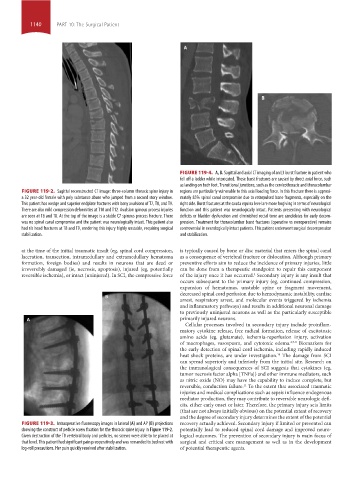
                                                                       FIGURE 119-4.  A, B. Sagittal and axial CT imaging of an L3 burst fracture in patient who
                                                                       fell off a ladder while intoxicated. These burst fractures are caused by direct axial force, such
                                                                       as landing on both feet. Transitional junctions, such as the cervicothoracic and thoracolumbar
                 FIGURE 119-2.  Sagittal reconstructed CT image: three-column thoracic spine injury in   regions are particularly vulnerable to this axial loading force. In this fracture there is approxi-
                 a 32 year-old female with poly substance abuse who jumped from a second story window.   mately 85% spinal canal compromise due to retropulsed bone fragments, especially on the
                 This patient has wedge and superior endplate fractures with bony avulsions of T7, T8, and T9.   right side. Burst fractures at the cauda equina level are more forgiving in terms of neurological
                 There are also mild compression deformities at T10 and T12. Avulsion spinous process injuries   function and this patient was neurologically intact. Patients presenting with neurological
                 are seen at T6 and T8. At the top of the image is a stable C7 spinous process fracture. There   deficits or bladder dysfunction and diminished rectal tone are candidates for early decom-
                 was no spinal canal compromise and the patient was neurologically intact. This patient also   pression. Treatment for thoracolumbar burst fractures (operative vs nonoperative) remains
                 had rib head fractures at T8 and T9, rendering this injury highly unstable, requiring surgical   controversial in neurologically intact patients. This patient underwent surgical decompression
                 stabilization.                                        and stabilization.

                 at the time of the initial traumatic insult (eg, spinal cord compression,     is typically caused by bone or disc material that enters the spinal canal
                 laceration,  transection,  intramedullary  and  extramedullary  hematoma   as a consequence of vertebral fracture or dislocation. Although primary
                 formation, foreign bodies)  and results in neurons that are dead or   preventive efforts aim to reduce the incidence of primary injuries, little
                 irreversibly damaged (ie, necrosis, apoptosis), injured  (eg, potentially   can be done from a therapeutic standpoint to repair this component
                 reversible ischemia), or intact (uninjured). In SCI, the compressive force   of the injury once it has occurred.  Secondary injury is any insult that
                                                                                                4
                                                                       occurs subsequent to the primary injury (eg, continued compression,
                                                                       expansion of hematomas, unstable spine or fragment movement,
                                                                       decreased spinal cord perfusion due to hemodynamic instability, cardiac
                                                                       arrest, respiratory arrest, and molecular events triggered by ischemia
                                                                       and inflammatory pathways) and results in additional neuronal damage
                                                                       to previously uninjured neurons as well as the particularly susceptible
                                                                       primarily injured neurons.
                                                                         Cellular processes involved in secondary injury include proinflam-
                                                                       matory cytokine release, free radical formation, release of excitotoxic
                                                                       amino acids (eg, glutamate), ischemia-reperfusion injury, activation
                                                                       of macrophages, vasospasm, and cytotoxic edema. 4,7-9  Biomarkers for
                                                                       the early detection of spinal cord ischemia, including rapidly induced
                                                                       heat shock proteins, are under investigation.  The damage from SCI
                                                                                                        10
                                                                       can spread superiorly and inferiorly from the initial site. Research on
                                                                       the immunological consequences of SCI suggests that cytokines (eg,
                                                                       tumor necrosis factor alpha [TNFa]) and other immune mediators, such
                                                                       as nitric oxide (NO) may have the capability to induce complete, but
                                                                       reversible, conduction failure.  To the extent that associated traumatic
                                                                                             11
                                                                       injuries and medical complications such as sepsis influence endogenous
                                                                       mediator production, they may contribute to reversible neurologic defi-
                                                                       cits, either early onset or later. Therefore, the primary injury sets limits
                                                                       (that are not always initially obvious) on the potential extent of recovery
                                                                       and the degree of secondary injury determines the extent of the potential
                 FIGURE 119-3.  Intraoperative fluoroscopy images in lateral (A) and AP (B) projections   recovery actually achieved. Secondary injury if limited or prevented can
                 showing the construct of pedicle screw fixation for the thoracic spine injury in Figure 119-2.   potentially lead to reduced spinal cord damage and improved neuro-
                 Given destruction of the T8 vertebral body and pedicles, no screws were able to be placed at   logical outcomes. The prevention of secondary injury is main focus of
                 that level. This patient had significant pain preoperatively and was remanded to bed rest with   surgical and critical care management as well as in the development
                 log-roll precautions. Her pain quickly resolved after stabilization.  of potential therapeutic agents.


            section10.indd   1140                                                                                      1/20/2015   9:20:27 AM

