


Page 1626 - Hall et al (2015) Principles of Critical Care-McGraw-Hill
P. 1626
CHAPTER 119: Spinal Injuries  1145


                                  Medulla                   Baroreceptors
                                                    CN IX


                                                     CN X


                                               DVPs
                                 Cervical
                                                        HR (PNS)

                                                         HR (SNS)

                                Level of
                                 injury

                                         SPNs


                                  Thoracic           Arterioles


                                            SPN

                                   Lumbar


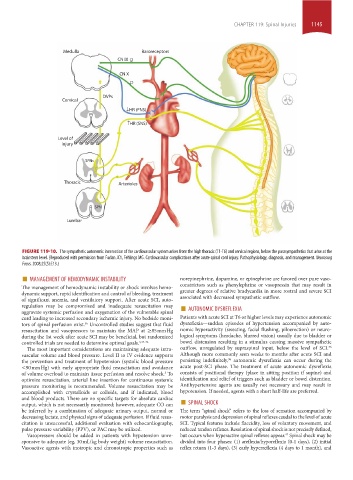
                    FIGURE 119-10.  The sympathetic autonomic innervation of the cardiovascular system arises from the high thoracic (T1-T6) and cervical regions, below the parasympathetics that arise at the
                    brainstem level. (Reproduced with permission from Furlan JC1, Fehlings MG. Cardiovascular complications after acute spinal cord injury: Pathophysiology, diagnosis, and management. Neurosurg
                    Focus. 2008;25(5):E13.)
                        ■  MANAGEMENT OF HEMODYNAMIC INSTABILITY          norepinephrine, dopamine, or epinephrine are favored over pure vaso-

                    The management of hemodynamic instability or shock involves hemo-  constrictors such as phenylephrine or vasopressin that may result in
                    dynamic support, rapid identification and control of bleeding, treatment    greater degrees of relative bradycardia in more rostral and severe SCI
                    of significant anemia, and ventilatory support. After acute SCI, auto-  associated with decreased sympathetic outflow.
                    regulation may be compromised and inadequate resuscitation may     ■
                    aggravate systemic perfusion and oxygenation of the vulnerable spinal   AUTONOMIC DYSREFLEXIA
                    cord leading to increased secondary ischemic injury. No bedside moni-  Patients with acute SCI at T6 or higher levels may experience autonomic
                    tors of spinal perfusion exist.  Uncontrolled studies suggest that fluid   dysreflexia—sudden episodes of hypertension accompanied by auto-
                                         36
                    resuscitation  and  vasopressors  to  maintain  the  MAP  at  ≥85 mm Hg   nomic hyperactivity (sweating, facial flushing, piloerection) or neuro-
                    during the 1st week after acute SCI may be beneficial, but randomized   logical symptoms (headache, blurred vision) usually due to bladder or
                    controlled trials are needed to determine optimal goals. 5,44-46  bowel distension resulting in a stimulus causing massive sympathetic
                                                                                                                            36
                     The most important considerations are maintaining adequate intra-  outflow,  unregulated  by  supraspinal  input,  below  the  level  of  SCI.
                    vascular volume and blood pressure. Level II to IV evidence supports   Although more commonly seen weeks to months after acute SCI and
                                                                                          36
                    the prevention and treatment of hypotension (systolic blood pressure   persisting indefinitely,  autonomic dysreflexia can occur during the
                    <90 mm Hg) with early appropriate fluid resuscitation and avoidance   acute post-SCI phase. The treatment of acute autonomic dysreflexia
                    of volume overload to maintain tissue perfusion and resolve shock.  To   consists of positional therapy (place in sitting position if supine) and
                                                                    5
                    optimize resuscitation, arterial line insertion for continuous systemic   identification and relief of triggers such as bladder or bowel distention.
                    pressure monitoring is recommended. Volume resuscitation may be   Antihypertensive  agents  are usually not  necessary and may  result  in
                    accomplished  with  crystalloids  or  colloids,  and  if  indicated,  blood   hypotension. If needed, agents with a short half-life are preferred.
                    output, which is not necessarily monitored; however, adequate CO can   ■  SPINAL SHOCK
                    and blood products. There are no specific targets for absolute cardiac
                    be inferred by a combination of adequate urinary output, normal or     The term “spinal shock” refers to the loss of sensation accompanied by
                    decreasing lactate, and physical signs of adequate perfusion. If fluid resus-  motor paralysis and depression of spinal reflexes caudal to the level of acute
                    citation is unsuccessful, additional evaluation with echocardiography,    SCI. Typical features include flaccidity, loss of voluntary movement, and
                    pulse pressure variability (PPV), or PAC may be utilized.  reduced tendon reflexes. Resolution of spinal shock is not precisely defined,
                     Vasopressors should be added in patients with hypotension unre-  but occurs when hyperactive spinal reflexes appear.  Spinal shock may be
                                                                                                             47
                    sponsive to adequate (eg, 30 mL/kg body weight) volume resuscitation.   divided into four phases: (1) areflexia/hyporeflexia (0-1 days), (2) initial
                    Vasoactive agents with inotropic and chronotropic properties such as   reflex return (1-3 days), (3) early hyperreflexia (4 days to 1 month), and


            section10.indd   1145                                                                                      1/20/2015   9:20:35 AM

