


Page 1649 - Hall et al (2015) Principles of Critical Care-McGraw-Hill
P. 1649
1168     PART 10: The Surgical Patient


                 requiring prolonged operative procedures, the use of massive amounts
                 of crystalloids and blood transfusions leading to hypothermia and hypo-    • Initial management of pelvic injuries requires hemorrhage control
                 coagulable states. Treatment should be directed at correction and pre-  and volume resuscitation.
                 vention of these precipitating factors. A high index of suspicion should     • Provisional acute stabilization of the pelvis using a binder or external
                 be maintained in order to predict the onset of this condition so that   fixation is a key element in the initial control of hemorrhage from
                 preventive measures and early diagnosis will result in better outcomes.  pelvic fractures.
                                                                           • Extremity fractures, though frequently not life threatening, require
                                                                          accurate diagnosis and appropriate management to prevent signifi-
                   KEY REFERENCES                                         cant disability and morbidity.
                     • Brasel KJ, Borgstrom DC, Meyer P, Weigelt JA. Predictors of out-    • Complications of extremity injuries, such as compartment syndrome
                                https://kat.cr/user/tahir99/
                    come in blunt diaphragm rupture. J Trauma. 1996;41:484.  and neurovascular compromise, can best be detected by a high
                     • Demetriades D, Asensio JA, Valmahos G, et al. Complex problems   index of suspicion, careful assessment, and institution of appropriate
                    in penetrating neck trauma. Surg Clin North Am. 1996;76:661.    preventive measures.
                     • Diebel LN, Wilson RF, Dulchavsky SA, et al. Effect of increased     • Knowledge of the mechanism of injury is important in predicting
                    intraabdominal  pressure  on  hepatic  arterial,  portal  venous  and   the type and severity of extremity injuries.
                    hepatic microcirculatory blood flow. J Trauma. 1992;33:279.
                     • Fabian TC, Croce MA, Pritchard FE, et al. Planned ventral her-
                    nia: staged management for abdominal wall defects.  Ann Surg.
                    1994;219:643.                                      PELVIC RING INJURIES
                     • Fabian TC, Davis KA, Gavant ML, et al. Prospective study of   Patients sustaining major pelvic and extremity trauma frequently are
                    blunt aortic injury: helical CT is diagnostic and anti-hypertensive   managed in the ICU setting. These patients may present with signifi-
                    therapy reduces rupture. Ann Surg. 1998;227:606.   cant hemodynamic abnormality owing to their associated injuries, and
                     • Kisat M, Morrison JJ, Hashmi ZG, Efron DT, Rasmussen TE,   this can be compounded by inadequate resuscitation resulting from
                    Haider AH. Epidemiology and outcomes of non-compressible   underestimation of the volume of blood loss associated with such
                    torso hemorrhage. J Surg Res. 2013;184(1):414-421.    injuries. The following information is provided to assist the intensivist
                     • Mee SL, McAninch JW, Robinson AL, et al. Radiographic assess-  in  understanding extremity and pelvic ring injuries, thus allowing early
                                                                       diagnosis with prompt and appropriate management aimed at preventing
                    ment of renal trauma: a 10-year prospective study of patient selec-  major morbidity and mortality.
                    tion. J Urol. 1989;141:1095.                         Significant force is required to sustain an injury to the pelvic ring. In
                     • Pachter HL, Knudson MM, Esrig B, et al. Status of nonoperative   various epidemiologic  studies, mortality rates  of up to 25% have been
                    management of blunt hepatic injuries in 1995: a multicenter expe-  reported, depending on the pattern and severity of the pelvic injury.  While
                                                                                                                     1,2
                    rience with 404 patients. J Trauma. 1996;40:31.    the direct cause of death is usually attributed to a head or thoracic injury,
                                                                                                                          3
                     • Powell M, Courcoulas A, Gardner M, et al. Management of blunt   pelvic bleeding significantly contributes to this high rate of mortality.
                    splenic trauma, significant differences between adults and chil-  There is an increased risk of mortality in association with open pelvic
                    dren. Surgery. 1997;122:654.                       fractures, a high injury severity score (ISS), or concomitant head, thoracic,
                                                                                              4
                     • Shapiro  MB,  Jenkins  DH,  Schwab  CW,  et  al.  Damage  control:     abdominal, or neurologic injury.  The incidence of associated injuries is
                                                                                               3
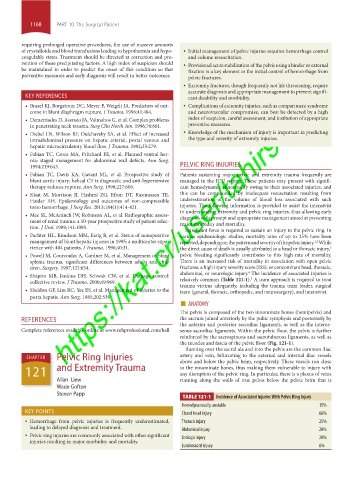
                    collective review. J Trauma. 2000;49:969.          relatively common (Table 121-1).  A team approach is required to treat
                     • Sheldon GF, Lim RC, Yee ES, et al. Management of injuries to the   trauma victims adequately, including the trauma team leader, surgical
                                                                       team (general, thoracic, orthopedic, and neurosurgery), and intensivist.
                                                                           ■  ANATOMY
                    porta hepatis. Ann Surg. 1985;202:539.
                                                                       The pelvis is composed of the two innominate bones (hemipelvis) and
                 REFERENCES                                            the sacrum joined anteriorly by the pubic symphysis and posteriorly by
                                                                       the anterior and posterior sacroiliac ligaments, as well as the interos-
                 Complete references available online at www.mhprofessional.com/hall  seous sacroiliac ligaments. Within the pelvic floor, the pelvis is further
                                                                       reinforced by the sacrospinous and sacrotuberous ligaments, as well as
                                                                       the muscles and fascia of the pelvic floor (Fig. 121-1).
                                                                         Running over the sacral ala and into the pelvis are the common iliac
                   CHAPTER   Pelvic Ring Injuries                      artery and vein, bifurcating to the external and internal iliac vessels
                                                                       above and below the pelvic brim, respectively. These vessels run close
                  121        and Extremity Trauma                      to the innominate bones, thus making them vulnerable to injury with
                                                                       any disruption of the pelvic ring. In particular, there is a plexus of veins
                             Allan  Liew                               running  along the walls of true  pelvis below the pelvic  brim that is
                             Wade Gofton
                             Steven Papp
                                                                         TABLE 121-1    incidence of Associated injuries With Pelvic Ring injury
                                                                        Hemodynamically unstable                       15%
                  KEY POINTS                                            Closed head injury                             66%
                     • Hemorrhage from pelvic injuries is frequently underestimated,   Thoracic injury                 25%
                    leading to delayed diagnosis and treatment.         Abdominal injury                               20%
                     • Pelvic ring injuries are commonly associated with other significant   Urologic injury           20%
                    injuries resulting in major morbidity and mortality.
                                                                        Lumbosacral injury                             8%


            section10.indd   1168                                                                                      1/20/2015   9:21:14 AM

