


Page 1651 - Hall et al (2015) Principles of Critical Care-McGraw-Hill
P. 1651
1170     PART 10: The Surgical Patient


                                                            Pelvic fracture classification
                                                               (Young and Burgess)
                                    Lateral               AP                 Vertical            Combined
                                  compression         compression             shear             mechanism


                                                         Type I
                                                                              Type I
                                    Type I
                                    Type I               Type I               Type I          Anterolateral force
                                                                                              Anterolateral force


                                   Type IIA, IIB         Type II             Type II         Anterovertical force
                                                         Type II
                                   Type IIA, IIB
                                                                             Type II
                                                                                             Anterovertical force


                                    Type III             Type III            Type III

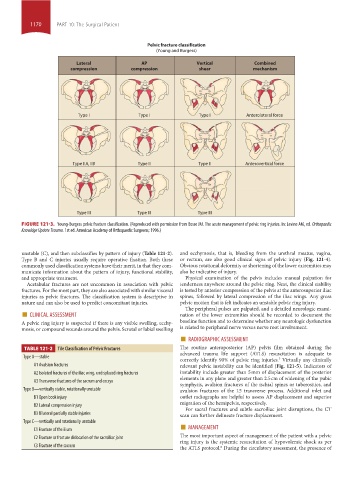
                 FIGURE 121-3.  Young-Burgess pelvic fracture classification. (Reproduced with permission from Bosse MJ. The acute management of pelvic ring injuries. In: Levine AM, ed. Orthopaedic
                 Knowldge Update Trauma. 1st ed. American Academy of Orthopaedic Surgeons; 1996.)


                 unstable (C), and then subclassifies by pattern of injury (Table 121-2).   and ecchymosis, that is, bleeding from the urethral meatus, vagina,
                 Type B and C injuries  usually require operative fixation. Both these   or rectum, are also good clinical signs of pelvic injury (Fig.  121-4).
                 commonly used classification systems have their merit, in that they com-  Obvious rotational deformity or shortening of the lower extremities may
                 municate information about the pattern of injury, functional stability,     also be indicative of injury.
                 and appropriate treatment.                              Physical examination of the pelvis includes manual palpation for
                   Acetabular fractures are not uncommon in association with pelvic   tenderness anywhere around the pelvic ring. Next, the clinical stability
                 fractures. For the most part, they are also associated with similar visceral   is tested by anterior compression of the pelvis at the anterosuperior iliac
                 injuries as pelvic fractures. The classification system is descriptive in   spines, followed by lateral compression of the iliac wings. Any gross
                 nature and can also be used to predict concomitant injuries.  pelvic motion that is felt indicates an unstable pelvic ring injury.
                     ■  CLINICAL ASSESSMENT                            nation  of  the  lower  extremities  should  be  recorded  to  document  the
                                                                         The peripheral pulses are palpated, and a detailed neurologic exami-
                 A pelvic ring injury is suspected if there is any visible swelling, ecchy-  baseline function and to determine whether any neurologic dysfunction
                 mosis, or compound wounds around the pelvis. Scrotal or labial swelling   is related to peripheral nerve versus nerve root involvement.
                                                                           ■  RADIOGRAPHIC ASSESSMENT

                   TABLE 121-2    Tile Classification of Pelvic Fractures  The routine anteroposterior (AP) pelvis film obtained during the
                                                                       advanced trauma life support (ATLS) resuscitation is adequate to
                  Type A—stable
                                                                       correctly identify 90% of pelvic ring injuries.  Virtually any clinically
                                                                                                         7
                      A1 Avulsion fractures                            relevant pelvic instability can be identified (Fig. 121-5). Indicators of
                      A2 Isolated fractures of the iliac wing, undisplaced ring fractures  instability include greater than 5 mm of displacement of the posterior
                                                                       elements in any plane and greater than 2.5 cm of widening of the pubic
                      A3 Transverse fractures of the sacrum and coccyx
                                                                       symphysis, avulsion fractures of the ischial spines or tuberosities, and
                  Type B—vertically stable, rotationally unstable      avulsion fractures of the L5 transverse process. Additional inlet and
                      B1 Open book injury                              outlet radiographs are helpful to assess AP displacement and superior
                                                                       migration of the hemipelvis, respectively.
                      B2 Lateral compression injury
                                                                         For sacral fractures and subtle sacroiliac joint disruptions, the CT
                      B3 Bilateral partially stable injuries           scan can further delineate fracture displacement.
                  Type C—vertically and rotationally unstable              ■
                      C1 Fracture of the ilium                            MANAGEMENT
                      C2 Fracture or fracture dislocation of the sacroiliac joint  The most important aspect of management of the patient with a pelvic
                                                                       ring injury is the systemic resuscitation of hypovolemic shock as per
                      C3 Fracture of the sacrum
                                                                       the ATLS protocol.  During the circulatory assessment, the presence of
                                                                                     8


            section10.indd   1170                                                                                      1/20/2015   9:21:21 AM

