


Page 1653 - Hall et al (2015) Principles of Critical Care-McGraw-Hill
P. 1653
1172     PART 10: The Surgical Patient


                   Provisional stabilization while the patient is being optimized in the
                 ICU includes external fixation for unstable injuries, as well as skeletal
                 traction on the lower extremity if there is associated vertical instability
                 of the pelvis. 19,20
                   Definitive stabilization for mechanically unstable pelvic ring injuries
                 usually requires fixation of both the posterior and anterior ring injuries,
                 provided there are no contraindications to surgery. The ideal time for this
                 is when the patient is systemically optimized and stable (Fig. 121-5B).
                 The use of external fixation and traction for routine injuries treatable
                 with open reduction and internal fixation is not advised 21,22  because this
                 usually compromises mobilization of the patient and increases the risk
                 of associated problems of prolonged bed rest, including pneumonia,
                 venous thromboembolism, and decubitus skin ulceration, as well as an
                 increased mortality rate.
                     ■  COMPLICATIONS


                 Other complications may arise as a direct result of the pelvic ring injury.
                 Massive blood loss and hemodynamic instability as described earlier are
                 the most acute issues to be managed. Injuries to the gastrointestinal and
                 urologic systems, vaginal tears, and skin degloving can cause significant
                 problems if not managed properly in the acute setting.
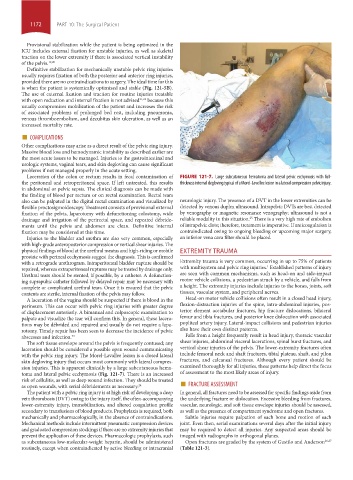
                   Laceration of the colon or rectum results in fecal contamination of   FIGURE 121-7.  Large subcutaneous hematoma and lateral pelvic ecchymosis with full-
                 the peritoneal  and retroperitoneal space. If  left untreated, this  results   thickness internal degloving typical of a Morel-Lavellee lesion in a lateral compression pelvic injury.
                 in abdominal or pelvic sepsis. The clinical diagnosis can be made with
                 the finding of blood per rectum or on rectal examination. Rectal tears
                 also can be palpated in the digital rectal examination and visualized by   neurologic injury. The presence of a DVT in the lower extremities can be
                 flexible proctosigmoidoscopy. Treatment consists of provisional external   detected by venous duplex ultrasound. Intrapelvic DVTs are best detected
                 fixation of the pelvis, laparotomy with defunctioning colostomy, wide   by venography or magnetic resonance venography; ultrasound is not a
                 drainage and irrigation of the perirectal space, and repeated débride-  reliable modality in this situation.  There is a very high rate of embolism
                                                                                               25
                 ments  until  the  pelvis  and  abdomen  are  clean.  Definitive  internal    of intrapelvic clots; therefore, treatment is imperative. If anticoagulation is
                 fixation may be considered at this time.              contraindicated owing to ongoing bleeding or upcoming major surgery,
                   Injuries to the bladder and urethra are also very common, especially   an inferior vena cava filter should be placed.
                 with high-grade anteroposterior compression or vertical shear injuries. The
                 physical findings of blood at the urethral meatus and high-riding or mobile  EXTREMITY TRAUMA
                 prostate with perineal ecchymosis suggest the diagnosis. This is confirmed
                 with a retrograde urethrogram. Intraperitoneal bladder rupture should be   Extremity trauma is very common, occurring in up to 75% of patients
                                                                                                     1
                 repaired, whereas extraperitoneal ruptures may be treated by drainage only.   with multisystem and pelvic ring injuries.  Established patterns of injury
                 Urethral tears should be stented, if possible, by a catheter. A defunction-  are seen with common mechanisms, such as head-on and side-impact
                 ing suprapubic catheter followed by delayed repair may be necessary with   motor vehicle collisions, a pedestrian struck by a vehicle, and falls from
                 complete or complicated urethral tears. Once it is ensured that the pelvic   a height. The extremity injuries include injuries to the bones, joints, soft
                 contents are sterile, internal fixation of the pelvis may follow.  tissues, vascular system, and peripheral nerves.
                   A laceration of the vagina should be suspected if there is blood in the   Head-on motor vehicle collisions often result in a closed head injury,
                 perineum. This can occur with pelvic ring injuries with greater degree   flexion-distraction injuries of the spine, intra-abdominal injuries, pos-
                 of displacement anteriorly. A bimanual and colposcopic examination to   terior  element  acetabular  fractures,  hip  fracture  dislocations,  bilateral
                 palpate and visualize the tear will confirm this. In general, these lacera-  femur and tibia fractures, and posterior knee dislocation with associated
                 tions may be débrided and repaired and usually do not require a lapa-  popliteal artery injury. Lateral-impact collisions and pedestrian injuries
                 rotomy. Timely repair has been seen to decrease the incidence of pelvic   also have their own distinct patterns.
                 abscesses and infection. 23                             Falls from a height frequently result in head injury, thoracic vascular
                   The soft tissue envelope around the pelvis is frequently contused; any   shear injuries, abdominal visceral lacerations, spinal burst fractures, and
                 laceration should be considered a possible open wound communicating   vertical shear injuries of the pelvis. The lower-extremity fractures often
                 with the pelvic ring injury. The Morel-Lavallee lesion is a closed lateral   include femoral neck and shaft fractures, tibial plateau, shaft, and pilon
                 skin degloving injury that occurs most commonly with lateral compres-  fractures, and calcaneal fractures. Although every patient should be
                 sion injuries. This is apparent clinically by a large subcutaneous hema-  examined thoroughly for all injuries, these patterns help direct the focus
                 toma and lateral pelvic ecchymosis (Fig. 121-7). There is an increased   of assessment to the most likely areas of injury.
                 risk of cellulitis, as well as deep wound infection. They should be treated     ■
                 as open wounds, with serial débridements as necessary. 24  FRACTURE ASSESSMENT
                   The patient with a pelvic ring injury is at high risk of developing a deep   In general, all fractures need to be assessed for specific findings aside from
                 vein thrombosis (DVT) owing to the injury itself, the often-accompanying   the underlying fracture or dislocation. Excessive bleeding from fractures,
                 lower-extremity injury, immobilization, and altered coagulation profile   vascular, neurologic, and soft tissue envelope injuries should be assessed,
                 secondary to transfusions of blood products. Prophylaxis is required, both   as well as the presence of compartment syndrome and open fractures.
                 mechanically and pharmacologically, in the absence of contraindications.   Subtle injuries  require palpation of each bone  and motion of each
                 Mechanical methods include intermittent pneumatic compression devices   joint. Even then, serial examinations several days after the initial injury
                 and graduated compression stockings if there are no extremity injuries that   may be required to detect all injuries. Any suspected areas should be
                 prevent the application of these devices. Pharmacologic prophylaxis, such   imaged with radiographs in orthogonal planes.
                 as subcutaneous low-molecular-weight heparin, should be administered   Open fractures are graded by the system of Gustilo and Anderson 26,27
                 routinely, except when contraindicated by active bleeding or intracranial   (Table 121-3).


            section10.indd   1172                                                                                      1/20/2015   9:21:27 AM

