


Page 1652 - Hall et al (2015) Principles of Critical Care-McGraw-Hill
P. 1652
CHAPTER 121: Pelvic Ring Injuries and Extremity Trauma   1171


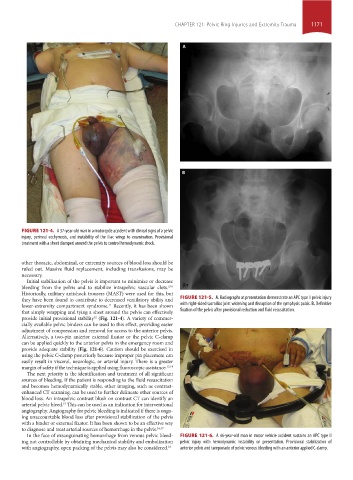
                    FIGURE 121-4.  A 37-year-old man in a motorcycle accident with clinical signs of a pelvic
                    injury, perineal ecchymosis, and instability of the iliac wings to examination. Provisional
                    treatment with a sheet clamped around the pelvis to control hemodynamic shock.


                    other thoracic, abdominal, or extremity sources of blood loss should be
                    ruled out. Massive fluid replacement, including transfusions, may be
                    necessary.
                     Initial stabilization of the pelvis is important to minimize or decrease
                    bleeding from the pelvis and  to stabilize intrapelvic vascular clots.
                                                                     9,10
                    Historically, military antishock trousers (MAST) were used for this, but
                    they have been found to contribute to decreased ventilatory ability and   FIGURE 121-5.  A. Radiographs at presentation demonstrate an APC type II pelvic injury
                    lower-extremity compartment syndrome.  Recently, it has been shown   with right-sided sacroiliac joint widening and disruption of the symphysis pubis. B. Definitive
                                                 11
                    that simply wrapping and tying a sheet around the pelvis can effectively   fixation of the pelvis after provisional reduction and fluid resuscitation.
                    provide initial provisional stability  (Fig. 121-4). A variety of commer-
                                            12
                    cially available pelvic binders can be used to this effect, providing easier
                    adjustment of compression and removal for access to the anterior pelvis.
                    Alternatively, a two-pin anterior external fixator or the pelvic C-clamp
                    can be applied quickly to the anterior pelvis in the emergency room and
                    provide adequate stability (Fig. 121-6). Caution should be exercised in
                    using the pelvic C-clamp posteriorly because improper pin placement can
                    easily result in visceral, neurologic, or arterial injury. There is a greater
                    margin of safety if the technique is applied using fluoroscopic assistance. 13,14
                     The next priority is the identification and treatment of all significant
                    sources of bleeding. If the patient is responding to the fluid resuscitation
                    and becomes hemodynamically stable, other imaging, such as contrast-
                    enhanced CT scanning, can be used to further delineate other sources of
                    blood loss. An intrapelvic contrast blush on contrast CT can identify an
                    arterial pelvic bleed.  This can be used as an indication for interventional
                                  15
                    angiography. Angiography for pelvic bleeding is indicated if there is ongo-
                    ing unaccountable blood loss after provisional stabilization of the pelvis
                    with a binder or external fixator. It has been shown to be an effective way
                    to diagnose and treat arterial sources of hemorrhage in the pelvis. 16,17
                     In the face of exsanguinating hemorrhage from venous pelvic bleed-  FIGURE 121-6.  A 46-year-old man in motor vehicle accident sustains an APC type II
                    ing not controllable by obtaining mechanical stability and embolization   pelvic injury with hemodynamic instability on presentation. Provisional stabilization of
                    with angiography, open packing of the pelvis may also be considered. 18  anterior pelvis and tamponade of pelvic venous bleeding with an anterior applied C-clamp.


            section10.indd   1171                                                                                      1/20/2015   9:21:25 AM

