


Page 1650 - Hall et al (2015) Principles of Critical Care-McGraw-Hill
P. 1650
CHAPTER 121: Pelvic Ring Injuries and Extremity Trauma   1169


                                                         Iliolumbar ligament
                                            Posterior sacroiliac
                                                  ligament


                                                                                            Sacrospinous
                                                                                            ligament
                                  https://kat.cr/user/tahir99/
                                                  Sacrotuberous
                                                     ligament


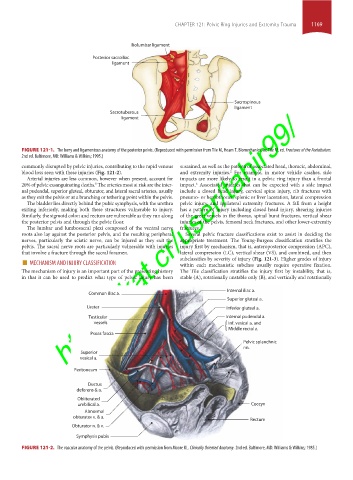
                    FIGURE 121-1.  The bony and ligamentous anatomy of the posterior pelvis. (Reproduced with permission from Tile M, Hearn T. Biomechanics. In: Tile M, ed. Fractures of the Acetabulum.
                    2nd ed. Baltimore, MD: Williams & Wilkins; 1995.)
                    commonly disrupted by pelvic injuries, contributing to the rapid venous   sustained, as well as the pattern of associated head, thoracic, abdominal,
                    blood loss seen with these injuries (Fig. 121-2).     and extremity injuries.  For example, in motor vehicle crashes, side
                                                                                           2
                     Arterial injuries are less common, however when present, account for   impacts are more likely to result in a pelvic ring injury than a frontal
                    20% of pelvic exsanguinating deaths.  The arteries most at risk are the inter-  impact.  Associated injuries that can be expected with a side impact
                                             5
                                                                               6
                    nal pudendal, superior gluteal, obturator, and lateral sacral arteries, usually   include  a  closed head  injury,  cervical  spine  injury,  rib  fractures  with
                    as they exit the pelvis or at a branching or tethering point within the pelvis.  pneumo- or hemothorax, splenic or liver laceration, lateral compression
                     The bladder lies directly behind the pubic symphysis, with the urethra   pelvic injury, and ipsilateral extremity fractures. A fall from a height
                    exiting inferiorly, making both these structures vulnerable to injury.   has a pattern of injury including closed head injury, shearing injuries
                    Similarly, the sigmoid colon and rectum are vulnerable as they run along   of the great vessels in the thorax, spinal burst fractures, vertical shear
                    the posterior pelvis and through the pelvic floor.    injuries of the pelvis, femoral neck fractures, and other lower-extremity
                     The lumbar and lumbosacral plexi composed of the ventral nerve   fractures.
                    roots also lay against the posterior pelvis, and the resulting peripheral   Several pelvic fracture classifications exist to assist in deciding the
                    nerves, particularly the sciatic nerve, can be injured as they exit the     appropriate treatment. The Young-Burgess classification stratifies the
                    pelvis. The sacral nerve roots are particularly vulnerable with injuries   injury first by mechanism, that is, anteroposterior compression (APC),
                    that involve a fracture through the sacral foramen.   lateral compression (LC), vertical shear (VS), and combined, and then
                        ■  MECHANISM AND INJURY CLASSIFICATION            subclassifies by severity of injury (Fig. 121-3). Higher grades of injury
                                                                          within  each  mechanistic  subclass  usually  require  operative  fixation.
                    The mechanism of injury is an important part of the presenting history   The Tile classification stratifies the injury first by instability, that is,
                    in  that  it  can  be  used  to  predict  what  type  of  pelvic  injury  has been   stable (A), rotationally unstable only (B), and vertically and rotationally

                                                                                          Internal iliac a.
                                          Common iliac a.
                                                                                          Superior gluteal a.
                                          Ureter                                         Inferior gluteal a.

                                          Testicular                                     Internal pudendal a.
                                            vessels                                       Inf. vesical a. and
                                                                                          Middle rectal a.
                                           Psoas fascia
                                                                                               Pelvic splanchnic
                                                                                               nn.
                                        Superior
                                        vesical a.

                                     Peritoneum

                                          Ductus
                                      deferens & a.
                                       Obliterated
                                       umbilical a.                                               Coccyx
                                         Abnormal
                                     obturator v. & a.
                                                                                                 Rectum
                                     Obturator n. & v.
                                      Symphysis pubis
                    FIGURE 121-2.  The vascular anatomy of the pelvis. (Reproduced with permission from Moore KL. Clinically Oriented Anatomy. 2nd ed. Baltimore, MD: Williams & Wilkins; 1985.)


            section10.indd   1169                                                                                      1/20/2015   9:21:17 AM

