


Page 1738 - Hall et al (2015) Principles of Critical Care-McGraw-Hill
P. 1738
CHAPTER 124: Toxicology in Adults  1207


                    38,000 of these cases were treated in health care facilities; 25,764 patients   (SI Units)
                    received N-acetylcysteine (NAC); 1193 had major complications;      M per L   g per mL
                    235 died.  In late 2010, the FDA approved an IV formulation of
                           1
                    acetaminophen.                                          6000    1000
                     The evolution of acetaminophen toxicity is often divided into four   5000
                    phases.  Phase I refers to the first 24 hours after ingestion. During this   4000
                         100
                    period, acetaminophen is absorbed and metabolized, glutathione stores   500
                    are depleted, and hepatotoxicity begins. Patients are alert but may expe-  3000
                    rience nausea, vomiting, anorexia, malaise, pallor, or diaphoresis toward
                    the end of this phase. These nonspecific signs and symptoms create the   2000
                    potential for a missed diagnosis. Furthermore, when acetaminophen is   1300  200
                    combined with another drug such as codeine or oxycodone, the effects
                    of the other drug may mask the initial subtle manifestations of acet-  1000  150
                    aminophen poisoning.                                     900
                     Phase II occurs 24 to 72 hours after untreated ingestion. During   800
                    this period, patients may develop right upper quadrant pain and   700  100
                    minor abnormalities of liver function consisting of elevation of hepatic   600
                    enzymes, prothrombin time, and bilirubin. Phase III (72-96 hours after   500           Probable hepatic
                    untreated ingestion) is characterized by continued hepatic necrosis,                      toxicity
                    hepatic encephalopathy, disseminated intravascular coagulation, and   400
                    jaundice. Liver function abnormalities typically peak during phase III.   50
                    It is not unusual for serum aspartate aminotransferase levels to rise to   300         Possible hepatic
                    10,000 IU/L or higher. Extreme elevation of alanine aminotransferase   250                toxicity
                    may also be seen. Rare phase III sequelae include hemorrhagic pancre-
                    atitis, myocardial necrosis, and acute renal failure. Phase IV takes place  Acetaminophen plasma concentration  200
                    4 days to 2 weeks after ingestion. During this period, the patient may
                    die, fully recover without chronic liver disease, or require emergent liver
                    transplantation. Some patients with untreated acetaminophen poisoning
                    exhibit a pattern of rising prothrombin time, ammonia, and bilirubin, as   100
                    levels of hepatic enzymes decline, indicating fulminant hepatic necrosis.  90  No hepatic
                                                                                                   toxicity
                     A product of normal acetaminophen metabolism is responsible for   80
                    hepatotoxicity. As acetaminophen is metabolized by the cytochrome   70
                    P-450 mixed oxidase system, a toxic product (N-acetyl-p-benzoquinone   60  10
                    imine or NAPQI) is rapidly detoxified by hepatic intracellular    50
                    glutathione.  In overdose cases, glutathione is depleted, allowing the
                            101
                    toxic metabolite to combine with hepatic cell proteins and cause cen-  40
                    trilobular necrosis with periportal sparing. Local production of NAPQI   5                          25%
                    makes the liver the primary target, but other organs can be affected.  30
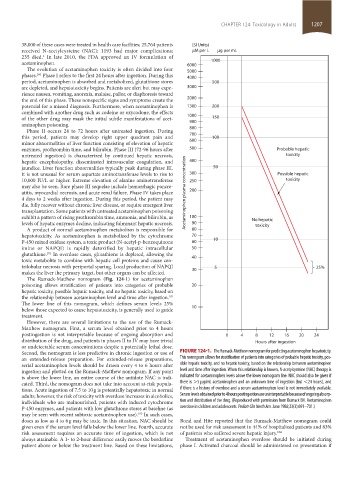
                     The Rumack-Matthew nomogram (Fig. 124-1) for acetaminophen
                    poisoning allows stratification of patients into categories of probable   20
                    hepatic toxicity, possible hepatic toxicity, and no hepatic toxicity, based on
                    the relationship between acetaminophen level and time after ingestion.
                                                                      102
                    The  lower  line  of this  nomogram,  which  defines  serum  levels  25%
                    below those expected to cause hepatotoxicity, is generally used to guide   10
                    treatment.
                     However, there are several limitations to the use of the Rumack-
                    Matthew nomogram. First, a serum level obtained prior to 4 hours
                    postingestion  is  not  interpretable  because  of  ongoing  absorption  and   0  4  8  12  16  20  24
                    distribution of the drug, and patients in phases II to IV may have trivial     Hours after ingestion
                    or undetectable serum concentrations despite a potentially lethal dose.
                    Second, the nomogram is less predictive in chronic ingestion or use of   FIGURE 124-1.  The Rumack-Matthew nomogram for predicting acetaminophen hepatoxicity.
                    an extended-release preparation. For extended-release preparations,   This nomogram allows for stratification of patients into categories of probable hepatic toxicity, pos-
                    serial acetaminophen levels should be drawn every 4 to 6 hours after   sible hepatic toxicity, and no hepatic toxicity, based on the relationship between acetaminophen
                    ingestion and plotted on the Rumack-Matthew nomogram. If any point   level and time after ingestion. When this relationship is known, N-acetylcysteine (NAC) therapy is
                    is above the lower line, an entire course of the antidote NAC is indi-  indicated for acetaminophen levels above the lower nomogram line. NAC should also be given if
                    cated. Third, the nomogram does not take into account at-risk popula-  there is >5 µg/mL acetaminophen and an unknown time of ingestion (but <24 hours), and
                    tions. Acute ingestion of 7.5 to 10 g is potentially hepatotoxic in normal     if there is a history of overdose and a serum acetaminophen level is not immediately available.
                    adults; however, the risk of toxicity with overdose increases in alcoholics,   Serum levels obtained prior to 4 hours postingestion are uninterpretable because of ongoing absorp-
                    individuals who are malnourished, patients with induced cytochrome   tion and distribution of the drug. (Reproduced with permission from Rumack BH. Acetaminophen
                    P-450 enzymes, and patients with low glutathione stores at baseline (as   overdose in children and adolescents. Pediatr Clin North Am. June 1986;33(3):691–701.)
                    may be seen with recent subtoxic acetaminophen use).  In such cases,
                                                           103
                    doses as low as 4 to 6 g may be toxic. In this situation, NAC should be   Bond and Hite reported that the Rumack-Matthew nomogram could
                    given even if the serum level falls below the lower line. Fourth, accurate   not be used for risk assessment in 44% of hospitalized patients and 83%
                    risk assessment requires an accurate time of ingestion, which is not   of patients who suffered severe hepatic injury. 104
                    always attainable. A 1- to 2-hour difference easily moves the borderline   Treatment of acetaminophen overdose  should be initiated during
                    patient above or below the treatment line. Based on these limitations,   phase I. Activated charcoal should be administered on presentation if


            section11.indd   1207                                                                                      1/19/2015   10:51:59 AM

