


Page 1733 - Hall et al (2015) Principles of Critical Care-McGraw-Hill
P. 1733
1202     PART 11: Special Problems in Critical Care


                 can occur in the absence of a documented increased osmol gap. Thus,     TABLE 124-18     Drugs Commonly Included in Urine Toxicology Screens
                 measuring serum levels of these alcohols is important in any patient in   (Available in 2-3 Hours)
                 whom inebriation, acidosis, or other clinical features suggest intoxica-
                 tion with these agents.                                Acetaminophen
                                                                        Amoxapine
                 Oxygen Saturation Gap:  An elevated arterial oxygen saturation gap is
                 defined by a >5% difference between saturation calculated from an   Barbiturates other than phenobarbital
                 arterial blood gas and saturation measured by cooximetry. Elevated   Benzodiazepine metabolites
                 oxygen  saturation  gap  is seen  in carbon monoxide poisoning and     Nordiazepam
                 with methemoglobinemia. These toxins interfere with oxygen bind-
                 ing to hemoglobin and thereby significantly decrease oxygen content     Oxazepam
                                                      ).  It  is  important  to   Cannabinoids (marijuana)
                 without lowering arterial oxygen pressure (Pa O 2
                 note that oxygen saturation measured by pulse oximetry is falsely high   Carbamazepine
                 in these settings. Hydrogen sulfide and cyanide interfere with cellular
                 utilization of oxygen, leading to an abnormally high venous oxygen   Chlorpromazine
                 saturation and “arteriolization” of venous blood.      Cimetidine
                 Additional Laboratory Tests:  Additional useful laboratory data include   Codeine
                 urine ferric chloride analysis, which provides rapid evidence of salicy-  Cocaine metabolites
                 late or phenothiazine intake; a pregnancy test in women of child-  Desipramine
                 bearing age; and abdominal radiography, which may detect retained
                 pills (such as iron) or show evidence for body packing (see below).   Dextromethorphan
                 Sustained-release preparations may be detected more easily through   Diphenhydramine
                 digital enhancement of the radiograph. 45              Doxepin
                     ■  TOXICOLOGY SCREENING                            Doxylamine


                 Toxicology screening provides direct evidence of ingestion, but it rarely   Ephedrine
                 impacts initial management, and supportive measures should not await   Erythromycin
                 results of such analysis. In Brett’s review of 209 cases of intentional drug   Glutethimide
                 overdose,  toxicology analysis supported the clinical suspicion in 47%   Guaifenesin
                        46
                 of cases. Clinically unsuspected drugs were detected in 27% of cases, but
                 unexpected findings altered management in only three cases. Kellerman   Hydrocodone
                 and coworkers reviewed urine toxicology screens in 361 of 405 consecu-  Hydromorphone
                 tive ED patients with suspected drug overdose.  Management changes   Imipramine
                                                    47
                 followed drug screening in only 16 (4.4%) of cases.
                   Toxicology screening provides evidence for select intoxications quickly   Lidocaine
                 (see below) and may establish the grounds for treatment with a specific   Meperidine
                 antidote or method for enhancing elimination. Toxicology screening   Meprobamate
                 also identifies drugs that should be quantitated to guide subsequent
                 management.  If at all possible, samples should be collected before   Methadone
                           48
                 administration of medications that might confuse toxicologic analysis.  Methamphetamine
                   Understanding the limitations of toxicology screening is important,   Methaqualone
                 including which drugs are (and which drugs are not) included in routine
                 screening panels. These panels are institutionally variable. Most institu-  Morphine
                 tions offer urine screening for commonly abused drugs only, preferring   Nortriptyline
                 to send more extensive screening panels to outside laboratories. Other   Opiates
                 institutions routinely perform extensive urine and blood analysis on all
                 patients in selected categories (eg, trauma patients). Urine screens used   Orphenadrine
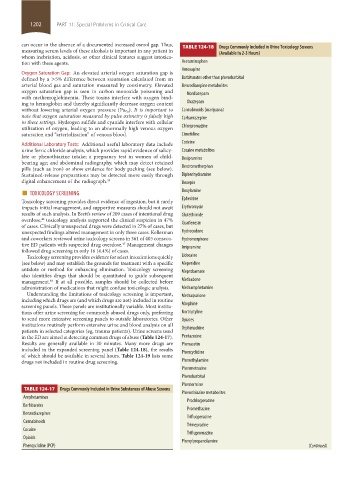
                 in the ED are aimed at detecting common drugs of abuse (Table 124-17).    Pentazocine
                 Results are generally available in 30 minutes. Many more drugs are   Phenacetin
                 included in the expanded screening panel (Table 124-18), the results   Phencyclidine
                 of which should be available in several hours. Table 124-19 lists some
                 drugs not included in routine drug screening.          Phenethylamine
                                                                        Phenmetrazine
                                                                        Phenobarbital
                                                                        Phentermine
                   TABLE 124-17    Drugs Commonly Included in Urine Substances of Abuse Screens
                                                                        Phenothiazine metabolites
                  Amphetamines
                                                                          Prochlorperazine
                  Barbiturates
                                                                          Promethazine
                  Benzodiazepines
                                                                          Trifluoperazine
                  Cannabinoids
                                                                          Trimeprazine
                  Cocaine
                                                                          Triflupromazine
                  Opioids
                                                                        Phenylpropanolamine
                  Phencyclidine (PCP)                                                                              (Continued)


            section11.indd   1202                                                                                      1/19/2015   10:51:57 AM

