


Page 1735 - Hall et al (2015) Principles of Critical Care-McGraw-Hill
P. 1735
1204     PART 11: Special Problems in Critical Care

                                                                           ■
                   The use of activated charcoal (AC) in acute overdose has become a   WHOLE-BOWEL IRRIGATION
                 source of heated debate in the last few years. The largest prospective ran-  The routine use of whole-bowel irrigation (WBI) is not recommended,
                 domized clinical trial to date, published by Eddleston et al in 2008, failed   as efficacy has not been established in controlled clinical trials.  Based
                                                                                                                     73
                 to show difference between poisoned patients given AC, multidose AC,   on case reports, its use can be considered in a few cases: (1) potentially
                 and supportive care only ; although the study has been criticized for   fatal or otherwise highly toxic ingestion of sustained-release or enteric-
                                    56
                 its mean length from time of ingestion to hospital presentation and AC   coated drugs, (2) ingestion of a large amount of iron, and (3) ingestion
                 administration (greater than 4 hours) and the frequent use of forced   of large number of packets of illicit drugs (in the case of body packers).
                                                                                                                          73
                 emesis prior to presentation. Other prospective trials, large retrospective   WBI is performed with a polyethylene glycol electrolyte solution
                 studies, and meta-analyses, however, show effective absorption of drug   (eg, GoLYTELY) 1 to 2 L/h by mouth or nasogastric tube. Irrigation is
                 and improvement in clinical outcome measures. 57-59   generally continued until the rectal effluent is clear or there is radio-
                   In light of these conflicting studies, the routine use of single-dose acti-  graphic evidence of clearance. Contraindications to WBI include ileus,
                 vated charcoal in every poisoned patient is not recommended.  Those   gastrointestinal hemorrhage, and bowel perforation.
                                                               60
                 patients who should receive single-dose activated charcoal include those
                 that have no contraindications for AC use and have a potentially toxic/    ■  FORCED DIURESIS AND URINARY pH MANIPULATIONS
                 fatal ingestion of drugs that can bind to AC. 61
                   If AC is administered, it should be done in a timely fashion after   We do not recommend forced diuresis by volume loading and diuretic
                 ingestion, as efficacy has been shown to decrease over time. While clas-  administration, which is intended to augment elimination of renally
                 sically taught that AC should be given within 1 hour of ingestion, there is   excreted toxins through inhibition of tubular reabsorption. This regi-
                 evidence that it continues to significantly reduce drug absorption for up   men is of unproven benefit and has the potential to compromise fluid
                 to 4 hours.  Activated charcoal should be avoided in stuporous, coma-  and electrolyte homeostasis and lead to fluid overload (pulmonary or
                         59
                 tose, or convulsing patients unless an endotracheal tube protects the    cerebral edema). 74
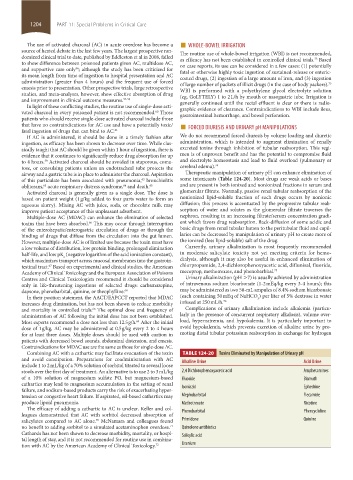
                 airway and a gastric tube is in place to administer the charcoal. Aspiration   Therapeutic manipulation of urinary pH can enhance elimination of
                 of this particulate has been associated with pneumonia,  bronchiolitis   some intoxicants (Table 124-20). Most drugs are weak acids or bases
                                                          62
                 obliterans,  acute respiratory distress syndrome,  and death. 65  and are present in both ionized and nonionized fractions in serum and
                                                    64
                         63
                   Activated charcoal  is  generally  given  as a  single dose.  The  dose  is   glomerular filtrate. Normally, passive renal tubular reabsorption of the
                 based on patient weight (1 g/kg added to four parts water to form an   nonionized lipid-soluble fraction of such drugs occurs by nonionic
                 aqueous slurry). Mixing AC with juice, soda, or chocolate milk may   diffusion; this process is accentuated by the progressive tubular reab-
                 improve patient acceptance of this unpleasant adsorbent.  sorption of water and solutes as the glomerular filtrate traverses the
                   Multiple-dose AC (MDAC) can enhance the elimination of selected   nephron, resulting in an increasing filtrate/serum concentration gradi-
                 toxins that have been absorbed.  This may occur through interruption   ent which favors drug reabsorption. Back-diffusion of some acidic and
                                        66
                 of the enterohepatic/enterogastric circulation of drugs or through the   basic drugs from renal tubular lumen to the peritubular fluid and capil-
                 binding of drugs that diffuse from the circulation into the gut lumen.   laries can be decreased by manipulation of urinary pH to create more of
                 However, multiple-dose AC is of limited use because the toxin must have   the ionized (less lipid-soluble) salt of the drug.
                 a low volume of distribution, low protein binding, prolonged elimination   Currently, urinary alkalinization  is  most  frequently  recommended
                 half-life, and low pK  (negative logarithm of the acid ionization constant),   in  moderate salicylate  toxicity not yet meeting criteria for hemo-
                               a
                 which maximizes transport across mucosal membranes into the gastroin-  dialysis, although it may also be useful in enhanced elimination of
                 testinal tract.  Based on experimental and clinical studies, the American   chlorpropamide, 2,4-dichlorophenoxyacetic acid, diflunisal, fluoride,
                          67
                 Academy of Clinical Toxicology and the European Association of Poisons   mecoprop, methotrexate, and phenobarbital. 75
                 Centres and Clinical Toxicologists recommend it should be considered   Urinary alkalinization (pH >7) is usually achieved by administration
                 only in life-threatening ingestions of selected drugs: carbamazepine,   of intravenous sodium bicarbonate (1-2 mEq/kg every 3-4 hours); this
                 dapsone, phenobarbital, quinine, or theophylline. 68  may be administered as two 50-mL ampules of 8.4% sodium bicarbonate
                   In their position statement, the AACT/EAPCCT reported that MDAC   (each containing 50 mEq of NaHCO ) per liter of 5% dextrose in water
                                                                                                  3
                 increases drug elimination, but has not been shown to reduce morbidity   infused at 250 mL/h. 76
                 and mortality in controlled trials.  The optimal dose and frequency of   Complications of urinary alkalinization include alkalemia (particu-
                                         68
                 administration of AC following the initial dose has not been established.   larly in the presence of concurrent respiratory alkalosis), volume over-
                 Most experts recommend a dose not less than 12.5 g/h.  After the initial   load, hypernatremia, and hypokalemia. It is particularly important to
                                                        69
                 dose of 1 g/kg, AC may be administered at 0.5 g/kg every 2 to 4 hours   avoid hypokalemia, which prevents excretion of alkaline urine by pro-
                 for at least three doses. Multiple doses should be used with caution in   moting distal tubular potassium reabsorption in exchange for hydrogen
                 patients with decreased bowel sounds, abdominal distension, and emesis.
                 Contraindications for MDAC use are the same as those for single-dose AC.
                   Combining AC with a cathartic may facilitate evacuation of the toxin     TABLE 124-20    Toxins Eliminated by Manipulation of Urinary pH
                 and avoid constipation. Preparations for coadministration with AC   Alkaline Urine              Acid Urine
                 include 1 to 2 mL/kg of a 70% solution of sorbitol titrated to several loose
                 stools over the first day of treatment. An alternative is to use 2 to 3 mL/kg     2,4 Dichlorophenoxyacetic acid  Amphetamines
                 of a 10% solution of magnesium sulfate PO, but magnesium-based   Fluoride                       Bismuth
                 cathartics may lead to magnesium accumulation in the setting of renal   Isoniazid               Ephedrine
                 failure, and sodium-based products carry the risk of exacerbating hyper-
                 tension or congestive heart failure. If aspirated, oil-based cathartics may   Mephobarbital     Flecainide
                 produce lipoid pneumonia.                              Methotrexate                             Nicotine
                   The efficacy of adding a cathartic to AC is unclear. Keller and col-
                 leagues  demonstrated  that AC  with  sorbitol  decreased  absorption  of   Phenobarbital       Phencyclidine
                 salicylates compared to AC alone.  McNamara and colleagues found   Primidone                    Quinine
                                           70
                 no benefit to adding sorbitol to a simulated acetaminophen overdose.    Quinolone antibiotics
                                                                    71
                 Catharsis has not been shown to decrease morbidity, mortality, or hospi-  Salicylic acid
                 tal length of stay, and it is not recommended for routine use in combina-
                 tion with AC by the American Academy of Clinical Toxicology. 72  Uranium


            section11.indd   1204                                                                                      1/19/2015   10:51:58 AM

