


Page 1737 - Hall et al (2015) Principles of Critical Care-McGraw-Hill
P. 1737
1206     PART 11: Special Problems in Critical Care


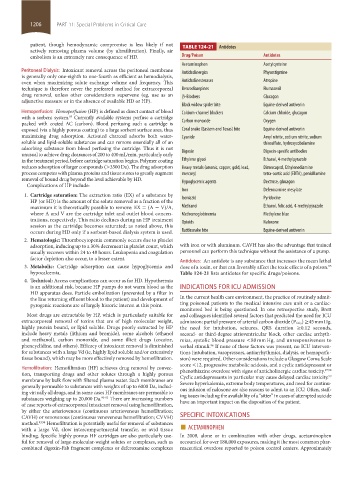
                    patient, though hemodynamic compromise is less likely if not     TABLE 124-21    Antidotes
                    actively removing plasma volume (by ultrafiltration). Finally, air
                    embolism is an extremely rare consequence of HD.    Drug/Poison                 Antidotes
                                                                        Acetaminophen               Acetylcysteine
                 Peritoneal Dialysis:  Intoxicant removal across the peritoneal membrane   Anticholinergics  Physostigmine
                 is generally only one-eighth to one-fourth as efficient as hemodialysis,
                 even when maximizing solute exchange volume and frequency. This   Anticholinesterases  Atropine
                 technique is therefore never the preferred method for extracorporeal   Benzodiazepines  Flumazenil
                 drug removal, unless other considerations supervene (eg, use as an   β-Blockers    Glucagon
                 adjunctive measure or in the absence of available HD or HP).
                                                                        Black widow spider bite     Equine-derived antivenin
                 Hemoperfusion:  Hemoperfusion (HP) is defined as direct contact of blood   Calcium-channel blockers  Calcium chloride, glucagon
                 with a sorbent system.  Currently available systems perfuse a cartridge
                                 89
                 packed with coated AC (carbon). Blood perfusing such a cartridge is   Carbon monoxide  Oxygen
                 exposed (via a highly porous coating) to a large sorbent surface area, thus   Coral snake (Eastern and Texas) bite  Equine-derived antivenin
                 maximizing drug adsorption. Activated charcoal adsorbs both water-  Cyanide        Amyl nitrite, sodium nitrite, sodium
                 soluble and lipid-soluble substances and can remove essentially all of an          thiosulfate, hydroxycobalamine
                 adsorbing substance from blood perfusing the cartridge. Thus it is not
                 unusual to achieve drug clearances of 200 to 400 mL/min, particularly early   Digoxin  Digoxin-specific antibodies
                 in the treatment period, before cartridge saturation begins. Polymer coating   Ethylene glycol  Ethanol, 4-methylpyrazole
                 reduces adsorption of larger compounds (>3500 Da). The drug adsorption   Heavy metals (arsenic, copper, gold, lead,   Dimercaprol, Ethylenediamine
                 process competes with plasma proteins and tissue stores to greatly augment   mercury)  tetra-acetic acid (EDTA), penicillamine
                 removal of bound drug beyond the level achievable by HD.  Hypoglycemic agents      Dextrose, glucagon
                   Complications of HP include:
                                                                        Iron                        Deferoxamine mesylate
                   1.  Cartridge saturation: The extraction ratio (EX) of a substance by
                    HP (or HD) is the amount of the solute removed as a fraction of the   Isoniazid  Pyridoxine
                    maximum it is theoretically possible to remove: EX = (A − V)/A,   Methanol      Ethanol, folic acid, 4-methylpyrazole
                    where A and V are the cartridge inlet and outlet blood concen-  Methemoglobinemia  Methylene blue
                    trations, respectively. This ratio declines during an HP treatment    Opioids   Naloxone
                    session as the cartridge becomes saturated; as noted above, this
                    occurs during HD only if a sorbent-based dialysis system is used.  Rattlesnake bite  Equine-derived antivenin
                   2.  Hematologic: Thrombocytopenia commonly occurs due to platelet
                    adsorption, inducing up to a 30% decrement in platelet count, which   with iron or with aluminum. CAVH has also the advantage that trained
                    usually recovers within 24 to 48 hours. Leukopenia and coagulation   personnel can perform this technique without the assistance of a pump.
                    factor depletion also occur, to a lesser extent.   Antidotes:  An antidote is any substance that increases the mean lethal
                   3.  Metabolic: Cartridge adsorption can cause hypoglycemia and   dose of a toxin, or that can favorably affect the toxic effects of a poison.
                                                                                                                          95
                    hypocalcemia.                                      Table 124-21 lists antidotes for specific drugs/poisons.
                   4.  Technical: Access complications can occur as for HD. Hypothermia
                    is an additional risk, because HP pumps do not warm blood as the  INDICATIONS FOR ICU ADMISSION
                    HD apparatus does. Particle embolization (prevented by a filter in
                    the line returning effluent blood to the patient) and development of   In the current health care environment, the practice of routinely admit-
                    pyrogenic reactions are of largely historic interest at this point.  ting poisoned patients to the medical intensive care unit or a cardiac-
                                                                       monitored bed is being questioned. In one retrospective study, Brett
                   Most drugs are extractable by HP, which is particularly suitable for   and colleagues identified several factors that predicted the need for ICU
                 extracorporeal removal of toxins that are of high molecular weight,   admission: partial pressure of arterial carbon dioxide (P CO 2 ) ≥45 mm Hg,
                 highly protein bound, or lipid soluble. Drugs poorly extracted by HP   the need for intubation, seizures, QRS duration  ≥0.12 seconds,
                 include heavy metals (lithium and bromide), some alcohols (ethanol   second- or third-degree atrioventricular block, other cardiac arrhyth-
                 and methanol), carbon monoxide, and some illicit drugs (cocaine,   mias, systolic blood pressure <80 mm Hg, and unresponsiveness to
                 phencyclidine, and others). Efficacy of intoxicant removal is diminished   verbal stimuli.  If none of these factors was present, no ICU interven-
                                                                                  96
                 for substances with a large Vd (ie, highly lipid soluble and/or extensively     tions (intubation, vasopressors, antiarrhythmics, dialysis, or hemoperfu-
                 tissue bound), which may be more effectively removed by hemofiltration.  sion) were required. Other considerations include a Glasgow Coma Scale
                                                                       score <12, progressive metabolic acidosis, and a cyclic antidepressant or
                 Hemofiltration:  Hemofiltration (HF) achieves drug removal by convec-                                   97,98
                 tion, transporting drugs and other solutes through a highly porous   phenothiazine overdose with signs of anticholinergic cardiac toxicity.  99
                                                                       Cyclic antidepressants in particular may cause delayed cardiac toxicity.
                 membrane by bulk flow with filtered plasma water. Such membranes are
                 generally permeable to substances with weights of up to 6000 Da, includ-  Severe hyperkalemia, extreme body temperatures, and need for continu-
                                                                       ous infusion of naloxone are also reasons to admit to an ICU. Often, staff-
                 ing virtually all drugs, and in some cases HF membranes are permeable to
                 substances weighing up to 20,000 Da. 90-92  There are increasing numbers   ing issues including the availability of a “sitter” in cases of attempted suicide
                                                                       have an important impact on the disposition of the patient.
                 of case reports of extracorporeal intoxicant removal using hemofiltration,
                 by either the arteriovenous (continuous arteriovenous hemofiltration;
                 CAVH) or venovenous (continuous venovenous hemofiltration; CVVH)   SPECIFIC INTOXICATIONS
                 with a large Vd, slow intercompartmental transfer, or avid tissue    ■  ACETAMINOPHEN
                 method.
                          Hemofiltration is potentially useful for removal of substances
                       93,94
                 binding. Specific highly porous HF cartridges are also particularly use-  In 2008, alone or in combination with other drugs, acetaminophen
                 ful for removal of large-molecular-weight solutes or complexes, such as   accounted for over 180,000 exposures, making it the most common phar-
                 combined digoxin-Fab fragment complexes or deferoxamine complexes   maceutical overdose reported to poison control centers. Approximately


            section11.indd   1206                                                                                      1/19/2015   10:51:58 AM

