


Page 1785 - Hall et al (2015) Principles of Critical Care-McGraw-Hill
P. 1785
1254     PART 11: Special Problems in Critical Care


                   CHAPTER   Critical Illness in Pregnancy
                                                                          stress of surgery may make vaginal delivery a better option in the
                  127        Karen C. Patterson                            • The increased volume of distribution and glomerular filtration rate
                                                                          nonemergent setting and when the mother is capable of labor.
                             Michael F. O’Connor
                             Jesse B. Hall                                may affect dosing of medications in pregnancy.
                             Mary E. Strek                                 • Successful management of critical illness in pregnancy requires a
                                                                          multidisciplinary team of intensive care, pharmacy, obstetric, and
                                                                          neonatal consultants.
                  KEY POINTS

                     • Assessment of the adequacy of maternal blood flow requires an
                                https://kat.cr/user/tahir99/
                    understanding that the baseline flow is substantially increased and   Critical illness during pregnancy requires a multidisciplinary approach that
                    is further augmented during labor and delivery.    considers both the mother and the fetus. There is a paucity of definitive tri-
                     • The  increased  cardiac  output  of  pregnancy  is  often  diminished,   als to guide therapy in critically ill pregnant patients. Measures that optimize
                                                                       maternal well-being are usually best for the fetus as well. Knowledge of
                    especially in late pregnancy, in the supine position by uterine com-  the expected adaptations in maternal physiology is essential to distinguish
                    pression of the vena cava and abdominal aorta. Placing the patient   between normal and pathologic findings in gravid patients. This chapter
                    in the left lateral decubitus position is an important management   begins with an overview of the normal physiologic changes in pregnancy
                    principle in shock.                                and the determinants of fetal oxygen delivery. The remainder of the chapter
                     • The normal hyperventilation of pregnancy results in a respiratory   focuses on the disorders and management of critical illness in pregnancy.
                    alkalosis with a compensatory metabolic acidosis. The normal
                                                          > 100 mm Hg,
                    arterial blood gas values in pregnancy include a P O 2  PHYSIOLOGY OF PREGNANCY
                         of 27 to 34 mm Hg, and a serum bicarbonate concentration
                    a P CO 2
                    of 18 to 21 mEq/L.                                     ■  ADAPTATION OF THE CIRCULATORY SYSTEM
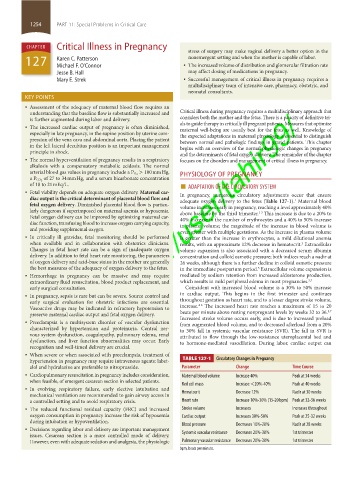
                     • Fetal viability depends on adequate oxygen delivery. Maternal car-  In pregnancy, numerous circulatory adjustments occur that ensure
                    diac output is the critical determinant of placental blood flow and   adequate oxygen delivery to the fetus (Table 127-1).  Maternal blood
                                                                                                              1
                    fetal  oxygen delivery. Diminished placental blood flow is particu-  volume increases early in pregnancy, reaching a level approximately 40%
                    larly dangerous if superimposed on maternal anemia or hypoxemia.   above baseline by the third trimester.  This increase is due to a 20% to
                                                                                                  1-3
                    Fetal oxygen delivery can be improved by optimizing maternal car-  40% increase in the number of erythrocytes and a 40% to 50% increase
                    diac function, transfusing blood to increase oxygen carrying capacity,   in  plasma  volume;  the  magnitude  of  the  increase  in  blood  volume  is
                    and providing supplemental oxygen.                 even greater with multiple gestations. As the increase in plasma volume
                     • In critically ill gravidas, fetal monitoring should be performed   is greater than the increase in erythrocytes, a mild dilutional anemia
                    when available and in collaboration with obstetrics clinicians.   results, with an approximate 12% decrease in hematocrit.  Extracellular
                                                                                                                 2
                    Changes in fetal heart rate can be a sign of inadequate oxygen   volume expansion is also associated with a decreased serum albumin
                    delivery. In addition to fetal heart rate monitoring, the parameters   concentration and colloid osmotic pressure; both indices reach a nadir at
                    of oxygen delivery and acid-base status in the mother are generally   26 weeks, although there is a further decline in colloid osmotic pressure
                    the best measures of the adequacy of oxygen delivery to the fetus.  in the immediate postpartum period.  Extracellular volume expansion is
                                                                                                  3
                     • Hemorrhage in pregnancy can be massive and may require   mediated by sodium retention from increased aldosterone production,
                    extraordinary fluid resuscitation, blood product replacement, and   which results in mild peripheral edema in most pregnancies. 2,3
                    early surgical consultation.                         Coincident with increased blood volume is a 30% to 50% increase
                     • In pregnancy, sepsis is rare but can be severe. Source control and   in cardiac output. This begins in the first trimester and continues
                    early surgical evaluation for obstetric infections are essential.   throughout gestation as heart rate, and to a lesser degree stroke volume,
                                                                             4-6
                    Vasoactive drugs may be indicated in refractory hypotension to   increase.  The increased heart rate reaches a maximum of 15 to 20
                                                                                                                          5,7
                    preserve maternal cardiac output and fetal oxygen delivery.  beats per minute above resting nonpregnant levels by weeks 32 to 36.
                                                                       Increased stroke volume occurs early, and is due to increased preload
                     • Preeclampsia  is a  multisystem  disorder  of vascular  dysfunction   from augmented blood volume, and to decreased afterload from a 20%
                    characterized by hypertension and proteinuria. Central ner-  to  30%  fall in  systemic  vascular  resistance  (SVR).  The  fall  in  SVR  is
                    vous system dysfunction, coagulopathy, pulmonary edema, renal    attributed to flow through the low-resistance uteroplacental bed and
                    dysfunction, and liver function abnormalities may occur. Early   to hormone-mediated vasodilation. During labor, cardiac output can
                    recognition and well-timed delivery are crucial.
                     • When severe or when associated with preeclampsia, treatment of
                    hypertension in pregnancy may require intravenous agents: labet-    TABLE 127-1    Circulatory Changes in Pregnancy
                    alol and hydralazine are preferable to nitroprusside.  Parameter      Change             Time Course
                     • Cardiopulmonary resuscitation in pregnancy includes consideration,   Maternal blood volume  Increase 40%  Peak at 34 weeks
                    when feasible, of emergent cesarean section in selected patients.  Red cell mass  Increase <20%-40%  Peak at 40 weeks
                     • In evolving respiratory failure, early elective intubation and
                    mechanical ventilation are recommended to gain airway access in   Hematocrit  Decrease 12%  Nadir at 30 weeks
                    a controlled setting and to avoid respiratory crisis.  Heart rate     Increase 10%-30% (15-20 bpm) Peak at 32-36 weeks
                     • The reduced functional residual capacity (FRC) and increased   Stroke volume  Increases  Increases throughout
                    oxygen consumption in pregnancy increase the risk of hypoxemia   Cardiac output  Increases 30%-50%  Peak at 25-32 weeks
                    during intubation or hypoventilation.               Blood pressure    Decreases 10%-20%  Nadir at 28 weeks
                     • Decisions regarding labor and delivery are important management
                    issues.  Cesarean  section  is  a more  controlled mode of  delivery.   Systemic vascular resistance  Decreases 20%-30%  1st trimester
                    However, even with adequate sedation and analgesia, the  physiologic   Pulmonary vascular resistance  Decreases 20%-30%  1st trimester
                                                                       bpm, beats per minute.


            section11.indd   1254                                                                                      1/19/2015   10:52:18 AM

