


Page 1787 - Hall et al (2015) Principles of Critical Care-McGraw-Hill
P. 1787
1256     PART 11: Special Problems in Critical Care


                                                     Maternal-fetal circulation and oxygen transport
                                          Uterine
                                           artery                                           Uterine
                                                                                             vein
                                                   100       Maternal P50 = 27 mm Hg

                                                                                  40
                                                               Placental membrane
                                                 25                                       35
                                https://kat.cr/user/tahir99/
                                                              Fetal P50 = 17-19 mm Hg
                                       Umbilical                                               Umbilical
                                         artery                                                vein
                                                                Fetal Hb ~ 15 g/dL

                                                 25                                       35
                                                                     Fetal
                                                                     heart
                                                        25

                                                                 Fetal circulation


                                         100  Number inside circle = approximate P O 2  in mm Hg

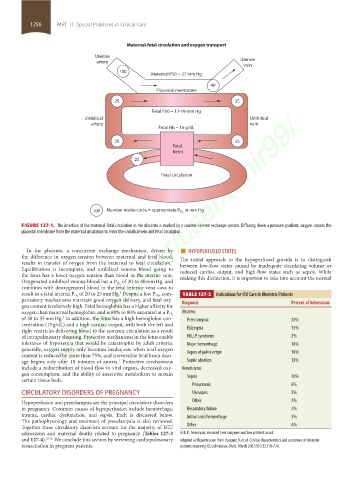
                 FIGURE 127-1.  The interface of the maternal-fetal circulation in the placenta is marked by a counter-current exchange system. Diffusing down a pressure gradient, oxygen crosses the
                 placental membrane from the maternal circulation to enter the umbilical vein and fetal circulation.


                   In  the  placenta,  a  concurrent  exchange  mechanism,  driven  by     ■  HYPOPERFUSED STATES
                 the difference in oxygen tension between maternal and fetal blood,   The initial approach to the hypoperfused gravida is to distinguish
                 results in transfer of oxygen from the maternal to fetal circulation.    between low-flow states caused by inadequate circulating volume or
                                                                    3
                 Equilibration is incomplete, and umbilical venous blood going to   reduced cardiac  output, and  high-flow  states  such as  sepsis.  While
                 the fetus has a lower oxygen tension than blood in the uterine vein.   making this distinction, it is important to take into account the normal
                                                    of 30 to 40 mm Hg, and
                 Oxygenated umbilical venous blood has a P O 2
                 combines with deoxygenated blood in the fetal inferior vena cava to
                                                   3            , com-
                 result in a fetal arterial P O 2  of 20 to 25 mm Hg.  Despite a low P O 2    TABLE 127-3    Indications for ICU Care in Obstetric Patients
                 pensatory mechanisms maintain good oxygen delivery, and fetal oxy-  Diagnosis               Percent of Admissions
                 gen content is relatively high. Fetal hemoglobin has a higher affinity for
                                                                        Obstetric
                 oxygen than maternal hemoglobin, and is 80% to 90% saturated at a P O 2
                 of 30 to 35 mm Hg.  In addition, the fetus has a high hemoglobin con-    Preeclampsia       20%
                               3
                 centration (15 g/dL) and a high cardiac output, with both the left and
                 right ventricles delivering blood to the systemic circulation as a result     Eclampsia     15%
                 of intrapulmonary shunting. Protective mechanisms in the fetus enable     HELLP syndrome    2%
                 tolerance of hypoxemia that would be catastrophic by adult criteria:     Major hemorrhage   16%
                 generally, oxygen supply only becomes inadequate when fetal oxygen     Sepsis of pelvic origin  16%
                 content is reduced by more than 75%, and irreversible fetal brain dam-
                 age begins only after 10 minutes of anoxia.  Protective mechanisms     Septic abortion      12%
                                                  3
                 include a redistribution of blood flow to vital organs, decreased oxy-  Nonobstetric
                 gen consumption, and the ability of anaerobic metabolism to sustain     Sepsis              10%
                 certain tissue beds.
                                                                           Pneumonia                         6%
                 CIRCULATORY DISORDERS OF PREGNANCY                        Urosepsis                         2%

                 Hypoperfusion and preeclampsia are the principal circulatory disorders      Other           2%
                 in pregnancy. Common causes of hypoperfusion include hemorrhage,     Respiratory failure    4%
                 trauma, cardiac  dysfunction,  and  sepsis.  Each is  discussed  below.     Intracranial hemorrhage  3%
                 The pathophysiology and treatment of preeclampsia is also reviewed.
                 Together  these  circulatory  disorders  account  for  the  majority  of  ICU     Other     4%
                 admissions and maternal deaths related to pregnancy (Tables  127-3   HELLP, hemolysis, elevated liver enzymes and low platelet count.
                 and 127-4). 23-25  We conclude this section by reviewing cardiopulmonary   Adapted with permission from Vasquez D, et al. Clinical characteristics and outcomes of obstetric
                 resuscitation in pregnant patients.                   patients requiring ICU admission. Chest. March 2007;131(3):718-724.


            section11.indd   1256                                                                                      1/19/2015   10:52:20 AM

