


Page 1786 - Hall et al (2015) Principles of Critical Care-McGraw-Hill
P. 1786
CHAPTER 127: Critical Illness in Pregnancy  1255


                    increase another 10% to 15% due to increased blood return from uter-  somewhat decreased in normal pregnancy, the drop in bicarbonate is
                    ine contractions, and to pain-mediated sympathetic stimulation. This   not associated with a substantial change in the anion gap.
                    effect on cardiac output may be tempered by blood loss during delivery.   Due to augmented minute ventilation, the maternal arterial partial
                    In healthy women, there is no substantial change in the properties of   pressure of oxygen (Pa O 2 ) is increased throughout pregnancy to greater
                    ventricular contractility over the course of pregnancy. 4-6,8  Cardiac output   than 100 mm Hg. As it does not alter the degree of hemoglobin satura-
                    in pregnancy can be highly dependent on body position; vena caval and   tion, this increase in Pa O 2  does not significantly increase oxygen delivery.
                    aortic obstruction by the gravid uterus is maximal in the supine posi-  An increased alveolar-to-arterial oxygen gradient [(A − a) O 2 ] with mild
                    tion but is much less pronounced in the left lateral decubitus position.    hypoxemia may occur in the supine position.  Whenever possible, arte-
                                                                       2
                                                                                                          16
                    Obstruction of the inferior vena cava results in reduced venous return,   rial blood gas samples should be obtained in the seated position to avoid
                    and obstruction of the abdominal aorta results in increased afterload.   the confounding effect of positional hypoxemia.
                    These effects on cardiac output are most notable in the third trimester.  Lung compliance is unchanged in pregnancy. However, elevation of
                     Blood pressure decreases early in pregnancy, reaching a nadir   the diaphragm from the enlarging uterus leads to decreased chest wall
                    between 16 and 28 weeks, and then gradually increases.  Blood pres-  compliance. This results in a progressive decline in the functional resid-
                                                             9
                    sure returns to prepregnancy levels shortly after delivery. Hypertension   ual capacity (FRC), which reaches a 10% to 25% reduction by term.
                                                                                                                           3,15
                    in pregnancy is defined by systolic pressures >140 mm Hg or diastolic   Expiratory reserve volume and residual volume are de
                                  https://kat.cr/user/tahir99/creased during
                    pressures >90 mm Hg. Systolic pressures ≥160 mm Hg or diastolic pres-  the second half of pregnancy.  Total lung capacity, however, decreases
                                                                                               15
                    sures ≥110 mm Hg define severe hypertension, and require treatment. 10  minimally as respiratory muscle function is unimpaired, and widening
                     The normal adaptation of the circulatory system to pregnancy results   of the thoracic cage increases inspiratory capacity. 12,15  Vital capacity also
                    in a physiologic third heart sound in many patients. The chest radio-  remains unchanged during pregnancy. Diffusing capacity is unchanged
                    graph reveals an enlarged cardiac silhouette due to increased circulating   or slightly increased early in pregnancy and then decreases to normal
                    blood volume and cardiac filling. The pulmonary artery and right ven-  or slightly below normal after the first trimester.  Airway closure may
                                                                                                             17
                    tricular pressures are unchanged, with a hormone-mediated reduction   occur near or above FRC in some women late in pregnancy. 17,18  The
                    in pulmonary vascular resistance compensating for the increased flow   decrease  in  FRC  combined  with  an  increase  in  oxygen  consumption
                    from augmented cardiac output. The pulmonary artery wedge pressure   make the pregnant woman and the fetus more vulnerable to hypoxia
                    (Ppw) also is generally unchanged from prepartum values. 3,11  in the event of hypoventilation or apnea. This is an important consid-
                        ■  ADAPTATION OF THE RESPIRATORY SYSTEM           eration during endotracheal intubation. Despite increases in several
                                                                          hormones known to affect smooth muscle, airway function does not
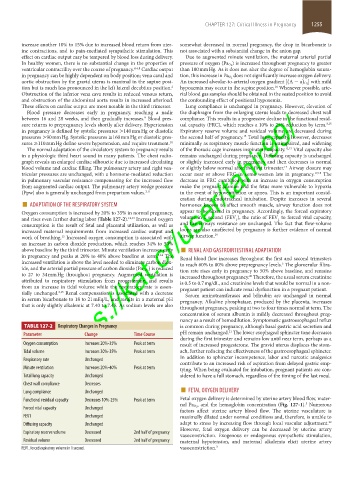
                    Oxygen consumption is increased by 20% to 35% in normal pregnancy,   appear to be altered in pregnancy. Accordingly, the forced expiratory
                    and rises even further during labor (Table 127-2). 12,13  Increased oxygen   volume in 1 second (FEV ), the ratio of FEV  to forced vital capacity,
                                                                                                           1
                                                                                             1
                    consumption is the result of fetal and placental utilization, as well as   and the airways resistance are unchanged. The fact that flow-volume
                    increased maternal requirements from increased cardiac output and   loops are also unaffected by pregnancy is further evidence of normal
                    work of breathing.  Increased oxygen consumption is associated with   airway function. 19
                                 13
                    an increase in carbon dioxide production, which reaches 34% to 50%
                    above baseline by the third trimester. Minute ventilation increases early     ■  RENAL AND GASTROINTESTINAL ADAPTATION
                    in pregnancy and peaks at 20% to 40% above baseline at term.  The   Renal blood flow increases throughout the first and second trimesters
                                                                  3,14
                    increased ventilation is above the level needed to eliminate carbon diox-  to reach 60% to 80% above prepregnancy levels.  The glomerular filtra-
                                                                                                            3
                                                               ) is reduced
                    ide, and the arterial partial pressure of carbon dioxide (Pa CO 2  tion rate rises early in pregnancy to 50% above baseline, and remains
                    to 27 to 34 mm Hg throughout pregnancy. Augmented ventilation is   increased throughout pregnancy.  Therefore, the usual serum creatinine
                                                                                                 20
                    attributed to respiratory stimulation from progesterone, and results   is 0.5 to 0.7 mg/dL, and creatinine levels that would be normal in a non-
                    from an increase in tidal volume while the respiratory rate is essen-  pregnant patient can indicate renal dysfunction in a pregnant patient.
                    tially unchanged.  Renal compensation is associated with a decrease   Serum aminotransferases and bilirubin are unchanged in normal
                                3,15
                    in serum bicarbonate to 18 to 21 mEq/L, and results in a maternal pH   pregnancy. Alkaline phosphatase, produced by the placenta, increases
                    that is only slightly alkalemic at 7.40 to 7.45. As sodium levels are also   throughout pregnancy, peaking at two to four times normal at term. The
                                                                          concentration of serum albumin is mildly decreased throughout preg-
                                                                          nancy as a result of hemodilution. Symptomatic gastroesophageal reflux
                      TABLE 127-2    Respiratory Changes in Pregnancy     is common during pregnancy, although basal gastric acid secretion and
                                                                                          21
                    Parameter            Change           Time Course     pH remain unchanged.  The lower esophageal sphincter tone decreases
                                                                          during the first trimester and remains low until near term, perhaps as a
                    Oxygen consumption   Increases 20%-35%  Peak at term  result of increased progesterone. The gravid uterus displaces the stom-
                    Tidal volume         Increases 30%-35%  Peak at term  ach, further reducing the effectiveness of the gastroesophageal sphincter.
                    Respiratory rate     Unchanged                        In addition to sphincter incompetence, labor and narcotic analgesics
                                                                          contribute to an increased risk of aspiration from delayed gastric emp-
                    Minute ventilation   Increases 20%-40%  Peak at term  tying. When being evaluated for intubation, pregnant patients are con-
                    Total lung capacity  Unchanged                        sidered to have a full stomach, regardless of the timing of the last meal.
                    Chest wall compliance  Decreases                          ■
                    Lung compliance      Unchanged                          FETAL OXYGEN DELIVERY
                    Functional residual capacity  Decreases 10%-25%  Peak at term  Fetal oxygen delivery is determined by uterine artery blood flow, mater-
                                                                                ,  and  the  hemoglobin  concentration  (Fig. 127-1).   Numerous
                                                                                                                    3
                    Forced vital capacity  Unchanged                      nal  Pa O 2
                                                                          factors affect uterine artery blood flow. The uterine vasculature is
                    FEV1                 Unchanged                        maximally dilated under normal conditions and, therefore, is unable to
                                                                                                                            22
                    Diffusing capacity   Unchanged                        adapt to stress by increasing flow through local vascular adjustment.
                                                                          However, fetal oxygen delivery can be decreased by uterine artery
                    Expiratory reserve volume  Decreased  2nd half of pregnancy
                                                                          vasoconstriction. Exogenous or endogenous sympathetic stimulation,
                    Residual volume      Decreased        2nd half of pregnancy  maternal  hypotension, and maternal alkalemia elicit uterine artery
                    FEV1, forced expiratory volume in 1 second.           vasoconstriction. 3


            section11.indd   1255                                                                                      1/19/2015   10:52:18 AM

