


Page 1789 - Hall et al (2015) Principles of Critical Care-McGraw-Hill
P. 1789
1258     PART 11: Special Problems in Critical Care


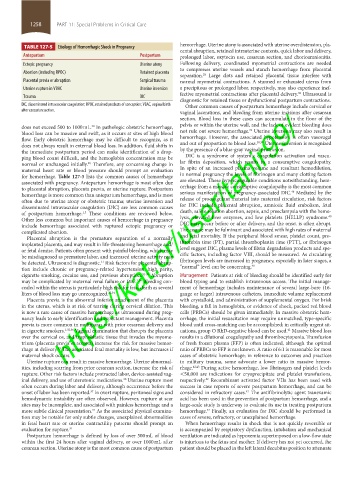
                                                                       hemorrhage. Uterine atony is associated with uterine overdistension, pla-
                   TABLE 127-5    Etiology of Hemorrhagic Shock in Pregnancy
                                                                       cental abruption, retained intrauterine contents, quick labor and delivery,
                  Antepartum                              Postpartum   prolonged labor, oxytocin use, cesarean section, and chorioamnionitis.
                  Ectopic pregnancy                       Uterine atony  Following  delivery,  coordinated  myometrial  contractions  are  needed
                                                                       to compresses uterine vessels and stanch hemorrhage from placental
                  Abortion (including RPOC)               Retained placenta
                                                                       separation.  Large clots and retained placental tissue interfere with
                                                                               28
                  Placental previa or abruption           Surgical trauma  normal myometrial contractions. A stunned or exhausted uterus from
                  Uterine rupture in VBAC                 Uterine inversion  a precipitous or prolonged labor, respectively, may also experience inef-
                                                                                                               38
                  Trauma                                  DIC          fective myometrial contractions after placental delivery.  Ultrasound is
                                                                       diagnostic for retained tissue or dysfunctional postpartum contractions.
                 DIC, disseminated intravascular coagulation; RPOC, retained products of conception; VBAC, vaginal birth   Other common causes of postpartum hemorrhage include cervical or
                                https://kat.cr/user/tahir99/
                 after caesarian section.
                                                                       vaginal lacerations, and bleeding from uterine incisions after cesarean
                                                                       section.  Blood  loss  in  these  cases  can  accumulate  in  the  floor  of  the
                 does not exceed 500 to 1000 mL.  In pathologic obstetric hemorrhage,   pelvis or within the uterine wall, and the lack of evident bleeding does
                                         30
                                                                                               31
                 blood loss can be massive and swift, as it occurs at sites of high blood   not rule out severe hemorrhage.  Uterine inversion may also result in
                 flow. Early obstetric hemorrhage may be difficult to recognize, as it   hemorrhage. However, the associated hypotension is often vasovagal
                                                                                                 38,39
                 does not always result in external blood loss. In addition, fluid shifts in   and out of proportion to blood loss.   Uterine inversion is recognized
                 the immediate postpartum period can make identification of a drop-  by the presence of a blue-gray vaginal protrusion.
                 ping blood count difficult, and the hemoglobin concentration may be   DIC is a syndrome of systemic coagulation activation and vascu-
                 normal or unchanged initially.  Therefore, any concerning change in   lar fibrin deposition, which results in a consumptive coagulopathy.
                                        28
                 maternal  heart  rate or  blood  pressure should prompt  an  evaluation   In spite of an increased plasma volume and resultant hemodilution,
                 for hemorrhage. Table 127-5 lists the common causes of hemorrhage   in normal pregnancy the levels of fibrinogen and many clotting factors
                 associated with pregnancy. Antepartum hemorrhage is most often due   are elevated. These hypercoagulable conditions notwithstanding, hem-
                 to placental abruption, placenta previa, or uterine rupture. Postpartum   orrhage from a massive consumptive coagulopathy is the most common
                                                                                                             40
                 hemorrhage is more common than antepartum hemorrhage, and is most   serious manifestation of pregnancy-associated DIC.  Mediated by the
                 often due to uterine atony or obstetric trauma; uterine inversion and   release of procoagulant material into maternal circulation, risk factors
                 disseminated intravascular coagulation (DIC) are less common causes   for DIC include placental abruption, amniotic fluid embolism, fetal
                 of postpartum hemorrhage.  These conditions are reviewed below.   death, saline solution abortion, sepsis, and preeclampsia with the hemo-
                                      1,3
                                                                                                                          40
                 Other less common but important causes of hemorrhage in pregnancy    lysis, elevated liver enzymes, and low platelets (HELLP) syndrome.
                 include  hemorrhage associated with ruptured  ectopic  pregnancy or   DIC may occur before or after delivery, and the onset is often abrupt.
                 complicated abortion.                                 The course may be fulminant and associated with high rates of maternal
                   Placental abruption is the premature separation of a normally   and fetal mortality. If the peripheral blood smear, platelet count, pro-
                 implanted placenta, and may result in life-threatening hemorrhage and/  thrombin time (PT), partial thromboplastin time (PTT), or fibrinogen
                 or fetal demise. Patients often present with painful bleeding, which may   level suggest DIC, plasma levels of fibrin degradation products and spe-
                 be misdiagnosed as premature labor, and increased uterine activity may   cific factors, including factor VIII, should be measured. As circulating
                 be detected. Ultrasound is diagnostic.  Risk factors for placental abrup-  fibrinogen levels are increased in pregnancy, especially in later stages, a
                                            31
                                                                                                40
                 tion include chronic or pregnancy-related hypertension, high parity,   “normal” level can be concerning.
                 cigarette smoking, cocaine use, and previous abruption. 32-35  Abruption   Management:  Patients at risk of bleeding should be identified early for
                 may be complicated by maternal renal failure or DIC.  Bleeding con-  blood typing and to establish intravenous access. The initial manage-
                                                        3,34
                 cealed within the uterus is particularly high risk for fetal death as several   ment of hemorrhage includes maintenance of several large-bore (16-
                 liters of blood loss may go unrecognized. 31,34       gauge or larger) intravenous catheters, immediate volume replacement
                   Placenta previa is the abnormal inferior attachment of the placenta   with crystalloid, and administration of supplemental oxygen. For brisk
                 in the uterus, which is at risk of tearing during cervical dilation. This   bleeding, a fall in hemoglobin, or evidence of shock, packed red blood
                 is now a rare cause of massive hemorrhage as ultrasound during preg-  cells (PRBCs) should be given immediately. In massive obstetric hem-
                 nancy leads to early identification and expectant management. Placenta   orrhage, the initial resuscitation may require unmatched, type-specific
                 previa is more common in multiparas with prior cesarean delivery and   blood until cross-matching can be accomplished; in critically urgent sit-
                 in cigarette smokers. 1,32,36  Vaginal examination that disrupts the placenta   uations, group O RhD-negative blood can be used.  Massive blood loss
                                                                                                            41
                 over the cervical os, and trophoblastic tissue that invades the myome-  results in a dilutional coagulopathy and thrombocytopenia. Transfusion
                 trium (placenta previa et accreta) increase the risk for massive hemor-  of fresh frozen plasma (FFP) is often indicated, although the optimal
                 rhage at delivery.  The associated fetal mortality is low, but increases if   ratio of PRBCs to FFP is not known. A ratio of 6:1 is reasonable for most
                              33
                 maternal shock occurs.                                cases of obstetric hemorrhage; in reference to outcomes and practices
                   Uterine rupture can result in massive hemorrhage. Uterine abnormal-  in military trauma, some advocate a lower ratio in massive hemor-
                 ities, including scarring from prior cesarean section, increase the risk of   rhage. 42,43  During active hemorrhage, low fibrinogen and platelet levels
                 rupture. Other risk factors include protracted labor, device-assisted vag-  <50,000 are indications for cryoprecipitate and platelet transfusions,
                 inal delivery, and use of uterotonic medications.  Uterine rupture most   respectively.  Recombinant activated factor VIIa has been used with
                                                                                42
                                                    36
                 often occurs during labor and delivery, although occurrence before the   success in case reports of severe postpartum hemorrhage, and can be
                 onset of labor has been reported.  In overt rupture, peritoneal signs and   considered in refractory cases.  The antifibrinolytic agent tranexamic
                                         37
                                                                                              42
                 hemodynamic instability are often observed. However, rupture at scar   acid has been used in the prevention of postpartum hemorrhage, and a
                 sites may be incomplete, and associated with painless hemorrhage and a   large-scale study is underway to evaluate its use in treating postpartum
                 more subtle clinical presentation.  As the associated physical examina-  hemorrhage.  Finally, an evaluation for DIC should be performed in
                                                                                42
                                         31
                 tion may be notable for only subtle changes, unexplained abnormalities   cases of severe, refractory, or unexplained hemorrhage.
                 in fetal heart rate or uterine contractility patterns should prompt an   When hemorrhage results in shock that is not quickly reversible or
                 evaluation for rupture. 31                            is accompanied by respiratory dysfunction, intubation and mechanical
                   Postpartum hemorrhage is defined by loss of over 500 mL of blood   ventilation are indicated as hypoxemia superimposed on a low-flow state
                 within the first 24 hours after vaginal delivery, or over 1000 mL after   is injurious to the fetus and mother. If delivery has not yet occurred, the
                 cesarean section. Uterine atony is the most common cause of postpartum   patient should be placed in the left lateral decubitus position to attenuate


            section11.indd   1258                                                                                      1/19/2015   10:52:21 AM

