


Page 1788 - Hall et al (2015) Principles of Critical Care-McGraw-Hill
P. 1788
CHAPTER 127: Critical Illness in Pregnancy  1257


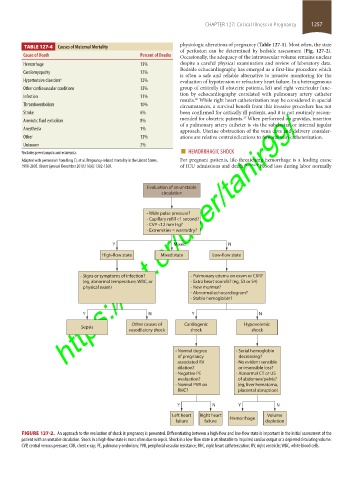
                                                                          physiologic alterations of pregnancy (Table 127-1). Most often, the state
                      TABLE 127-4    Causes of Maternal Mortality
                                                                          of perfusion can be determined by bedside assessment (Fig. 127-2).
                    Cause of Death                          Percent of Deaths  Occasionally, the adequacy of the intravascular volume remains unclear
                    Hemorrhage                              13%           despite a careful physical examination and review of laboratory data.
                                                                          Bedside echocardiography has emerged as a first-line procedure which
                    Cardiomyopathy                          12%
                                                                          is often a safe and reliable alternative to invasive monitoring for the
                    Hypertensive disorders a                12%           evaluation of hypotension or refractory heart failure. In a heterogeneous
                    Other cardiovascular conditions         12%           group of critically ill obstetric patients, left and right ventricular func-
                                                                          tion by echocardiography correlated with pulmonary artery catheter
                    Infection                               11%
                                                                          results.  While right heart catheterization may be considered in special
                                                                               26
                    Thromboembolism                         10%           circumstances, a survival benefit from this invasive procedure has not
                                  https://kat.cr/user/tahir99/
                    Stroke                                  6%            been confirmed for critically ill patients, and it is not routinely recom-
                                                                          mended for obstetric patients.  When performed on gravidas, insertion
                                                                                               27
                    Amniotic fluid embolism                 8%
                                                                          of a pulmonary artery catheter is via the subclavian or internal jugular
                    Anesthesia                              1%            approach. Uterine obstruction of the vena cava and delivery consider-
                    Other                                   13%           ations are relative contraindications to femoral vein catheterization.
                    Unknown                                 2%
                    a Includes preeclampsia and eclampsia.                    ■  HEMORRHAGIC SHOCK
                    Adapted with permission from Berg CJ, et al. Pregnancy-related mortality in the United States,    For pregnant patients, life-threatening hemorrhage is a leading cause
                    1998-2005. Obstet Gynecol. December 2010;116(6):1302-1309.  of ICU admissions and death. 23,24,28,29  Blood loss during labor normally


                                                              Evaluation of an unstable
                                                                   circulation


                                                              - Wide pulse pressure?
                                                              - Capillary refill <1 second?
                                                              - CVP <12 mm Hg?
                                                              - Extremities = warm/dry?

                                                   Y                   Mixed              N
                                               High-flow state     Mixed state       Low-flow state


                                        - Signs or symptoms of infection?    - Pulmonary edema on exam or CXR?
                                        (eg, abnormal temperature, WBC, or   - Extra heart sounds? (eg, S3 or S4)
                                        physical exam)                       - New murmur?
                                                                             - Abnormal echocardiogram?
                                                                             - Stable hemoglobin?

                                        Y                      N              Y                     N
                                                         Other causes of   Cardiogenic         Hypovolemic
                                        Sepsis
                                                        vasodilatory shock   shock                shock


                                                                        - Normal degree      - Serial hemoglobin
                                                                         of pregnancy         decreasing?
                                                                         associated RV       - No evident sensible
                                                                         dilation?             or insensible loss?
                                                                        - Negative PE        - Abnormal CT or US
                                                                         evaluation?           of abdomen/pelvis?
                                                                        - Normal PVR on        (eg, liver hematoma,
                                                                         RHC?                  placental abruption)

                                                                         Y           N       Y            N
                                                                       Left heart  Right heart  Hemorrhage  Volume
                                                                        failure   failure              depletion
                    FIGURE 127-2.  An approach to the evaluation of shock in pregnancy is presented. Differentiating between a high-flow and low-flow state is important in the initial assessment of the
                    patient with an unstable circulation. Shock in a high-flow state is most often due to sepsis. Shock in a low-flow state is attributable to impaired cardiac output or a depleted circulating volume.
                    CVP, central venous pressure; CXR, chest x-ray; PE, pulmonary embolism; PVR, peripheral vascular resistance; RHC, right heart catheterization; RV, right ventricle; WBC, white blood cells.


            section11.indd   1257                                                                                      1/19/2015   10:52:20 AM

