


Page 1795 - Hall et al (2015) Principles of Critical Care-McGraw-Hill
P. 1795
1264     PART 11: Special Problems in Critical Care


                 evacuation, and fetal survival is well-documented if delivery is arranged   asthma deterioration is most likely to occur, with improvement often
                 early in the course of resuscitation. 110,115  Therefore, when available,   seen during the last month of pregnancy. Adverse maternal outcomes
                 obstetric services should be contacted immediately in an arrest.  associated with asthma during pregnancy include pregnancy-induced
                                                                       hypertension, preeclampsia, and cesarean delivery.  Adverse fetal out-
                                                                                                            119
                                                                       comes include preterm birth and small for gestational age. 119
                 RESPIRATORY DISORDERS OF PREGNANCY
                                                                       Management:  The management of the pregnant patient with status
                 Despite the increased ventilatory demands of pregnancy, frank ventila-  asthmaticus is similar to that of the nonpregnant patient, with a few
                 tory failure is uncommon. When it occurs, respiratory insufficiency is   3            is decreased in pregnancy,
                 the result of severe underlying lung disease that impairs tolerance of   notable exceptions.  As the baseline Pa CO 2
                                                                       and usually falls further in the early stages of an acute asthma attack,
                 the additional load of pregnancy, exacerbations in a preexisting condi-   >35 mm Hg during status asthmaticus should alert the clini-
                 tion, or de novo pulmonary events. For patients with little pulmonary   a Pa CO 2
                                                                       cian  to  impending  ventilatory  failure.  Maternal  oxygenation  status
                 reserve, close monitoring is important as respiratory failure may develop   should be assessed even in mild attacks. Even mild hypoxemia should
                 precipitously, especially in later pregnancy. In patients with chronic   be treated aggressively in the gravid patient as it is detrimental to the
                 lung disease, a baseline vital capacity of at least 1 L has been considered   fetus.  Inhaled bronchodilators are a mainstay of treatment of any
                                                                           120
                 essential for a safe pregnancy, although patients with a vital capacity less   asthma attack; parenteral β-agonists are not commonly used. Systemic
                 than this have had successful pregnancies. 116,117    corticosteroids  are  indicated  for  significant  exacerbations.   The
                                                                                                                     121
                   Asthma remains the most common pulmonary problem encountered   chronic use of oral corticosteroids has been associated with a twofold
                 in pregnancy, affecting 1% to 4% of all gravidas, although frank ventila-  increase in the incidence of preeclampsia, and rarely with fetal adrenal
                 tory failure from asthma in pregnancy is uncommon. While less com-  insufficiency. In addition, corticosteroid use early in pregnancy con-
                 mon than asthma, other chronic lung diseases often carry a higher risk   fers an increased risk of cleft palate, although the absolute incidence
                 of respiratory failure. De novo pulmonary events that cause respiratory   remains low. Generally, and often significantly, the maternal and
                 insufficiency in pregnancy include pneumonia, aspiration, tocolysis-  fetal risks associated with poorly controlled asthma or with asthma-
                 induced pulmonary edema, amniotic fluid embolism, venous air embo-  related respiratory failure outweigh the risks of corticosteroid use
                 lism, or ARDS.  The following sections review these chronic and de   in pregnancy. Heliox, a low-density mixture of helium and oxygen,
                            118
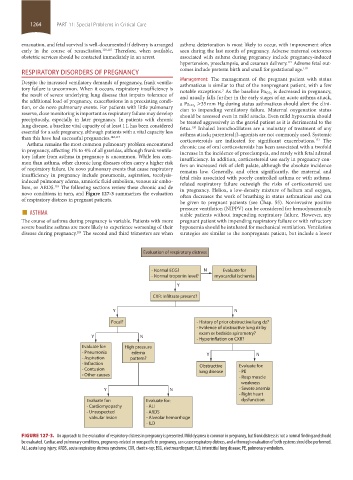
                 novo conditions in turn, and Figure 127-3 summarizes the evaluation   often decreases the work of breathing in status asthmaticus and can
                 of respiratory distress in pregnant patients.         be  given to pregnant  patients (see Chap.  55). Noninvasive positive
                     ■  ASTHMA                                         pressure ventilation (NIPPV) can be considered for hemodynamically
                                                                       stable patients without impending respiratory failure. However, any
                 The course of asthma during pregnancy is variable. Patients with more   pregnant patient with impending respiratory failure or with refractory
                 severe baseline asthma are more likely to experience worsening of their   hypoxemia should be intubated for mechanical ventilation. Ventilation
                 disease during pregnancy.  The second and third trimesters are when   strategies are similar to the nonpregnant patient, but include a lower
                                    119


                                                           Evaluation of respiratory distress


                                                             - Normal ECG?     N      Evaluate for
                                                             - Normal troponin level?  myocardial ischemia
                                                                      Y
                                                              CXR: infiltrate present?

                                                Y                                         N
                                                Focal?                       - History of prior obstructive lung dz?
                                                                             - Evidence of obstructive lung dz by
                                                                                exam or bedside spirometry?
                                         Y                N
                                                                             - Hyperinflation on CXR?
                                      Evaluate for:  High pressure
                                      - Pneumonia      edema                    Y                N
                                      - Aspiration    pattern?
                                      - Infarction                            Obstructive  Evaluate for:
                                      - Contusion                             lung disease  - PE
                                      - Other causes
                                                                                           - Resp muscle
                                                                                            weakness
                                             Y                      N                      - Severe anemia
                                                                                           - Right heart
                                       Evaluate for:        Evaluate for:                   dysfunction
                                       - Cardiomyopathy     - ALI
                                       - Unsuspected        - ARDS
                                        valvular lesion     - Alveolar hemorrhage
                                                            - ILD

                 FIGURE 127-3.  An approach to the evaluation of respiratory distress in pregnancy is presented. Mild dyspnea is common in pregnancy, but frank distress is not a normal finding and should
                 be evaluated. Cardiac and pulmonary conditions, pregnancy-related or nonspecific to pregnancy, can cause respiratory distress, and a thorough evaluation of both systems should be performed.
                 ALI, acute lung injury; ARDS, acute respiratory distress syndrome; CXR, chest x-ray; ECG, electrocardiogram; ILD, interstitial lung disease; PE, pulmonary embolism.


            section11.indd   1264                                                                                      1/19/2015   10:52:23 AM

