


Page 1798 - Hall et al (2015) Principles of Critical Care-McGraw-Hill
P. 1798
CHAPTER 127: Critical Illness in Pregnancy  1267


                    sex, criminal abortions using air, and insufflation of the vagina during   blockade may assist in cardiopulmonary stabilization by decreasing
                    gynecologic procedures.  Air is thought to enter subplacental venous   oxygen consumption and avoiding the intrathoracic pressure effects of
                                     140
                    sinuses, embolize through the venous circulation, and obstruct pul-  active ventilatory effort. Inhaled nitric oxide has not been well studied
                    monary blood flow. Signs and symptoms include a continuous cough,   in pregnant patients.  Prone positioning  also  has not been studied,
                    dyspnea, lightheadedness, diaphoresis, tachypnea, cyanosis, tachycardia,   although the gravid state makes this maneuver difficult. 128,153  Delivery
                    and hypotension. A mill wheel murmur or bubbling sound is occasion-  for severe ARDS cannot be universally recommended; decisions are
                    ally heard over the precordium. With a significantly sized embolism,   made for individual cases, weighing the theoretical improvements in
                    hypotension  is  often  followed  by respiratory  arrest.  Arrhythmias  and   ventilation against the physiologic costs of delivery. 152
                    evidence of right heart strain and ischemia have been noted on ECG.
                    If readily available, evaluation of the right and left sternal borders by     ■  CONSIDERATIONS OF MECHANICAL VENTILATION IN PREGNANCY
                    Doppler ultrasound is the most sensitive noninvasive diagnostic test.    The indications for intubation and mechanical ventilation are not sig-
                                                                      151
                    Patients who survive an initial cardiopulmonary collapse may develop                                    of
                    noncardiogenic pulmonary edema.                       nificantly changed by pregnancy, although the adjusted normal Pa CO 2
                                                                          27 to 34 mm Hg of pregnancy should be considered when interpreting
                                                                                                        1
                    Management:  When venous air embolism is suspected, the patient   blood gases and the need for intubation.  In the setting of progressive
                    should immediately be placed in the left lateral decubitus position   respiratory distress, a decision regarding intubation is best made in col-
                    to direct the embolus away from the right ventricular outflow tract.   laboration with the critical care physician, obstetrician, and neonatolo-
                    Trendelenburg positioning has also been advocated, although it has   gist. NIPPV for acute respiratory failure has not been well studied in
                    not been demonstrated to improve outcomes. To facilitate resorption   pregnancy. In the stable patient able to protect their airway, NIPPV may
                    of nitrogen, 100% oxygen should be provided. If available, and if the   be reasonable for certain conditions, such as mild hypoxemia associated
                    clinical status permits, hyperbaric oxygen will also aid in resorption.   with  readily  reversible  pulmonary  edema.  Theoretical  limitations  to
                    Aspiration of air from the right atrium is not often successful, but can   NIPPV include pregnancy-related upper airway edema and an increased
                    be attempted as a salvage intervention. Acute right heart failure con-  risk of aspiration, although a definitive aspiration risk associated with
                                                                                                                 157
                    tributes to clinical deterioration, and inotropic support with dobuta-  NIPPV use in pregnancy has not been established.  If respiratory
                    mine may be helpful. If cardiac arrest occurs, chest compressions may   failure is imminent, intubation and mechanical ventilation should be
                    therapeutically disperse larger emboli.               performed electively. The institution of mechanical ventilation early in
                        ■  ARDS                                           and fetus, and permits identification and treatment of reversible fac-
                                                                          the  course  of  respiratory  failure  facilitates  stabilization  of  the  mother
                    ARDS is defined by the acute onset of diffuse, noncardiogenic pulmo-  tors in a controlled setting. When delivery is indicated in the setting of
                                                                          respiratory failure, mechanical ventilation can support successful surgi-
                                                        <200. The pathophys-
                    nary edema which results in a ratio of Pa O 2  to Fi O 2  cal delivery. If maternal death occurs, fetal viability can be maintained
                    iology and management of ARDS is reviewed extensively elsewhere (see   throughout pregnancy with mechanical ventilation.
                    Chap. 52). However, several considerations for ARDS during pregnancy   Tracheal intubation can be a high-risk procedure in pregnant patients.
                    are emphasized here. ARDS in pregnancy is associated with maternal   Intubation failure occurs more frequently than in nonpregnant patients,
                    and fetal mortality, perinatal asphyxia, and premature delivery. As with   and is associated with morbidity and mortality.  Several difficulties in
                                                                                                            158
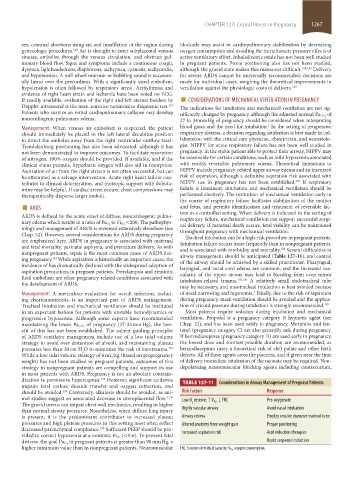
                    nonpregnant patients, sepsis is the most common cause of ARDS dur-  airway management should be anticipated (Table 127-11), and control
                    ing pregnancy.  While aspiration is historically an important cause, the   of the airway should be achieved by a skilled practitioner. Pharyngeal,
                              152
                    incidence of has dramatically declined with the widespread adoption of   laryngeal, and vocal cord edema are common, and the increased vas-
                    aspiration precautions in pregnant patients. Preeclampsia and amniotic   cularity of the upper airway may lead to bleeding from even minor
                    fluid embolism are other pregnancy-related conditions associated with   intubation-related trauma. 128,130  A relatively small endotracheal tube
                    the development of ARDS.
                                                                          may be necessary, and nasotracheal intubation is best avoided because
                    Management:  A meticulous evaluation for occult infection, includ-  of nasal narrowing and hyperemia.  Finally, due to the risk of aspiration
                                                                                                   3
                    ing chorioamnionitis, is an important part of ARDS management.   during pregnancy, mask ventilation should be avoided and the applica-
                    Tracheal intubation and mechanical ventilation should be instituted   tion of cricoid pressure during intubation is strongly recommended. 159
                    in an expectant fashion for patients with unstable hemodynamics or   Most patients require sedation during intubation and mechanical
                    progressive hypoxemia. Although some experts have recommended   ventilation. Propofol is a pregnancy category B hypnotic agent (see
                                          of pregnancy (27-34 mm Hg), the ben-  Chap. 22), and has been used safely in pregnancy. Morphine and fen-
                    maintaining the lower Pa CO 2
                    efit of this has not been established. The salient guiding principles   tanyl (pregnancy category C) are also generally safe during pregnancy.
                    of ARDS ventilator management include use of a low tidal volume   If benzodiazepines (pregnancy category D) are used early in pregnancy,
                    strategy to avoid over distention of alveoli, and maintaining plateau   the lowest dose and shortest possible duration are recommended, as
                    pressures less than 30 cm H O to minimize the risk of barotrauma.    benzodiazepines carry a theoretical risk of cleft palate and other birth
                                                                      153
                                        2
                    While a low tidal volume strategy of 6 mL/kg (based on prepregnancy   defects. All of these agents cross the placenta, and if given near the time
                    weight) has not been studied in pregnant patients, outcomes of this   of delivery immediate intubation of the neonate may be required. Non-
                    strategy in nonpregnant patients are compelling and support its use   depolarizing neuromuscular blocking agents including cisatracurium,
                    in most patients with ARDS. Pregnancy is not an absolute contrain-
                    dication to permissive hypercapnea.  However, significant acidemia
                                               154
                    impairs fetal carbon dioxide transfer and oxygen extraction, and     TABLE 127-11    Considerations in Airway Management of Pregnant Patients
                    should be avoided.  Conversely, alkalosis should be avoided, as ani-  Risk Factors  Response
                                  155
                    mal studies suggest an associated decrease in uteroplacental flow. 3,156    , ↓ FRC   Pre-oxygenate
                                                                              2
                    The gravid uterus can impair chest wall mechanics, resulting in higher   Low O  reserve: ↑ V O 2
                    than normal airway pressures. Nonetheless, when diffuse lung injury   Highly vascular airway  Avoid nasal intubation
                    is present, it is the predominant contributor to increased plateau   Airway edema  Employ smaller diameter tracheal tube
                    pressures and high plateau pressures in this setting most often reflect   Altered anatomy from weight gain  Proper positioning
                    decreased parenchymal compliance.  Sufficient PEEP should be pro-
                                              153
                                                      (<0.6). To prevent fetal   Increased aspiration risk  Acid reduction therapies
                    vided to correct hypoxemia at a nontoxic Fi O 2
                                    in pregnant patients is greater than 90 mm Hg, a                   Rapid sequence induction
                    distress, the goal Pa O 2
                    higher minimum value than in nonpregnant patients. Neuromuscular   FRC, functional residual capacity; VO 2 , oxygen consumption.


            section11.indd   1267                                                                                      1/19/2015   10:52:24 AM

