


Page 1793 - Hall et al (2015) Principles of Critical Care-McGraw-Hill
P. 1793
1262     PART 11: Special Problems in Critical Care


                 maternal and fetal morbidity and mortality. 89,90  Risk factors include a pri-  with periportal or focal parenchymal necrosis. The associated micro-
                 migravid state, multiple gestations, the presence of hydatidiform mole,   angiopathic hemolytic anemia and consumptive coagulopathy may lead
                 preeclampsia in a prior pregnancy, a family history of preeclampsia,   to DIC.
                 chronic hypertension, chronic renal disease, diabetes mellitus, obesity,   The diagnosis of preeclampsia may be difficult as hypertension may
                 age ≥40 years, autoimmune disease, and the presence of antiphospho-  be mild and proteinuria minimal or absent. 89,90  As edema is common in
                 lipid antibodies. 91,92  Preeclampsia may progress to a convulsive and   normal pregnancy, this nonspecific finding is no longer necessary for
                 potentially lethal phase, termed  eclampsia, without warning or overt   diagnosis. Diagnostic criteria vary but include new onset hypertension
                 preeclampsia.  Eclampsia may occur up to one month postpartum.    with a systolic blood pressure  ≥140 mm Hg or diastolic blood pres-
                           93
                                                                    94
                 An especially fulminant complication of preeclampsia is the HELLP syn-  sure ≥90 mm Hg on two or more occasions, and ≥300 mg protein in
                 drome, which occurs in 10% to 20% of cases of severe preeclampsia. 90,95    a 24-hour urine collection. Although the classic triad of hypertension,
                 Maternal and fetal morbidity and mortality are higher if eclampsia or   generalized edema, and proteinuria occurring after 20 weeks of gesta-
                                https://kat.cr/user/tahir99/
                 the HELLP syndrome develops, or if preeclampsia develops prior to 34   tion should suggest the diagnosis, the presentation of preeclampsia is
                 weeks of gestation.                                   often subtle and the onset may be postpartum. Nonspecific signs and
                   The etiology of preeclampsia remains unclear, but a genetic predis-  symptoms include malaise, headache, visual changes, nausea, vomiting,
                 position and host factors seem to favor its development. It is thought   and epigastric or right upper quadrant pain. There has been consider-
                 that abnormal development of blood vessels supplying the placenta   able interest in the development of a reliable biomarker.  Elevated
                                                                                                                  100
                 cause placental ischemia and oxidative stress, followed by the altered   levels of antiangiogenic factors such as fms-like tyrosine kinase 1 and
                 production of angiogenic factors which enter the maternal circulation   endoglin, and decreased levels of the proangiogenic protein placental
                 and disrupt endothelial function. 90,96  This results in increased vascular   growth factor have been useful in suggesting the diagnosis in research
                 permeability, increased sensitivity to endogenous and exogenous vaso-  settings but are not yet recommended for general use. 101,102  Hemolysis
                 pressors, and activation of the coagulation cascade. A study of hemody-  on a peripheral blood smear, increased serum bilirubin, increased
                 namics in preeclampsia found that the majority of patients had a normal   serum transaminases, and thrombocytopenia suggest the diagnosis of
                 Ppw, a normal to high cardiac index, and a higher SVR compared to   the HELLP syndrome. The differential diagnosis for HELLP syndrome
                 historical pregnant controls. 97                      includes acute fatty liver of pregnancy.
                   Preeclampsia variably involves the central nervous system, kidneys,   Manifestations of severe preeclampsia include seizures, cerebral hem-
                 liver, heart, systemic vasculature, and clotting cascade, with a myriad   orrhage or edema, cerebral vascular accidents, renal dysfunction, pulmo-
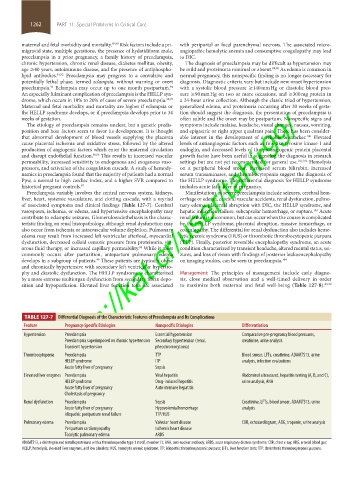
                 of associated symptoms and clinical findings (Table 127-7). Cerebral   nary edema, placental abruption with DIC, the HELLP syndrome, and
                 vasospasm, ischemia, or edema, and hypertensive encephalopathy may   hepatic infarction, failure, subcapsular hemorrhage, or rupture.  Acute
                                                                                                                     103
                 contribute to eclamptic seizures. Glomeruloendotheliosis is the charac-  renal failure is uncommon, but can occur when the course is complicated
                 teristic finding on renal histopathology, although renal dysfunction may   by the HELLP syndrome, placental abruption, massive hemorrhage, or
                 also occur from ischemia or intravascular volume depletion. Pulmonary   coagulopathy. The differential for renal dysfunction also includes hemo-
                 edema may result from increased left ventricular afterload, myocardial   lytic uremic syndrome (HUS) or thrombotic thrombocytopenic purpura
                 dysfunction, decreased colloid osmotic pressure from proteinuria, vig-  (TTP). Finally, posterior reversible encephalopathy syndrome, an acute
                 orous fluid therapy, or increased capillary permeability.  While it most   condition characterized by transient headache, altered mental status, sei-
                                                         98
                 commonly occurs after parturition, antepartum pulmonary edema   zures, and loss of vision with findings of posterior leukoencephalopathy
                 develops in a subgroup of patients.  These patients are typically obese   on imaging studies, can be seen in preeclampsia. 104
                                           99
                 and chronically hypertensive with secondary left ventricular hypertro-
                 phy and diastolic dysfunction. The HELLP syndrome is characterized   Management:  The principles of management include early diagno-
                 by a more extreme multiorgan dysfunction from secondary fibrin depo-  sis, close medical observation and a well-timed delivery in order
                 sition and hypoperfusion. Elevated liver function tests are associated   to maximize both maternal and fetal well-being (Table 127-8). 89,90


                   TABLE 127-7    Differential Diagnosis of the Characteristic Features of Preeclampsia and Its Complications
                  Feature       Pregnancy-Specific Etiologies  Nonspecific Etiologies       Differentiation
                  Hypertension  Preeclampsia                   Essential hypertension       Comparative pre-pregnancy blood pressures,
                                Preeclampsia superimposed on chronic hypertension  Secondary hypertension (renal,     creatinine, urine analysis
                                Transient hypertension           pheochromocytoma)
                  Thrombocytopenia  Preeclampsia               TTP                          Blood smear, LFTs, creatinine, ADAMTS13, urine
                                HELLP syndrome                 ITP                          analysis, infection evaluations
                                Acute fatty liver of pregnancy  Sepsis
                  Elevated liver enzymes Preeclampsia          Viral hepatitis              Abdominal ultrasound, hepatitis testing (A, B, and C),
                                HELLP syndrome                 Drug-induced hepatitis       urine analysis, ANA
                                Acute fatty liver of pregnancy  Auto-immune hepatitis
                                Cholestasis of pregnancy
                  Renal dysfunction  Preeclampsia              Sepsis                       Creatinine, LFTs, blood smear, ADAMTS13, urine
                                Acute fatty liver of pregnancy  Hypovolemia/hemorrhage      analysis
                                Idiopathic postpartum renal failure  TTP/HUS
                  Pulmonary edema  Preeclampsia                Valvular heart disease       CXR, echocardiogram, ABG, troponin, urine analysis
                                Peripartum cardiomyopathy      Ischemic heart disease
                                Tocolytic pulmonary edema      ARDS
                 ADAMTS13, a disintegrin and metalloproteinase with a thrombospondin type 1 motif, member 13; ANA, anti-nuclear antibody; ARDS, acute respiratory distress syndrome; CXR, chest x-ray; ABG, arterial blood gas;
                 HELLP, hemolysis, elevated liver enzymes, and low platelets; HUS, hemolytic uremic syndrome; ITP, idiopathic thrombocytopenic purpura; LFTs, liver function tests; TTP, thrombotic thrombocytopenic purpura.


            section11.indd   1262                                                                                      1/19/2015   10:52:22 AM

