


Page 1791 - Hall et al (2015) Principles of Critical Care-McGraw-Hill
P. 1791
1260     PART 11: Special Problems in Critical Care


                 so that increased blood flow results in pulmonary pressures that can   use of low dose aspirin has been safe in pregnancy. However, doses over
                 be even higher than baseline. Combined with increased myocardial   150 mg/d are cautionable, and clear recommendations for aspirin dosing
                 demand from augmented cardiac output, and increased preload from   in acute ischemia are lacking. Limited data on clopidogrel and glycopro-
                 an expanded circulating volume, higher pulmonary pressures can result   tein IIb/IIIa inhibitors in pregnancy often preclude their use in pregnant
                 in florid right heart failure. Labor and delivery are marked by a further   patients. While nitrates and most β-blockers are considered reasonably
                 increase in myocardial oxygen consumption, in addition to large fluid   safe in pregnancy, statin medications are contraindicated. 67,68
                 shifts from blood loss and the “auto-transfusions” of uterine contrac-  Labor  and delivery are high risk for  women with  cardiovascular
                 tions. Accordingly, the immediate postpartum period is a particularly   disease. The optimal delivery method in most cases is assisted vaginal
                 high-risk time for decompensation. 58                 delivery in the left lateral decubitus position.  Epidural anesthesia miti-
                                                                                                       60
                   De novo cardiac conditions of pregnancy include peripartum car-  gates the tachycardic response to pain.  Indications for cesarean section
                                                                                                   2
                 diomyopathy, myocardial ischemia, coronary or aortic dissection, and   include obstetric complications, fetal distress, or inability to tolerate
                                https://kat.cr/user/tahir99/
                 endocarditis. Peripartum cardiomyopathy develops in up to 1 in 1300   labor and delivery.  In addition, general anesthesia and surgical deliv-
                                                                                     2
                 deliveries. Postulated risk factors include African American ancestry,   ery may be preferred for patients with hypertrophic cardiomyopathy,
                 advanced  maternal  age,  multiple  gestations,  preeclampsia,  and  gesta-  aortic stenosis, or pulmonary hypertension, conditions which place
                 tional hypertension.  While peripartum cardiomyopathy can occur in   the patient at particular risk of decompensation during the increased
                                59
                 the last month of pregnancy and up to 5 months after deliver, the imme-  cardiac demand and large fluid shifts of labor and delivery.  If possible,
                                                                                                                  2
                 diate postpartum period is the most common time for presentation. 60,61    labor and delivery should be avoided for at least two weeks following
                 The presentation can be fulminant, with some patients requiring cardiac   an acute myocardial infarction; aggressive antiplatelet therapy can be a
                 transplantation, although most often the clinical course is marked by the   contraindication for vaginal delivery.
                 gradual recovery of ventricular function. An implantable defibrillator     ■
                 may be indicated during the recovery period.  Myocardial infarction is   SEPTIC SHOCK
                                                  62
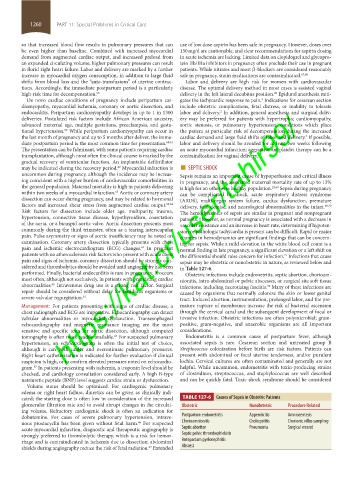
                 uncommon during pregnancy, although the incidence may be increas-  Sepsis remains an important cause of hypoperfusion and critical illness
                 ing coincident with a higher burden of cardiovascular comorbidities in   in pregnancy, and the associated maternal mortality rate of up to 13%
                 the general population. Maternal mortality is high in patients delivering   is high for an otherwise healthy population. 23,69  Sepsis during pregnancy
                 within two weeks of a myocardial infarction.  Aortic or coronary artery   can be complicated by shock, acute respiratory distress syndrome
                                                 63
                 dissection can occur during pregnancy, and may be related to hormonal   (ARDS),  multi-organ  system  failure,  cardiac  dysfunction,  premature
                 factors and increased shear stress from augmented cardiac output. 63,64    delivery, fetal demise, and neurological abnormalities in the infant. 69,70
                 Risk factors for dissection include older age, multiparity, trauma,   The hemodynamics of sepsis are similar in pregnant and nonpregnant
                 hypertension, connective tissue disease, hypothyroidism, coarctation   patients. However, as normal pregnancy is associated with a decrease in
                 of the aorta, or a bicuspid aortic valve. Aortic dissection presents most   vascular resistance and an increase in heart rate, determining if hypoten-
                 commonly during the third trimester, often as a tearing interscapular   sion or pathologic tachycardia is present can be difficult. Rapid or major
                 pain. Pulse asymmetry or signs of aortic insufficiency may be noted on   changes in hemodynamics are significant findings that can be concern-
                 examination. Coronary artery dissection typically presents with chest   ing for sepsis. While a mild elevation in the white blood cell count is a
                 pain and ischemic electrocardiogram (ECG) changes.  In pregnant   normal finding in late pregnancy, a significant elevation or a left shift on
                                                          64
                 patients with no atherosclerosis risk factors who present with acute chest   the differential should raise concern for infection.  Infections that cause
                                                                                                           71
                 pain and signs of ischemia, coronary dissection should be strongly con-  sepsis may be obstetric or nonobstetric in nature, as reviewed below and
                 sidered and thrombolytics should be avoided until angiography has been   in Table 127-6.
                 performed. Finally, bacterial endocarditis is rare in pregnancy. It occurs   Obstetric infections include endometritis, septic abortion, chorioam-
                 most often, although not exclusively, in patients with preexisting cardiac   nionitis, intra-abdominal or pelvic abscesses, or surgical site soft tissue
                 abnormalities.  Intravenous drug use is a strong risk factor. Surgical   infections, including necrotizing fasciitis.  Many of these infections are
                           65
                                                                                                     72
                 repair should be considered without delay for fastidious organisms or   caused by organisms that normally colonize the skin or lower genital
                 severe valvular regurgitation. 61                     tract. Induced abortion, instrumentation, prolonged labor, and the pre-
                 Management:  For  patients  presenting  with  signs  of  cardiac  disease,  a   mature rupture of membranes increase the risk of bacterial ascension
                 chest radiograph and ECG are imperative. Echocardiography can detect   through the cervical canal and the subsequent development of focal or
                 valvular abnormalities or myocardial dysfunction. Transesophageal   invasive infection. Obstetric infections are often polymicrobial; gram-
                 echocardiography and magnetic resonance imaging are the most   positive, gram-negative, and  anaerobic  organisms  are all  important
                 sensitive and specific tests for aortic dissection, although computed   considerations.
                 tomography is often more readily available.  For suspected pulmonary   Endometritis  is  a  common  cause  of  postpartum  fever,  although
                                                 63
                 hypertension, an  echocardiogram is  often  the initial test of  choice,   associated sepsis is rare. Cesarean section and untreated group B
                 although it can both under and overestimate pulmonary pressures.   Streptococcus colonization before birth are risk factors. Patients can
                 Right heart catheterization is indicated for further evaluation if clinical   present with abdominal or focal uterine tenderness, and/or purulent
                 suspicion is high, or to confirm elevated pressures noted on echocardio-  lochia. Cervical cultures are often contaminated and generally are not
                 gram.  In patients presenting with ischemia, a troponin level should be   helpful. While uncommon, endometritis with toxin-producing strains
                     57
                 checked, and cardiology consultation considered early. A high B-type   of clostridium, streptococcus, and staphylococcus are well described
                 natriuretic peptide (BNP) level suggests cardiac strain or dysfunction.  and can be quickly fatal. Toxic shock syndrome should be considered
                   Volume status should be optimized. For cardiogenic pulmonary
                 edema or right heart failure, diuretics can be given as clinically indi-
                 cated; the starting dose is often low in consideration of the increased     TABLE 127-6    Causes of Sepsis in Obstetric Patients
                 glomerular filtration rate and to avoid abrupt changes in the circulat-  Obstetric  Nonobstetric  Procedure Related
                 ing volume. Refractory cardiogenic shock is often an indication for
                 dobutamine. For cases of severe pulmonary hypertension, intrave-  Postpartum endometritis  Appendicitis  Amniocentesis
                 nous prostacyclin has been given without fetal harm.  For suspected   Chorioamnionitis  Cholecystitis  Chorionic villus  sampling
                                                         66
                 acute myocardial infarction, diagnostic and therapeutic angiography is   Septic abortion  Pneumonia  Surgical wound
                 strongly preferred to thrombolytic therapy, which is a risk for hemor-  Septic pelvic thrombophlebitis
                 rhage and is contraindicated in ischemia due to dissection; abdominal   Antepartum pyelonephritis
                 shields during angiography reduce the risk of fetal radiation.  Extended   Abscess
                                                             67


            section11.indd   1260                                                                                      1/19/2015   10:52:21 AM

