


Page 1837 - Hall et al (2015) Principles of Critical Care-McGraw-Hill
P. 1837
1306     PART 11: Special Problems in Critical Care


                                   40

                                           Overweight
                                   30


                                  Percent  20


                                               Obese

                                   10


                                           Extremely obese
                                    0
                                  1960-1962        1971-1974 1976-1980       1988-1994   1999-2000  2007-2008
                                                                                               2003-2004
                                                                     Years
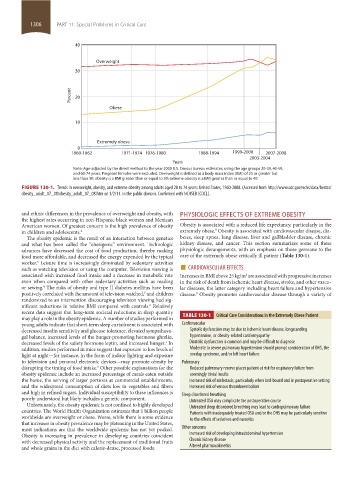
                                   Note: Age-adjusted by the direct method to the year 2000 U.S. Census bureau estimates, using the age groups 20-39, 40-59,
                                   and 60-74 years. Pregnant females were excluded. Overweight is defined as a body mass index (BMI) of 25 or greater but
                                   less than 30; obesity is a BMI greater than or equal to 30; extreme obesity is a BMI greater than or equal to 40.
                 FIGURE 130-1.  Trends in overweight, obesity, and extreme obesity among adults aged 20 to 74 years: United States, 1960-2008. (Accessed from http://www.cdc.gov/nchs/data/hestat/
                 obesity_adult_07_08/obesity_adult_07_08.htm on 3/2/11. In the public domain. Confirmed with NCHSED [CDC].).


                 and ethnic differences in the prevalence of overweight and obesity, with   PHYSIOLOGIC EFFECTS OF EXTREME OBESITY
                 the highest rates occurring in non-Hispanic black women and Mexican
                 American women. Of greatest concern is the high prevalence of obesity   Obesity is associated with a reduced life expectancy, particularly in the
                                                                                   9
                 in children and adolescents. 2                        extremely obese.  Obesity is associated with cardiovascular disease, dia-
                   The obesity epidemic is the result of an interaction between genetics   betes, sleep apnea, lung disease, liver and gallbladder disease, chronic
                 and what has been called the “obesigenic” environment. Technologic   kidney disease, and cancer. This section summarizes some of these
                 advances have decreased the cost of food production, thereby making   physiologic derangements, with an emphasis on those germane to the
                 food more affordable, and decreased the energy expended by the typical   care of the extremely obese critically ill patient (Table 130-1).
                 such as watching television or using the computer. Television viewing is   ■  CARDIOVASCULAR EFFECTS
                 worker.  Leisure time is increasingly dominated by sedentary activities
                       3
                 associated with increased food intake and a decrease in metabolic rate   Increases in BMI above 25 kg/m  are associated with progressive increases
                                                                                              2
                 even when compared with other sedentary activities such as reading   in the risk of death from ischemic heart disease, stroke, and other vascu-
                 or sewing.  The risks of obesity and type II diabetes mellitus have been    lar diseases, the latter category including heart failure and hypertensive
                         4
                 positively correlated with the amount of television watched,  and children   disease.  Obesity promotes cardiovascular disease through a variety of
                                                           5
                                                                             9
                 randomized to an intervention discouraging television viewing had sig-
                 nificant reductions in relative BMI compared with controls.  Relatively
                                                             6
                 recent data suggest that long-term societal reductions in sleep quantity
                 may play a role in the obesity epidemic. A number of studies performed in     TABLE 130-1    Critical Care Considerations in the Extremely Obese Patient
                 young adults indicate that short-term sleep curtailment is associated with   Cardiovascular
                 decreased insulin sensitivity and glucose tolerance, elevated sympathova-  Systolic dysfunction may be due to ischemic heart disease, longstanding
                 gal balance, increased levels of the hunger-promoting hormone ghrelin,     hypertension, or obesity-related cardiomyopathy
                 decreased levels of the satiety hormone leptin, and increased hunger.  In   Diastolic dysfunction is common and may be difficult to diagnose
                                                                  7
                 addition, studies performed in mice suggest that exposure to low levels of   Moderate to severe pulmonary hypertension should prompt consideration of OHS, the
                 light at night—for instance, in the form of indoor lighting and exposure   overlap syndrome, and/or left heart failure
                 to television and personal electronic devices—may promote obesity by   Pulmonary
                 disrupting the timing of food intake.  Other possible explanations for the   Reduced pulmonary reserve places patient at risk for respiratory failure from
                                           8
                 obesity epidemic include an increased percentage of meals eaten outside     seemingly trivial insults
                 the home, the serving of larger portions at commercial establishments,   Increased risk of atelectasis, particularly when bed-bound and in postoperative setting
                 and the widespread consumption of diets low in vegetables and fibers   Increased risk of venous thromboembolism
                 and high in refined sugars. Individual susceptibility to these influences is   Sleep disordered breathing
                 poorly understood but likely includes a genetic component.  Untreated OSA may complicate the postoperative course
                   Unfortunately, the obesity epidemic is not confined to highly developed   Untreated sleep disordered breathing may lead to cardiopulmonary failure
                 countries. The World Health Organization estimates that 1 billion people   Patients with inadequately treated OSA and/or the OHS may be particularly sensitive
                 worldwide are overweight or obese. Worse, while there is some evidence   to the effects of sedatives and narcotics
                 that increases in obesity prevalence may be plateauing in the United States,
                 most indications are that the worldwide epidemic has not yet peaked.   Other concerns
                 Obesity is increasing in prevalence in developing countries coincident   Increased risk of developing intraabdominal hypertension
                 with decreased physical activity and the replacement of traditional fruits   Chronic kidney disease
                 and whole grains in the diet with calorie-dense, processed foods.  Altered pharmacokinetics


            section11.indd   1306                                                                                      1/19/2015   10:56:02 AM

