


Page 1841 - Hall et al (2015) Principles of Critical Care-McGraw-Hill
P. 1841
1310     PART 11: Special Problems in Critical Care


                 OTHER PROBLEMS IN THE DELIVERY OF CRITICAL CARE       of this sedative or the accompanying analgesic is still desirable,
                     ■  ESTABLISHING VASCULAR ACCESS                   tion or conversion to a validated regimen of intermittent sedative
                                                                       whether it be by daily interruption of continuous intravenous seda-

                 Establishing intravenous access may be difficult in the extremely obese   administration.
                 venous line. The increased distance from skin to blood vessel makes any   ■  MINIMIZING COMPLICATIONS OF CRITICAL ILLNESS
                 patient, beginning with the frequent inability to place a peripheral intra-
                 attempt to cannulate a central vein more difficult, while the sharp angle   Because of the significantly elevated risk of venous thromboembo-
                 required at times to cannulate the subclavian and femoral veins may   lism  in  obesity,  an  aggressive  approach  to  prophylaxis  is  merited.
                 make it impossible for the operator to pass the wire and/or dilator. In   Unfortunately, data on this subject are lacking even in the general
                 some patients, the needle and the introducer may be too short for the   medical ICU population, and a survey of surgeons who perform
                 subclavian site. The femoral site should be used as a last resort because   bariatric surgery showed wide variation in practice.  We recom-
                                                                                                                45
                 of the increased risk of infection and thrombosis associated with this   mend following the ACCP guidelines for prophylaxis in the bariatric
                 site; in addition, this site is frequently inaccessible because of inter-  surgery patient. This guideline recommends the use of low molecu-
                 trigo. The internal jugular vein is therefore generally the site of choice   lar weight heparin, low dose unfractionated heparin three times
                 for extremely obese patients, even with the difficulties imposed by a   daily, fondaparinux, or the combination of one of these agents with
                 short, thick neck. We recommend the use of real-time ultrasonography     optimally used intermittent pneumatic compression.  Higher doses
                                                                                                               46
                 when possible.                                        than usual may be required (see Chaps. 5 and 39).
                     ■  NUTRITIONAL SUPPORT                            increased in the obese patient due to increased intraabdominal pressure
                                                                         Most studies suggest that the risk of aspiration of gastric contents is
                 Initially, critically ill obese patients exhibit less lipolysis and fat oxidation   and the high volume and low pH of gastric contents in such patients.
                 than nonobese subjects.  This decreased ability to mobilize fat increases   This has implications not only for intubation but also for routine nursing
                                  39
                 protein breakdown to fuel gluconeogenesis and, hence, ensure adequate   and feeding. We recommend that all extremely obese patients be fed and
                 carbohydrates for energy. An increased risk for protein malnutrition   nursed in the semi-upright position.
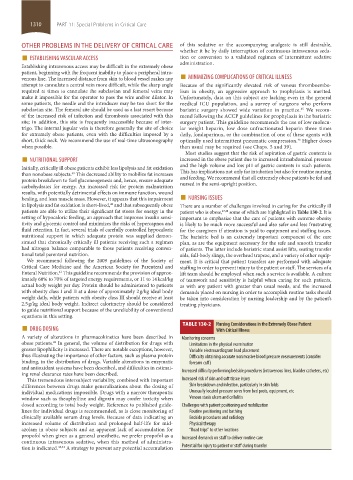
                 healing, and lean muscle mass. However, it appears that this impairment   ■  NURSING ISSUES
                 results, with potentially detrimental effects on immune function, wound
                 in lipolysis and fat oxidation is short-lived,  and that subsequently obese   There are a number of challenges involved in caring for the critically ill
                                               40
                 patients are able to utilize their significant fat stores for energy in the   patient who is obese, 47,48  some of which are highlighted in Table 130-2. It is
                 setting of hypocaloric feeding, an approach that improves insulin sensi-  important to emphasize that the care of patients with extreme obesity
                 tivity and glycemic control and minimizes the risks of hypercapnea and   is likely to be much more successful and also safer and less frustrating
                 fluid retention. In fact, several trials of carefully controlled hypocaloric   for the caregivers if attention is paid to equipment and staffing issues.
                 nutritional support in which adequate protein was supplied demon-  The  bariatric  bed  is an  extremely  important  component  of  the  care
                 strated that chronically critically ill patients receiving such a regimen   plan, as are the equipment necessary for the safe and smooth transfer
                 had nitrogen balance comparable to those patients receiving conven-  of patients. The latter include bariatric stand assist lifts, seating transfer
                 tional total parenteral nutrition.                    aids, full-body slings, the overhead trapeze, and a variety of other equip-
                   We recommend following the 2009 guidelines of the Society of   ment. It is critical that patient transfers are performed with adequate
                 Critical  Care  Medicine  and  the  American  Society  for  Parenteral  and   staffing in order to prevent injury to the patient or staff. The services of a
                 Enteral Nutrition.  This guideline recommends the provision of approx-  lift team should be employed when such a service is available. A culture
                              41
                 imately 60% to 70% of targeted energy requirements, or 11 to 14 kcal/kg   of teamwork and sensitivity is helpful when caring for such patients,
                 actual body weight per day. Protein should be administered to patients   as with any patient with greater than usual needs, and the increased
                 with obesity class I and II at a dose of approximately 2 g/kg ideal body   demands placed on nursing in order to accomplish routine tasks should
                 weight daily, while patients with obesity class III should receive at least   be taken into consideration by nursing leadership and by the patient’s
                 2.5 g/kg ideal body weight. Indirect calorimetry should be considered   treating physicians.
                 to guide nutritional support because of the unreliability of conventional
                 equations in this setting.
                     ■  DRUG DOSING                                      TABLE 130-2     Nursing Considerations in the Extremely Obese Patient
                                                                                    With Critical Illness
                 A variety of alterations in pharmacokinetics have been described in   Monitoring concerns
                 obese patients.  In general, the volume of distribution for drugs with   Limitations in the physical examination
                            42
                 greater lipophilicity is increased. There are notable exceptions, however,   Variable electrocardiogram lead placement
                 thus illustrating the importance of other factors, such as plasma protein   Difficulty obtaining accurate noninvasive blood pressure measurements (consider
                 binding, in the distribution of drugs. Variable alterations in enzymatic   forearm cuff)
                 and antioxidant systems have been described, and difficulties in estimat-
                 ing renal clearance rates have been described.         Increased difficulty performing bedside procedures (intravenous lines, bladder catheters, etc)
                   This tremendous intersubject variability, combined with important   Increased risk of skin and soft tissue injury
                 differences between drugs make generalizations about the dosing of   Skin breakdown and infection, particularly in skin folds
                 individual medications impossible. Drugs with a narrow therapeutic   Unusually located pressure sores from bed posts, equipment, etc
                 window such as theophylline and digoxin may confer toxicity when   Venous stasis ulcers and cellulitis
                 dosed according to total body weight. Reference to published guide-  Challenges with patient positioning and mobilization
                 lines for individual drugs is recommended, as is close monitoring of   Routine positioning and bathing
                 clinically available serum drug levels. Because of data indicating an   Bedside procedures and radiology
                 increased volume of distribution and prolonged half-life for mid-  Physical therapy
                 azolam in obese subjects and an apparent lack of accumulation for   “Road trips” to other locations
                 propofol when given as a general anesthetic, we prefer propofol as a   Increased demands on staff to deliver routine care
                 continuous intravenous sedative, when this method of administra-
                 tion is indicated. 43,44  A strategy to prevent any potential accumulation   Potential for injury to patient or staff during transfer


            section11.indd   1310                                                                                      1/19/2015   10:56:04 AM

