


Page 1833 - Hall et al (2015) Principles of Critical Care-McGraw-Hill
P. 1833
1302     PART 11: Special Problems in Critical Care


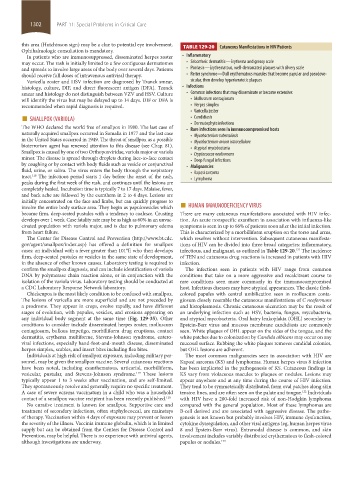
                 this area (Hutchinson sign) may be a clue to potential eye involvement.     TABLE 129-20    Cutaneous Manifestations in HIV Patients
                 Ophthalmologic consultation is mandatory.
                   In patients who are immunosuppressed, disseminated herpes zoster   •  Inflammatory
                 may occur. The rash is initially limited to a few contiguous dermatomes   •  Seborrheic dermatitis—Erythema and greasy scale
                 and spreads to involve large areas of the body over several days. Patients   •  Psoriasis—Erythematous, well-demarcated plaques with silvery scale
                 should receive full doses of intravenous antiviral therapy.  •  Reiter syndrome—Dull erythematous macules that become papular and pseudove-
                   Varicella zoster and HSV infection are diagnosed by Tzanck smear,   sicular, then develop hyperkeratotic plaques
                 histology, culture, DIF, and direct fluorescent antigen (DFA). Tzanck   •  Infections
                 smear and histology do not distinguish between VZV and HSV. Culture   •  Common infections that may disseminate or become extensive:
                 will identify the virus but may be delayed up to 14 days. DIF or DFA is   •  Molluscum contagiosum
                 recommended when rapid diagnosis is required.             •  Herpes simplex
                     ■  SMALLPOX (VARIOLA)                                 •  Varicella zoster
                                                                           •  Candidiasis
                                                                           •  Dermatophyte infections
                 The WHO declared the world free of smallpox in 1980. The last case of   •  Rare infections seen in immunocompromised hosts
                 naturally acquired smallpox occurred in Somalia in 1977 and the last case   •  Mycobacterium tuberculosis
                 in the United States occurred in 1949. The threat of smallpox as a possible   •  Mycobacterium avium intracellulare
                 bioterrorism agent has renewed attention to this disease (see Chap. 81).   •  Atypical mycobacteria
                 Smallpox is caused by one of two Orthopoxviridae, variola major or variola   •  Cryptococcus neoformans
                 minor. The disease is spread through droplets during face-to-face contact   •  Deep fungal infections
                 by coughing or by contact with body fluids such as vesicle or conjunctival   •  Malignancies
                 fluid, urine, or saliva. The virus enters the body through the respiratory   •  Kaposi sarcoma
                 tract.  The infectious period starts 1 day before the onset of the rash,   •  Lymphoma
                     118
                 peaks during the first week of the rash, and continues until the lesions are
                 completely healed. Incubation time is typically 7 to 17 days. Malaise, fever,
                 and back ache are followed by the exanthem in 2 to 4 days. Lesions are
                 involve the entire body surface area. They begin as papulovesicles which   ■  HUMAN IMMUNODEFICIENCY VIRUS
                 initially concentrated on the face and limbs, but can quickly progress to
                 become firm, deep-seated pustules with a tendency to coalesce. Crusting   There are many cutaneous manifestations associated with HIV infec-
                 develops over 1 week. Case fatality rate may be as high as 60% in an unvac-  tion. An acute nonspecific exanthem in association with influenza-like
                 cinated population with variola major, and is due to pulmonary edema   symptoms is seen in up to 66% of patients soon after the initial infection.
                 from heart failure.                                   This is characterized by a morbilliform eruption on the torso and arms,
                   The Center for Disease Control and Prevention (http://www.bt.cdc.  which resolves without intervention. Subsequent cutaneous manifesta-
                 gov/agent/smallpox/index.asp)  has  offered  a  definition  for  smallpox   tions of HIV can be divided into three broad categories: inflammatory,
                 cases: an individual with a fever greater than 101°F, who then develops   infectious, and malignant, as outlined in Table 129-20.  The incidence
                                                                                                               121
                 firm, deep-seated pustules or vesicles in the same state of development,   of TEN and cutaneous drug reactions is increased in patients with HIV
                 in the absence of other known causes. Laboratory testing is required to   infection.
                 confirm the smallpox diagnosis, and can include identification of variola   The infections seen in patients with HIV range from common
                 DNA by polymerase chain reaction alone, or in conjunction with the     conditions that take on a more aggressive and recalcitrant course to
                 isolation of the variola virus. Laboratory testing should be conducted at   rare conditions seen more commonly in the immunocompromised
                 a CDC Laboratory Response Network laboratory.         host. Infectious diseases may have atypical appearances. The classic flesh-
                   Chickenpox is the most likely condition to be confused with smallpox.     colored papules with central umbilication seen in molluscum conta-
                 The lesions of varicella are more superficial and are not preceded by   giosum closely resemble the cutaneous manifestations of C neoformans
                 a prodrome. They appear in crops, evolve rapidly, and have different   and histoplasmosis. Chronic cutaneous ulceration may be the result of
                 stages of evolution, with papules, vesicles, and erosions appearing on   an underlying infection such as HSV, bacteria, fungus, mycobacteria,
                 any individual body segment at the same time (Fig. 129-35). Other   and atypical mycobacteria. Oral hairy leukoplakia (OHL) secondary to
                 conditions to consider include disseminated herpes zoster, molluscum   Epstein-Barr virus and mucous membrane candidiasis are commonly
                 contagiosum, bullous impetigo, morbilliform drug eruptions, contact   seen. White plaques of OHL appear on the sides of the tongue, and the
                 dermatitis, erythema multiforme, Stevens-Johnson syndrome, entero-  white patches due to colonization by Candida albicans may occur on any
                 viral infections, especially hand-foot-and-mouth disease, disseminated   mucosal surface. Rubbing the white plaques removes candidal colonies,
                 herpes simplex, scabies, and insect bites including flea bites.  but OHL lesions are adherent.
                   Individuals at high risk of smallpox exposure, including military per-  The  most common malignancies seen in  association with  HIV are
                 sonnel, may be given the smallpox vaccine. Several cutaneous reactions   Kaposi sarcoma (KS) and lymphomas. Human herpes virus 8 infection
                 have been noted, including exanthematous, urticarial, morbilliform,   has been implicated in the pathogenesis of KS. Cutaneous findings in
                 vesicular, pustular, and Stevens-Johnson syndrome.  These lesions   KS vary from violaceous macules to plaques or nodules. Lesions may
                                                        119
                 typically  appear  1  to  3 weeks  after  vaccination,  and  are self-limited.   appear anywhere and at any time during the course of HIV infection.
                 They spontaneously resolve and generally require no specific treatment.   They tend to be symmetrically distributed, form oval patches along skin
                 A case of severe eczema vaccinatum in a child who was a household   tension lines, and are often seen on the palate and tongue.  Individuals
                                                                                                                 122
                 contact of a smallpox vaccine recipient has been recently published. 120  with HIV have a 200-fold increased risk of non-Hodgkin lymphoma
                   No curative treatment is known for smallpox. Supportive care and   compared with the general population. Most of these lymphomas are
                 treatment of secondary infections, often staphylococcal, are mainstays   B-cell  derived  and are  associated  with  aggressive  disease. The patho-
                 of therapy. Vaccination within 4 days of exposure may prevent or lessen   genesis is not known but probably involves HIV, immune dysfunction,
                 the severity of the illness. Vaccinia immune globulin, which is in limited   cytokine dysregulation, and other viral antigens (eg, human herpes virus
                 supply but can be obtained from the Centers for Disease Control and   8 and Epstein-Barr virus). Extranodal disease is common, and skin
                 Prevention, may be helpful. There is no experience with antiviral agents,   involvement includes variably distributed erythematous to flesh-colored
                 although investigations are underway.                 papules or nodules. 123


            section11.indd   1302                                                                                      1/19/2015   10:55:54 AM

