


Page 1835 - Hall et al (2015) Principles of Critical Care-McGraw-Hill
P. 1835
1304     PART 11: Special Problems in Critical Care

                                                                           ■
                   TABLE 129-21    Histologic Findings for Deep Fungal Infections  PRESSURE ULCERS
                  Condition  Staining Technique    Key Histologic Findings  The incidence of pressure ulcers in the ICU varies widely in the litera-
                                                                       ture. Continuous pressure over a bony site obstructs microcirculation,
                  Blastomycosis  KOH mount         Round, refractile spherical cells   leading to tissue ischemia and necrosis. ICU patients have multiple risk
                                                   with broad-based budding  factors for  developing  pressure ulcers,  which can occur in  as little as
                  Histoplasmosis H & E stain, Giemsa stain  Small yeast-like spores within   2 hours under certain conditions. Mechanical ventilation, limited mobil-
                                                   macrophages         ity, hypoperfusion, and the use of vasoactive drugs may increase the risk
                  Cryptococcus  India ink stain    Round to ovoid spores with   of pressure ulcers. The development of pressure ulcers leads to increased
                                                   large capsules      mortality rates, costs, and lengths of hospital stays.
                                                                         A National Pressure Ulcer Advisory Panel in 1998 developed the most
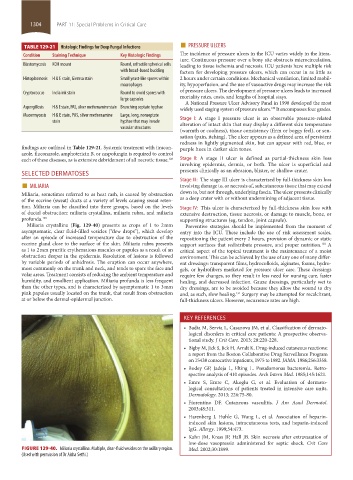
                  Aspergillosis  H & E stain, PAS, silver methenamine stain Branching septate hyphae  widely used staging system of pressure ulcers.  It encompasses four grades.
                                                                                                      129
                  Mucormycosis  H & E stain, PAS, silver methenamine   Large, long, nonseptate   Stage I:  A stage I pressure ulcer is an observable pressure-related
                            stain                  hyphae that may invade   alteration of intact skin that may display a different skin temperature
                                                     vascular structures
                                                                       (warmth or coolness), tissue consistency (firm or boggy feel), or sen-
                                                                       sation (pain, itching). The ulcer appears as a defined area of persistent
                                                                       redness in lightly pigmented skin, but can appear with red, blue, or
                 findings are outlined in Table 129-21. Systemic treatment with itracon-  purple hues in darker skin tones.
                 azole, fluconazole, amphotericin B, or caspofungin is required to control
                 each of these diseases, as is extensive debridement of all necrotic tissue. 128  Stage  II:  A  stage  II  ulcer is  defined  as  partial-thickness  skin loss
                                                                       involving epidermis, dermis, or both. The ulcer is superficial and
                 SELECTED DERMATOSES                                   presents clinically as an abrasion, blister, or shallow crater.
                     ■  MILIARIA                                       Stage III:  The stage III ulcer is characterized by full-thickness skin loss
                                                                       involving damage to, or necrosis of, subcutaneous tissue that may extend
                 Miliaria, sometimes referred to as heat rash, is caused by obstruction   down to, but not through, underlying fascia. The ulcer presents clinically
                 of the eccrine (sweat) ducts at a variety of levels causing sweat reten-  as a deep crater with or without undermining of adjacent tissue.
                 tion. Miliaria can be classified into three groups, based on the levels   Stage IV:  This ulcer is characterized by full-thickness skin loss with
                 of ductal obstruction: miliaria crystallina, miliaria rubra, and miliaria   extensive destruction, tissue necrosis, or damage to muscle, bone, or
                 profunda. 128                                         supporting structures (eg, tendon, joint capsule).
                   Miliaria crystallina (Fig. 129-40) presents as crops of 1 to 2 mm   Preventive strategies should be implemented from the moment of
                 asymptomatic, clear fluid-filled vesicles (“dew drops”), which develop   entry  into  the  ICU. These  include  the  use  of  risk  assessment scales,
                 after  an  episode  of  increased  temperature  due  to  obstruction  of  the   repositioning the patient every 2 hours, provision of dynamic or static
                 eccrine gland close to the surface of the skin. Miliaria rubra presents   support surfaces that redistribute pressure, and proper nutrition.  A
                                                                                                                       130
                 as 1 to 2 mm pruritic erythematous macules or papules as a result of an   critical aspect of the topical treatment is the maintenance of a moist
                 obstruction deeper in the epidermis. Resolution of lesions is followed   environment. This can be achieved by the use of any one of many differ-
                 by variable periods of anhidrosis. The eruption can occur anywhere,   ent dressings: transparent films, hydrocolloids, alginates, foams, hydro-
                 most commonly on the trunk and neck, and tends to spare the face and   gels, or hydrofibers marketed for pressure ulcer care. These dressings
                 volar areas. Treatment consists of reducing the ambient temperature and   require few changes, so they result in less need for nursing care, faster
                 humidity, and emollient application. Miliaria profunda is less frequent   healing, and decreased infection. Gauze dressings, particularly wet to
                 than the other types, and is characterized by asymptomatic 1 to 3 mm   dry dressings, are to be avoided because they allow the wound to dry
                 pink papules usually located on the trunk, that result from obstruction   and, as such, slow healing.  Surgery may be attempted for recalcitrant,
                                                                                          131
                 at or below the dermal-epidermal junction.            full-thickness ulcers. However, recurrence rates are high.


                                                                         KEY REFERENCES
                                                                           • Badia M, Servia L, Casanova JM, et al. Classification of dermato-
                                                                          logical disorders in critical care patients: A prospective observa-
                                                                          tional study. J Crit Care. 2013; 28:220-228.
                                                                           • Bigby M, Jick S, Jick H, Arndt K. Drug-induced cutaneous reactions:
                                                                          a report from the Boston Collaborative Drug Surveillance Program
                                                                          on 15438 consecutive inpatients, 1975 to 1982. JAMA. 1986;256:3358.
                                                                           • Bodey GP, Jadeja L, Elting L. Pseudomonas bacteremia. Retro-
                                                                          spective analysis of 410 episodes. Arch Intern Med. 1985;145:1621.
                                                                           • Emre S, Emre C, Akoglu G, et al. Evaluation of dermato-
                                                                          logical consultations of patients treated in intensive care units.
                                                                          Dermatology. 2013; 226:75-80.
                                                                           • Fiorentino  DF.  Cutaneous  vasculitis.  J Am Acad Dermatol.
                                                                          2003;48:311.
                                                                           • Harenberg J, Huhle G, Wang L, et al. Association of heparin-
                                                                          induced skin lesions, intracutaneous tests, and heparin-induced
                                                                          IgG. Allergy. 1999;54:473.
                                                                           • Kahn JM, Kress JP, Hall JB. Skin necrosis after extravasation of
                                                                          low-dose vasopressin administered for septic shock.  Crit Care
                 FIGURE 129-40.  Miliaria crystallina. Multiple, clear-fluid vesicles on the axillary region.   Med. 2002;30:1899.
                 (Used with permission of Dr Aisha Sethi.)


            section11.indd   1304                                                                                      1/19/2015   10:56:00 AM

