


Page 1832 - Hall et al (2015) Principles of Critical Care-McGraw-Hill
P. 1832
CHAPTER 129: Dermatologic Conditions  1301


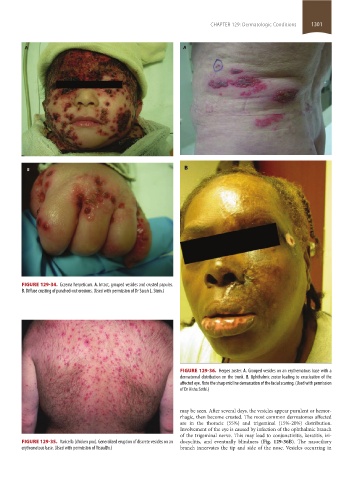
                    FIGURE 129-34.  Eczema herpeticum. A. Intact, grouped vesicles and crusted papules.
                    B. Diffuse crusting of punched-out erosions. (Used with permission of Dr Sarah L. Stein.)


                                                                          FIGURE 129-36.  Herpes zoster. A. Grouped vesicles on an erythematous base with a
                                                                          dermatomal distribution on the trunk. B. Ophthalmic zoster leading to enucleation of the
                                                                          affected eye. Note the sharp midline demarcation of the facial scarring. (Used with permission
                                                                          of Dr Aisha Sethi.)


                                                                          may be seen. After several days, the vesicles appear purulent or hemor-
                                                                          rhagic, then become crusted. The most common dermatomes affected
                                                                          are in the thoracic (55%) and trigeminal (15%-20%) distribution.
                                                                          Involvement of the eye is caused by infection of the ophthalmic branch
                                                                          of the trigeminal nerve. This may lead to conjunctivitis, keratitis, iri-
                    FIGURE 129-35.  Varicella (chicken pox). Generalized eruption of discrete vesicles on an   docyclitis, and eventually blindness (Fig. 129-36B). The nasociliary
                    erythematous base. (Used with permission of VisualDx.)  branch innervates the tip and side of the nose. Vesicles occurring in


            section11.indd   1301                                                                                      1/19/2015   10:55:53 AM

