


Page 1843 - Hall et al (2015) Principles of Critical Care-McGraw-Hill
P. 1843
1312     PART 11: Special Problems in Critical Care


                 factors, clinical diagnosis, and management of hypothermia. The use     TABLE 131-1    Causes of Hypothermia
                 of hypothermia as a treatment, such as after cardiac arrest, is covered
                 in Chap. 26.                                           Mechanism       Clinical Disorder
                                                                        Decreased heat production Endocrinologic failure
                 REGULATION OF BODY TEMPERATURE                                           Hypopituitarism
                 Body temperature is closely regulated through a balance between heat     Hypoadrenalism
                 production and heat dissipation.  The majority of endogenous heat pro-    Hypothyroidism
                                         2
                 duction results from metabolic activity in the heart and liver. The skin
                 accounts for 90% of heat loss and the lungs contribute the rest. Radiation   Insufficient fuel
                 cooling (heat loss in the form of infrared radiation) is the primary     Extreme exertion
                 method of thermal load dissipation and accounts for approximately 60%     Hypoglycemia
                 of heat loss. Conduction (direct transfer of heat to a cooler object) and
                 convection (heat removal by air currents) account for 10% to 15% of      Malnutrition
                 heat loss while evaporation from skin and the respiratory tract accounts   Neuromuscular inefficiency
                 for 25% to 30% of heat loss. Conduction is an important mechanism of     Age extremes
                 heat loss in immersion accidents because thermal conduction of water     Impaired shivering
                 is approximately 30 times that of air. Convection is important in windy
                 conditions by removing the warm insulating layer of air around the       Inactivity
                 body. The preoptic nucleus of the anterior hypothalamus is the thermal   Increased heat loss  Environmental exposure
                 control center, which maintains body temperature at a given set value.   Induced vasodilation
                 In response to a decrease in core body temperature, the hypothalamus
                 initiates mechanisms to conserve heat by cutaneous vasoconstriction      Drugs, including alcohol
                 and produce heat by stimulation of muscular activity in the form of      Toxins
                 shivering.  Nonshivering thermogenesis occurs via increased activity   Skin disorders
                        2,3
                 of thyroxine and catecholamines.  In a conscious individual, the appre-
                                         4,5
                 ciation of cold induces the individual to exercise, wear more clothes, or     Burns
                 move to a warmer environment.                                            Psoriasis
                   As  the  core  temperature  decreases  below  35°C  (95°F),  the  coordi-    Exfoliative dermatitis
                 nated systems responsible for thermoregulation begin to fail because the
                 physiologic responses to minimize heat loss are very limited.  Primary   Iatrogenic
                                                              6
                 hypothermia (accidental hypothermia) refers to a spontaneous decrease     Cold infusion
                 of core body temperature, usually as result of exposure to cold envi-    Emergent deliveries
                 ronments without adequate protection. Environmental hypothermia
                 results from a combination of heat loss by convection (degree of wind   Impaired thermoregulation Peripheral failure
                 exposure), conduction, and radiation to the surrounding ambient air.     Neuropathies
                 Secondary hypothermia  represents  a  complication  of  an  underlying     Spinal cord transection
                 disorder. Some of the disorders and conditions that may predispose an     Diabetes
                 individual to hypothermia by decreasing heat production, increasing
                 heat loss, or interfering with the central or peripheral control of thermo-  Central failure
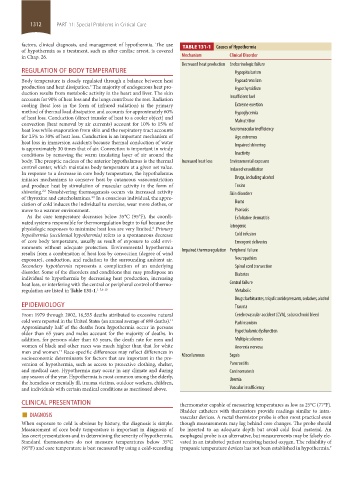
                 regulation are listed in Table 131-1. 1-3,6-10                           Metabolic
                                                                                          Drugs: barbiturates, tricyclic antidepressants, sedatives, alcohol
                 EPIDEMIOLOGY                                                             Trauma

                 From 1979 through 2002, 16,555 deaths attributed to excessive natural       Cerebrovascular accident (CVA), subarachnoid bleed
                 cold were reported in the United States (an annual average of 689 deaths).      Parkinsonism
                                                                    11
                 Approximately half of the deaths from hypothermia occur in persons
                 older than 65 years and males account for the majority of deaths. In     Hypothalamic dysfunction
                 addition, for persons older than 65 years, the death rate for men and     Multiple sclerosis
                 women of black and other races was much higher than that for white       Anorexia nervosa
                 men and women.  Race-specific differences may reflect differences in
                              12
                 socioeconomic determinants for factors that are important in the pre-  Miscellaneous  Sepsis
                 vention of hypothermia, such as access to protective clothing, shelter,   Pancreatitis
                 and medical care. Hypothermia may occur in any climate and during      Carcinomatosis
                 any season of the year. Hypothermia is most common among the elderly,
                 the homeless or mentally ill, trauma victims, outdoor workers, children,   Uremia
                 and individuals with certain medical conditions as mentioned above.    Vascular insufficiency

                 CLINICAL PRESENTATION                                 thermometer capable of measuring temperatures as low as 25°C (77°F).
                     ■  DIAGNOSIS                                      Bladder catheters with thermistors provide readings similar to intra-
                                                                       vascular devices. A rectal thermistor probe is often most practical even
                 When exposure to cold is obvious by history, the diagnosis is simple.   though measurements may lag behind core changes. The probe should
                 Measurement of core body temperature is important in diagnosis of   be inserted to an adequate depth but avoid cold fecal material. An
                 less overt presentations and in determining the severity of hypothermia.    esophageal probe is an alternative, but measurements may be falsely ele-
                 Standard thermometers  do not  measure  temperatures  below  35°C   vated in an intubated patient receiving heated oxygen. The reliability of
                 (95°F) and core temperature is best measured by using a cold-recording   tympanic temperature devices has not been established in hypothermia. 7


            section11.indd   1312                                                                                      1/19/2015   10:56:05 AM

