


Page 1844 - Hall et al (2015) Principles of Critical Care-McGraw-Hill
P. 1844
CHAPTER 131: Hypothermia  1313


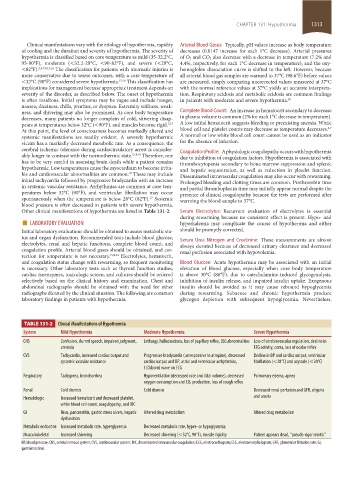
                     Clinical manifestations vary with the etiology of hypothermia, rapidity   Arterial Blood Gases:  Typically, pH values increase as body temperature
                    of cooling and the duration and severity of hypothermia. The severity of   decreases (0.0147 increase for each 1°C decrease). Arterial pressures
                    hypothermia is classified based on core temperature as mild (35-32.2°C,   of O 2 and CO 2 also decrease with a decrease in temperature (7.2% and
                    95-90°F),  moderate  (<32.2-28°C,  <90-82°F),  and  severe  (<28°C,   4.4%, respectively, for each 1°C decrease in temperature), and the oxy-
                    <82°F). 2,3,7,9,13,14  The classification for patients with traumatic injuries is   hemoglobin dissociation curve is shifted to the left. However, because
                    more conservative due to worse outcomes, with a core temperature of   all arterial blood gas samples are warmed to 37°C (98.6°F) before values
                    <32°C (90°F) considered severe hypothermia. 15,16  This classification has   are measured, simply comparing uncorrected values measured at 37°C
                    implications for management because appropriate treatment depends on   with the normal reference values at 37°C yields an accurate interpreta-
                    severity of the disorder, as described below. The onset of hypothermia   tion. Respiratory acidosis and metabolic acidosis are common findings
                    is often insidious. Initial symptoms may be vague and include hunger,   in patients with moderate and severe hypothermia. 20
                    nausea, dizziness, chills, pruritus, or dyspnea. Extremity stiffness, weak-
                    ness, and shivering may also be prominent. As core body temperature   Complete Blood Count:  An increase in hematocrit secondary to decrease
                    decreases, many patients no longer complain of cold, shivering disap-  in plasma volume is common (2% for each 1°C decrease in temperature).
                    pears at temperatures below 32°C (<90°F), and muscles become rigid.    A low initial hematocrit suggests bleeding or preexisting anemia. White
                                                                     7,17
                                                                                                                            2,7
                    At this point, the level of consciousness becomes markedly altered and   blood cell and platelet counts may decrease as temperature decreases.
                    systemic manifestations are readily evident. A severely hypothermic   A normal or low white blood cell count cannot be used as an indicator
                    victim has a markedly decreased metabolic rate. As a consequence, the   for the absence of infection.
                    cerebral ischemic tolerance during cardiocirculatory arrest is consider-  Coagulation Profile:  A physiologic coagulopathy occurs with hypothermia
                    ably longer in contrast with the normothermic state. 7,18,19  Therefore, one   due to inhibition of coagulation factors. Hypothermia is associated with
                    has to be very careful in assessing brain death while a patient remains   thrombocytopenia secondary to bone marrow suppression and splenic
                    hypothermic. Low temperatures cause the myocardium to become irrita-  and hepatic sequestration, as well as reduction in platelet function.
                    ble and cardiovascular abnormalities are common.  These may include   Disseminated intravascular coagulation may also occur with rewarming.
                                                        18
                    initial tachycardia followed by progressive bradycardia with an increase   Prolonged bleeding and clotting times are common. Prothrombin time
                    in systemic vascular resistance. Arrhythmias are common at core tem-  and partial thromboplastin time may initially appear normal despite the
                    peratures below 32°C (90°F), and ventricular fibrillation may occur   presence of clinical coagulopathy because the tests are performed after
                    spontaneously when the temperature is below 28°C (82°F).  Systemic   warming the blood sample to 37°C.
                                                               17
                    blood pressure is often decreased in patients with severe hypothermia.
                    Other clinical manifestations of hypothermia are listed in Table 131-2.  Serum Electrolytes:  Recurrent evaluation of electrolytes is essential
                        ■  LABORATORY EVALUATION                          during rewarming because no consistent effect is present. Hypo- and
                                                                          hyperkalemia may complicate the course of hypothermia and either
                    Initial laboratory evaluations should be obtained to assess metabolic sta-  should be promptly corrected.
                    tus and organ dysfunction. Recommended tests include blood glucose,    Serum  Urea Nitrogen and  Creatinine:  These measurements are almost
                    electrolytes, renal and hepatic functions, complete blood count, and   always elevated because of decreased urinary clearance and decreased
                    coagulation profile. Arterial blood gases should be obtained, and cor-  renal perfusion associated with hypovolemia.
                    rection for temperature  is not necessary. 7,20,21  Electrolytes, hematocrit,
                    and coagulation status change with rewarming, so frequent monitoring   Blood Glucose:  Acute hypothermia may be associated with an initial
                    is necessary. Other laboratory tests such as thyroid function studies,   elevation of blood glucose, especially when core body temperature
                    cardiac isoenzymes, toxicologic screen, and cultures should be ordered   is above 30°C (86°F), due to catecholamine-induced glycogenolysis,
                    selectively based on the clinical history and examination. Chest and   inhibition of insulin release, and impaired insulin uptake. Exogenous
                    abdominal radiographs should be obtained with the need for other   insulin should be avoided as it may cause rebound hypoglycemia
                    radiographs dictated by the clinical situation. The following are common   during rewarming. Subacute and chronic hypothermia produce
                    laboratory findings in patients with hypothermia.     glycogen depletion with subsequent hypoglycemia. Nevertheless,


                      TABLE 131-2    Clinical Manifestations of Hypothermia
                    System       Mild Hypothermia            Moderate Hypothermia                  Severe Hypothermia
                    CNS          Confusion, slurred speech, impaired judgment,    Lethargy, hallucinations, loss of pupillary reflex, EEG abnormalities Loss of cerebrovascular regulation, decline in
                                 amnesia                                                           EEG activity, coma, loss of ocular reflex
                    CVS          Tachycardia, increased cardiac output and   Progressive bradycardia (unresponsive to atropine), decreased    Decline in BP and cardiac output, ventricular
                                   systemic vascular resistance  cardiac output and BP, atrial and ventricular arrhythmias,   fibrillation (<28°C) and asystole (<20°C)
                                                             J (Osborn) wave on ECG
                    Respiratory  Tachypnea, bronchorrhea     Hypoventilation (decreased rate and tidal volume), decreased   Pulmonary edema, apnea
                                                             oxygen consumption and CO 2 production, loss of cough reflex
                    Renal        Cold diuresis               Cold diuresis                         Decreased renal perfusion and GFR, oliguria
                    Hematologic  Increased hematocrit and decreased platelet,                      and anuria
                                 white blood cell count, coagulopathy, and DIC
                    GI           Ileus, pancreatitis, gastric stress ulcers, hepatic    Altered drug metabolism  Altered drug metabolism
                                 dysfunction
                    Metabolic endocrine Increased metabolic rate, hyperglycemia  Decreased metabolic rate, hyper- or hypoglycemia
                    Musculoskeletal  Increased shivering     Decreased shivering (<32°C, 90°F), muscle rigidity  Patient appears dead, “pseudo-rigor mortis”
                    BP, blood pressure; CNS, central nervous system; CVS, cardiovascular system; DIC, disseminated intravascular coagulation; ECG, electrocardiogram; EEG, electroencephalogram; GFR, glomerular filtration rate; GI,
                    gastrointestinal.


            section11.indd   1313                                                                                      1/19/2015   10:56:05 AM

