


Page 1846 - Hall et al (2015) Principles of Critical Care-McGraw-Hill
P. 1846
CHAPTER 131: Hypothermia  1315


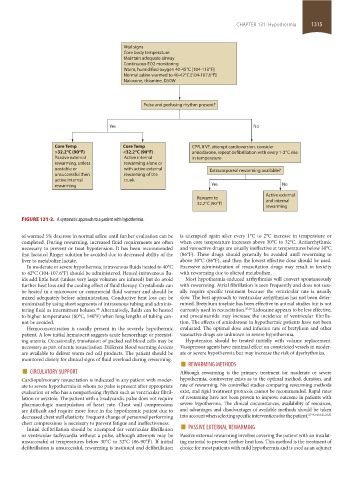
                                                      Vital signs
                                                      Core body temperature
                                                      Maintain adequate airway
                                                      Continuous ECG monitoring
                                                      Warm, humidified oxygen 40-45°C [104-113°F]
                                                      Normal saline warmed to 40-42°C [104-107.6°F]
                                                      Naloxone, thiamine, D50W


                                                             Pulse and perfusing rhythm present?


                                                  Yes                                              No


                               Core Temp              Core Temp               CPR, If VF, attempt cardioversion, consider
                               >32.2°C (90°F)         <32.2°C (90°F)          amiodarone, repeat defibrillation with every 1-2°C rise
                               Passive external        Active internal        in temperature
                               rewarming, unless       rewarming alone or
                               unstable or             with active external         Extracorporeal rewarming available?
                               unsuccessful then       rewarming of the
                               active internal         trunk
                               rewarming                                            Yes                     No
                                                                                                       Active external
                                                                               Rewarm to
                                                                               32.2°C (90°F)           and internal
                                                                                                       rewarming
                    FIGURE 131-2.  A systematic approach to a patient with hypothermia.

                    of warmed 5% dextrose in normal saline until further evaluation can be   is attempted again after every 1°C to 2°C increase in temperature or
                    completed. During rewarming, increased fluid requirements are often   when core temperature increases above 30°C to 32°C. Antiarrhythmic
                    necessary to prevent or treat hypotension. It has been recommended   and vasoactive drugs are usually ineffective at temperatures below 30°C
                    that lactated Ringer solution be avoided due to decreased ability of the   (86°F). These drugs should generally be avoided until rewarming to
                    liver to metabolize lactate.                          above 30°C (86°F), and then the lowest effective dose should be used.
                     In moderate or severe hypothermia, intravenous fluids heated to 40°C   Excessive administration of resuscitation drugs  may result in toxicity
                    to 42°C (104-107.6°F) should be administered. Heated intravenous flu-  with rewarming due to altered metabolism.
                    ids add little heat (unless very large volumes are infused) but do avoid   Most hypothermia-induced arrhythmias will convert spontaneously
                    further heat loss and the cooling effect of fluid therapy. Crystalloids can   with rewarming. Atrial fibrillation is seen frequently and does not usu-
                    be heated in a microwave or commercial fluid warmer and should be   ally require specific treatment because the ventricular rate is usually
                    mixed adequately before administration. Conductive heat loss can be   slow. The best approach to ventricular arrhythmias has not been deter-
                    minimized by using short segments of intravenous tubing and adminis-  mined. Bretylium tosylate has been effective in animal studies but is not
                    tering fluid as intermittent boluses.  Alternatively, fluids can be heated   currently used in resuscitation. 27,28  Lidocaine appears to be less effective,
                                             28
                    to higher temperatures (60°C, 140°F) when long lengths of tubing can-  and procainamide may increase the incidence of ventricular fibrilla-
                    not be avoided.                                       tion. The effects of amiodarone in hypothermic patients have not been
                     Hemoconcentration  is usually present in the severely  hypothermic   evaluated. The optimal dose and infusion rate of bretylium and other
                    patient. A low initial hematocrit suggests acute hemorrhage or preexist-  vasoactive drugs are unknown in severe hypothermia.
                    ing anemia. Occasionally, transfusion of packed red blood cells may be   Hypotension  should  be  treated  initially  with  volume  replacement.
                    necessary as part of acute resuscitation. Different blood warming devices   Vasopressor agents have minimal effect on constricted vessels in moder-
                    are available to deliver warm red cell products. The patient should be   ate or severe hypothermia but may increase the risk of dysrhythmias.
                    monitored closely for clinical signs of fluid overload during rewarming.    ■
                        ■  CIRCULATORY SUPPORT                            Although rewarming is the primary treatment for moderate or severe
                                                                            REWARMING METHODS

                    Cardiopulmonary resuscitation is indicated in any patient with moder-  hypothermia, controversy exists as to the optimal method, duration, and
                    ate to severe hypothermia in whom no pulse is present after appropriate   rate of rewarming. No controlled studies comparing rewarming methods
                    evaluation or who has a nonperfusing rhythm such as ventricular fibril-  exist, and rigid treatment protocols cannot be recommended. Rapid rates
                    lation or asystole. The patient with a bradycardic pulse does not require   of rewarming have not been proven to improve outcome in patients with
                    pharmacologic manipulation of heart rate. Chest wall  compressions   severe hypothermia. The clinical circumstances, availability of resources,
                    are difficult and require more force in the hypothermic patient due to   and advantages and disadvantages of available methods should be taken
                    decreased chest wall elasticity. Frequent change of personnel performing   into account when selecting specific interventions for the patient. 3,7-9,14,18,21,25,31
                     Initial defibrillation should be attempted for ventricular fibrillation   ■
                    chest compressions is necessary to prevent fatigue and ineffectiveness.  PASSIVE EXTERNAL REWARMING
                    or ventricular tachycardia without a pulse, although attempts may be   Passive external rewarming involves covering the patient with an insulat-
                    unsuccessful at temperatures below 30°C to 32°C (86-90°F). If initial   ing material to prevent further heat loss. This method is the treatment of
                    defibrillation is unsuccessful, rewarming is instituted and defibrillation   choice for most patients with mild hypothermia and is used as an adjunct


            section11.indd   1315                                                                                      1/19/2015   10:56:07 AM

