


Page 1845 - Hall et al (2015) Principles of Critical Care-McGraw-Hill
P. 1845
1314     PART 11: Special Problems in Critical Care


                                           V4


                                           V5

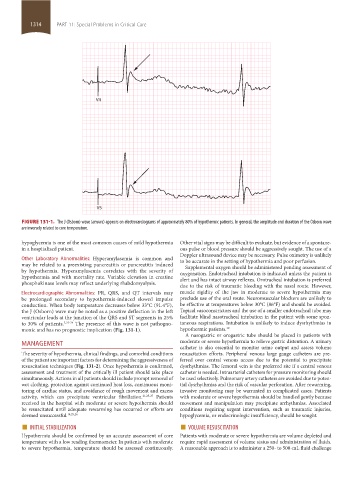
                 FIGURE 131-1.  The J (Osborn) wave (arrows) appears on electrocardiograms of approximately 80% of hypothermic patients. In general, the amplitude and duration of the Osborn wave
                 are inversely related to core temperature.

                 hypoglycemia is one of the most common causes of mild hypothermia   Other vital signs may be difficult to evaluate, but evidence of a spontane-
                 in a hospitalized patient.                            ous pulse or blood pressure should be aggressively sought. The use of a
                                                                       Doppler ultrasound device may be necessary. Pulse oximetry is unlikely
                 Other Laboratory Abnormalities:  Hyperamylasemia is common and   to be accurate in the setting of hypothermia and poor perfusion.
                 may be related  to a  preexisting  pancreatitis or pancreatitis  induced   Supplemental oxygen should be administered pending assessment of
                 by hypothermia. Hyperamylasemia correlates with the severity of   oxygenation. Endotracheal intubation is indicated unless the patient is
                 hypothermia and with mortality rate. Variable elevation in creatine   alert and has intact airway reflexes. Orotracheal intubation is preferred
                 phosphokinase levels may reflect underlying rhabdomyolysis.
                                                                       due  to the  risk  of  traumatic bleeding  with the  nasal  route.  However,
                 Electrocardiographic Abnormalities:  PR, QRS, and QT intervals may   muscle rigidity of the jaw in moderate to severe hypothermia may
                 be prolonged secondary to hypothermia-induced slowed impulse    preclude use of the oral route. Neuromuscular blockers are unlikely to
                 conduction. When body temperature decreases below 33°C (91.4°F),   be effective at temperatures below 30°C (86°F) and should be avoided.
                 the J (Osborn) wave may be noted as a positive deflection in the left   Topical vasoconstrictors and the use of a smaller endotracheal tube may
                 ventricular leads at the junction of the QRS and ST segments in 25%   facilitate blind nasotracheal intubation in the patient with some spon-
                 to 30% of patients. 2,22-24  The presence of this wave is not pathogno-  taneous respirations. Intubation is unlikely to induce dysrhythmias in
                 monic and has no prognostic implication (Fig. 131-1).  hypothermic patients. 10
                                                                         A nasogastric or orogastric tube should be placed in patients with
                 MANAGEMENT                                            moderate or severe hypothermia to relieve gastric distention. A urinary
                                                                       catheter is also essential to monitor urine output and assess volume
                 The severity of hypothermia, clinical findings, and comorbid conditions   resuscitation efforts. Peripheral venous large gauge catheters are pre-
                 of the patient are important factors for determining the aggressiveness of   ferred  over central  venous  access  due  to  the  potential  to  precipitate
                 resuscitation techniques (Fig. 131-2). Once hypothermia is confirmed,   dysrhythmias. The femoral vein is the preferred site if a central venous
                 assessment and treatment of the critically ill patient should take place   catheter is needed. Intraarterial catheters for pressure monitoring should
                 simultaneously. Actions in all patients should include prompt removal of   be used selectively. Pulmonary artery catheters are avoided due to poten-
                 wet clothing, protection against continued heat loss, continuous moni-  tial dysrhythmias and the risk of vascular perforation. After rewarming,
                 toring of cardiac status, and avoidance of rough movement and excess   invasive monitoring may be warranted in complicated cases. Patients
                 activity, which can precipitate ventricular fibrillation. 21,25-27  Patients   with moderate or severe hypothermia should be handled gently because
                 received in the hospital with moderate or severe hypothermia should   movement and manipulation may precipitate arrhythmias. Associated
                 be resuscitated until adequate rewarming has occurred or efforts are   conditions requiring urgent intervention, such as traumatic injuries,
                 deemed unsuccessful. 14,25,26                         hypoglycemia, or endocrinologic insufficiency, should be sought.
                     ■  INITIAL STABILIZATION                              ■  VOLUME RESUSCITATION

                 Hypothermia should be confirmed by an accurate assessment of core   Patients with moderate or severe hypothermia are volume depleted and
                 temperature with a low reading thermometer. In patients with moderate   require rapid assessment of volume status and administration of fluids.
                 to severe hypothermia, temperature should be assessed continuously.   A reasonable approach is to administer a 250- to 500-mL fluid challenge


            section11.indd   1314                                                                                      1/19/2015   10:56:06 AM

