


Page 1854 - Hall et al (2015) Principles of Critical Care-McGraw-Hill
P. 1854
CHAPTER 132: Diving Medicine and Drowning   1323


                                                                 Time (minutes)
                                     3  20  5  20  5  20  5  30  15       60       15      60         30
                                  0


                                                                                                        Ascent rate
                                Depth (FSW)  30
                                                                                                        (1 ft/min)


                                                                                                   Air

                                                            Ascent rate                            O 2
                                                            (1 ft/min)

                                 60
                                   Descent rate
                                   (20 ft/min)
                                                                     285 minutes
                                                                              periods at 60 FSW and two at 30 FSW
                                            USN Treatment Table 6 can be extended by two O 2
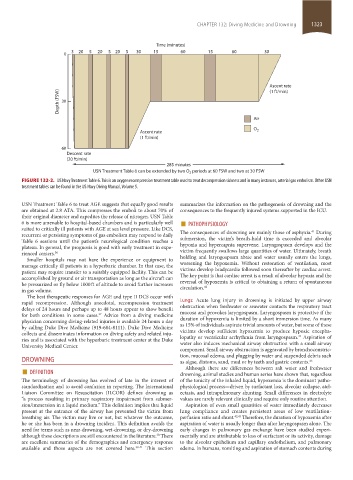
                    FIGURE 132-2.  US Navy Treatment Table 6. This is an oxygen recompression treatment table used to treat decompression sickness and in many instances, arterial gas embolism. Other USN
                    treatment tables can be found in the US Navy Diving Manual, Volume 5.

                    USN Treatment Table 6 to treat AGE suggests that equally good results   summarizes the information on the pathogenesis of drowning and the
                    are obtained at 2.8 ATA. This compresses the emboli to about 70% of   consequences to the frequently injured systems supported in the ICU.
                    their original diameter and expedites the release of nitrogen. USN Table
                    6 is more amenable to hospital-based chambers and is particularly well     ■  PATHOPHYSIOLOGY
                    suited to critically ill patients with AGE at sea level pressure. Like DCS,                       41
                    recurrent or persisting symptoms of gas embolism may respond to daily   The consequences of drowning are mainly those of asphyxia.  During
                    Table 6 sessions until the patient’s neurological condition reaches a   submersion, the victim’s breath-hold time is exceeded and alveolar
                    plateau. In general, the prognosis is good with early treatment in expe-  hypoxia and hypercapnia supervene. Laryngospasm develops and the
                    rienced centers. 36                                   victim frequently swallows large quantities of water. Ultimately, breath
                     Smaller hospitals may not have the experience or equipment to   holding  and  laryngospasm  abate  and  water  usually  enters  the  lungs,
                    manage critically ill patients in a hyperbaric chamber. In that case, the   worsening the hypoxemia. Without restoration of ventilation, most
                    patient may require transfer to a suitably equipped facility. This can be   victims develop bradycardia followed soon thereafter by cardiac arrest.
                    accomplished by ground or air transportation as long as the aircraft can   The key point is that cardiac arrest is a result of alveolar hypoxia and the
                    be pressurized or fly below 1000 ft of altitude to avoid further increases   reversal of hypoxemia is critical to obtaining a return of spontaneous
                                                                                  42
                    in gas volume.                                        circulation.
                     The best therapeutic responses for AGE and type II DCS occur with
                    rapid recompression. Although anecdotal, recompression treatment   Lungs:  Acute lung injury in drowning is initiated by upper airway
                    delays of 24 hours and perhaps up to 48 hours appear to show benefit   obstruction when freshwater or seawater contacts the respiratory tract
                    for both conditions in some cases.  Advice from a diving medicine   mucosa and provokes laryngospasm. Laryngospasm is protective if the
                                              37
                    physician concerning diving-related injuries is available 24 hours a day   duration of hypoxemia is limited by a short immersion time. As many
                    by calling Duke Dive Medicine (919-684-8111). Duke Dive Medicine   as 15% of individuals aspirate trivial amounts of water, but some of these
                    collects and disseminates information on diving safety and related inju-  victims develop sufficient hypoxemia to produce hypoxic encepha-
                                                                                                                  42
                    ries and is associated with the hyperbaric treatment center at the Duke   lopathy or ventricular arrhythmia from laryngospasm.  Aspiration of
                    University Medical Center.                            water also induces mechanical airway obstruction with a small airway
                                                                          component. Small airway obstruction is aggravated by bronchoconstric-
                                                                          tion, mucosal edema, and plugging by water and suspended debris such
                    DROWNING                                              as algae, diatoms, sand, mud or by teeth and gastric contents. 43
                        ■  DEFINITION                                     drowning, animal studies and human series have shown that, regardless
                                                                           Although there are differences between salt water and freshwater
                    The terminology of drowning has evolved of late in the interest of   of the tonicity of the inhaled liquid, hypoxemia is the dominant patho-
                    standardization and to avoid confusion in reporting. The International   physiological process—driven by surfactant loss, alveolar collapse, atel-
                    Liaison Committee on Resuscitation (ILCOR) defines drowning as     ectasis,  and  intrapulmonary  shunting.  Small  differences  in  electrolyte
                    “a process resulting in primary respiratory impairment from submer-  values are rarely relevant clinically and require only routine attention.
                    sion/immersion in a liquid medium.” This definition implies that liquid     Aspiration of even small quantities of water immediately decreases
                    present  at  the  entrance  of  the  airway  has  prevented  the  victim  from   lung compliance and creates persistent areas of low ventilation-
                    breathing air. The victim may live or not, but whatever the outcome,   perfusion ratio and shunt. 42,43  Therefore, the duration of hypoxemia after
                    he or she has been in a drowning incident. This definition avoids the   aspiration of water is usually longer than after laryngospasm alone. The
                    need for terms such as near-drowning, wet-drowning, or dry-drowning   early changes in pulmonary gas exchange have been studied experi-
                                                                  38
                    although these descriptions are still encountered in the literature.  There   mentally and are attributable to loss of surfactant or its activity, damage
                    are excellent summaries of the demographics and emergency response   to the alveolar epithelium and capillary endothelium, and pulmonary
                    available and those aspects are not covered here. 38-41  This section   edema. In humans, vomiting and aspiration of stomach contents during


            section11.indd   1323                                                                                      1/19/2015   10:56:12 AM

