


Page 1849 - Hall et al (2015) Principles of Critical Care-McGraw-Hill
P. 1849
1318     PART 11: Special Problems in Critical Care


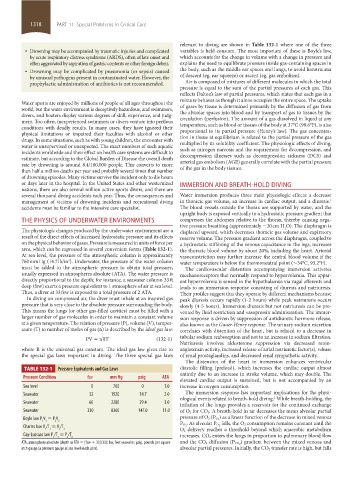
                                                                       relevant to diving are shown in  Table 132-1 where one of the three
                     • Drowning may be accompanied by traumatic injuries and complicated   variables is held constant. The most important of these is Boyle’s law,
                    by acute respiratory distress syndrome (ARDS), often of late onset and   which accounts for the change in volume with a change in pressure and
                    often aggravated by aspiration of gastric contents or other foreign debris.  explains the need to equilibrate pressure inside gas-containing spaces in
                     • Drowning may be complicated by pneumonia (or sepsis) caused   the body, such as the middle ear spaces and lungs, to avoid barotrauma
                    by unusual pathogens present in contaminated water. However, the   of descent (eg, ear squeeze) or ascent (eg, gas embolism).
                    prophylactic administration of antibiotics is not recommended.  Air is composed of mixtures of different molecules in which the total
                                                                       pressure is equal to the sum of the partial pressures of each gas. This
                                                                       reflects Dalton’s law of partial pressures, which states that each gas in a
                                                                       mixture behaves as though it alone occupies the entire space. The uptake
                 Water sports are enjoyed by millions of people of all ages throughout the   of gases by tissue is determined primarily by the diffusion of gas from
                 world, but the water environment is deceptively hazardous, and swimmers,
                 divers, and boaters display various degrees of skill, experience, and judg-  the alveolar spaces into blood and by transport of gas to tissues by the
                                                                       circulation (perfusion). The amount of a gas dissolved in liquid at any
                 ment. Too often, inexperienced swimmers or divers venture into perilous
                 conditions  with  deadly results.  In  many  cases,  they  have  ignored  their   temperature, such as blood or tissues of the body at 37°C (98.6°F), is also
                                                                       proportional to its partial pressure (Henry’s law). The gas concentra-
                 physical  limitations  or impaired  their faculties  with alcohol or  other
                 drugs. In some situations, such as with young children, the encounter with   tion in tissue at equilibrium is related to the partial pressure of the gas
                                                                       multiplied by its solubility coefficient. The physiologic effects of diving,
                 water is unsupervised or unexpected. The exact numbers of such aquatic
                 incidents worldwide and their effect on health care systems are difficult to   such as nitrogen narcosis and the requirement for decompression, and
                                                                       decompression illnesses such as decompression sickness (DCS) and
                 estimate, but according to the Global Burden of Disease the overall death
                 rate by drowning is around 8.4/100,000 people. This converts to more   arterial gas embolism (AGE) generally correlate with the partial pressure
                                                                       of the gas in the body tissues.
                 than half a million deaths per year and probably several times that number
                 of drowning episodes. Many victims survive the incident only to die hours
                 or days later in the hospital. In the United States and other westernized   IMMERSION AND BREATH-HOLD DIVING
                 nations, there are also several million active sports divers, and there are
                 several thousand diving accidents each year. Thus, the consequences and   Water immersion produces three main physiologic effects: a decrease
                 management of victims of drowning incidents and recreational diving   in thoracic gas volume, an increase in cardiac output, and a diuresis.
                                                                                                                          1
                 accidents must be familiar to the intensive care specialist.  The blood vessels outside the thorax are supported by water, and the
                                                                       upright body is exposed vertically to a hydrostatic pressure gradient that
                 THE PHYSICS OF UNDERWATER ENVIRONMENTS                compresses the abdomen relative to the thorax, thereby causing nega-
                                                                       tive pressure breathing (approximately −20 cm H O). The diaphragm is
                                                                                                           2
                 The physiologic changes produced by the underwater environment are a   displaced upward, which decreases thoracic gas volume and expiratory
                 result of the direct effects of increased hydrostatic pressure and its effects   reserve volume. The pressure gradient across the diaphragm, coupled to
                 on the physical behavior of gases. Pressure is measured in units of force per   a hydrostatic stiffening of the venous capacitance in the legs, increases
                 area, which can be expressed in several convenient forms (Table 132-1).    the thoracic blood volume by about 20%, including the heart. Arterial
                 At sea level, the pressure of the atmospheric column is approximately   vasoconstriction may further increase the central blood volume if the
                 760 mm Hg (14.7 lb/in ). Underwater, the pressure of the water column   water temperature is below the thermoneutral point (∼34°C, 93.2°F).
                                 2
                 must be added to the atmospheric  pressure to obtain total pressure,   The cardiovascular distention accompanying immersion activates
                 usually expressed in atmospheres absolute (ATA). The water pressure is   mechanoreceptors that normally respond to hypervolemia. This appar-
                 directly proportional to the depth; for instance, a seawater column 33 ft   ent hypervolemia is sensed in the hypothalamus via vagal afferents and
                 deep (fsw) exerts a pressure equivalent to 1 atmosphere of air at sea level.   leads to an immersion response consisting of diuresis and natriuresis.
                 Thus, a diver at 33 fsw is exposed to a total pressure of 2 ATA.  Their profiles suggest that they operate by different mechanisms because
                   In diving on compressed air, the diver must inhale at an inspired gas   peak diuresis occurs rapidly (1-2 hours) while peak natriuresis occurs
                 pressure that is very close to the absolute pressure surrounding the body.   slowly (4-5 hours). Immersion diuresis but not natriuresis can be pre-
                 This means the lungs (or other gas-filled cavities) must be filled with a   vented by fluid restriction and vasopressin administration. The immer-
                 larger number of gas molecules in order to maintain a constant volume   sion response is driven by suppression of antidiuretic hormone release,
                 at a given temperature. The relation of pressure (P), volume (V), temper-  also known as the Gauer-Henry response. The urinary sodium excretion
                 ature (T) to number of moles of gas (n) is described by the ideal gas law:  correlates with distention of the heart, but is related to a decrease in
                                       PV = nRT                (132-1)  tubular sodium reabsorption and not to an increase in sodium filtration.
                                                                       Natriuresis involves aldosterone suppression via decreased renin-
                 where R is the universal gas constant. The ideal gas law gives rise to   angiotensin activity, increased release of atrial natriuretic factor(s), release
                 the special gas laws important in diving. The three special gas laws   of renal prostaglandins, and decreased renal sympathetic activity.
                                                                         The distension of the heart in immersion enhances ventricular
                   TABLE 132-1    Pressure Equivalents and Gas Laws    diastolic filling (preload), which increases the cardiac output almost
                                                                       entirely due to an increase in stroke volume, which may double. The
                  Pressure Condition    fsw    mm Hg     psig    ATA
                                                                       elevated cardiac output is sustained, but is not accompanied by an
                  Sea level              0      760       0       1.0  increase in oxygen consumption.
                  Seawater              33      1520     14.7     2.0    The immersion response has important implications for the physi-
                                                                       ological events related to breath-hold diving.  While breath-holding, the
                                                                                                       2
                  Seawater              66      2280     29.4     3.0  inflation of the lungs provides a reservoir for the continued exchange
                  Seawater              330     8360     147.0   11.0  of O 2 for CO 2. A breath-hold in air decreases the mean alveolar partial
                  Boyle law P V  = P V                                 pressure of O 2 (P O 2 ) as a linear function of the decrease in mixed venous
                        1 1  2 2                                                      falls, the O 2 consumption remains constant until the
                  Charles law V /T  = V /T                             P O 2 . As alveolar P O 2
                         1  1  2  2                                    O 2 delivery reaches a threshold beyond which anaerobic metabolism
                  Gay-Lussaac law P /T  = P /T                         increases. CO 2 enters the lungs in proportion to pulmonary blood flow
                            1  1  2  2
                 ATA, atmosphere absolute (depth in ATA = [fsw + 33]/33); fsw, feet seawater; psig, pounds per square   and the CO 2 diffusion (P CO 2 ) gradient between the mixed venous and
                 inch gauge (a pressure gauge at sea level reads zero).  alveolar partial pressures. Initially, the CO 2 transfer rate is high, but falls


            section11.indd   1318                                                                                      1/19/2015   10:56:09 AM

