


Page 451 - Clinical Hematology_ Theory _ Procedures ( PDFDrive )
P. 451
CHAPTER 22  ■  Lymphoid and Plasma Cell Neoplasms                                  435


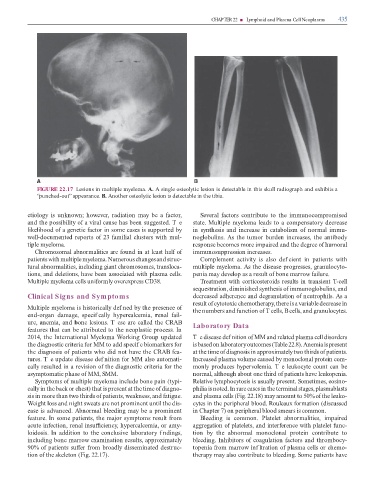
                         FIGURE 22.17  Lesions in   ultiple   yelo    . A. A single osteolytic lesion is   etect  ble in this skull r    iogr  ph   n   exhibits
                         “punche  -out”   ppe  r  nce. B. Another osteolytic lesion is   etect  ble in the tibi  .


                     etiology  is  unknown;  however,  r    i  tion      y  be         ctor,                                        Sever  l     ctors  contribute  to  the  i    unoco  pro  ise

                    n   the possibility o     vir  l c  use h  s been suggeste  . T e                                          st  te. Multiple   yelo     le    s to    co  pens  tory   ecre  se

                   likelihoo   o     genetic    ctor in so  e c  ses is supporte   by                                          in synthesis   n   incre  se in c  t  bolis   o  nor    l i    u-


                   well-  ocu  ente   reports o  23      ili  l clusters with   ul-                                            noglobulins. As the tu  or bur  en incre  ses, the   ntibo  y
                   tiple   yelo    .                                                                                           response beco  es   ore i  p  ire     n   the   egree o  hu  or  l

                        Chro  oso    l   bnor    lities   re  oun   in   t le  st h  l  o                                      i    unosuppression incre  ses.

                   p  tients with   ultiple   yelo    . Nu  erous ch  nges   n   struc-                                             Co  ple  ent    ctivity  is    lso    ef cient  in  p  tients  with

                   tur  l   bnor    lities, inclu  ing gi  nt chro  oso  es, tr  nsloc  -                                       ultiple   yelo    . As the   ise  se progresses, gr  nulocyto-

                   tions,   n     eletions, h  ve been   ssoci  te   with pl  s     cells.                                     peni       y   evelop   s    result o  bone     rrow    ilure.

                   Multiple   yelo     cells uni or  ly overexpress CD38.                                                            re  t  ent with corticosteroi  s results in tr  nsient   -cell

                                                                                                                               sequestr  tion,   i  inishe   synthesis o  i    unoglobulins,   n

                   Clinical Signs and Symptoms                                                                                  ecre  se      herence   n   egr  nul  tion o  neutrophils. As

                                                                                                                               result o  cytotoxic che  other  py, there is    v  ri  ble   ecre  se in
                   Multiple   yelo     is historic  lly   ef ne   by the presence o                                            the nu  bers   n    unction o     cells, B cells,   n   gr  nulocytes.

                   en  -org  n          ge,  specif c  lly  hyperc lce  i  ,  ren  l     il-

                   ure, ane  i  ,   n   bone lesions. T ese   re c  lle   the CRAB                                             Laboratory Data

                    e  tures th  t c  n be   ttribute   to the neopl  stic process. In

                   2014, the Intern  tion  l Myelo     Working Group up    te                                                  Te   ise  se   ef nition o  MM   n   rel  te   pl  s     cell   isor  ers

                   the   i  gnostic criteri    or MM to        specif c bio    rkers  or                                       is b  se   on l  bor  tory outco  es (    ble 22.8). Ane  i   is present

                   the   i  gnosis o  p  tients who   i   not h  ve the CRAB  e  -                                               t the ti  e o    i  gnosis in   pproxi    tely two thir  s o  p  tients.

                   tures. T e up    te   ise  se   ef nition  or MM   lso   uto    ti-                                         Incre  se   pl  s     volu  e c  use   by   onoclon  l protein co  -

                   c  lly resulte   in    revision o  the   i  gnostic criteri    or the                                         only pro  uces hypervole  i  . T e leukocyte count c  n be

                     sy  pto    tic ph  se o  MM, SMM.                                                                         nor    l,   lthough   bout one thir   o  p  tients h  ve leukopeni  .

                        Sy  pto  s o    ultiple   yelo     inclu  e bone p  in (typi-                                          Rel  tive ly  phocytosis is usu  lly present. So  eti  es, eosino-

                   c  lly in the b  ck or chest) th  t is present   t the ti  e o    i  gno-                                   phili   is note  . In r  re c  ses in the ter  in  l st  ges, pl  s    bl  sts

                   sis in   ore th  n two thir  s o  p  tients, we  kness,   n      tigue.                                       n   pl  s     cells (Fig. 22.18)     y     ount to 50% o  the leuko-

                   Weight loss   n   night swe  ts   re not pro  inent until the   is-                                         cytes in the peripher  l bloo  . Roule  ux  or    tion (  iscusse

                   e  se is     v  nce  . Abnor    l blee  ing     y be    pro  inent                                          in Ch  pter 7) on peripher  l bloo   s  e  rs is co    on.

                    e  ture. In so  e p  tients, the     jor sy  pto  s result  ro                                                  Blee  ing  is  co    on.  Pl  telet    bnor    lities,  i  p  ire

                     cute in ection, ren  l insu  ciency, hyperc  lce  i  , or     y-                                           ggreg  tion o  pl  telets,   n   inter erence with pl  telet  unc-

                   loi  osis. In       ition to the conclusive l  bor  tory  f n  ings,                                        tion  by  the    bnor    l    onoclon  l  protein  contribute  to

                   inclu  ing bone     rrow ex    in  tion results,   pproxi    tely                                           blee  ing. Inhibitors o  co  gul  tion    ctors   n   thro  bocy-

                   90% o  p  tients su  er  ro   bro    ly   isse  in  te     estruc-                                          topeni    ro       rrow inf ltr  tion o  pl  s     cells or che  o-

                   tion o  the skeleton (Fig. 22.17).                                                                          ther  py     y   lso contribute to blee  ing. So  e p  tients h  ve

