


Page 452 - Clinical Hematology_ Theory _ Procedures ( PDFDrive )
P. 452
436            PART 6  ■  Neoplastic Disorders


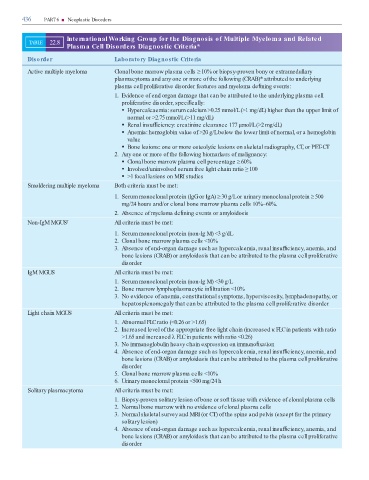
                                             International Working Group for the Diagnosis of Multiple Myeloma and Related
                    TABLE        22.8
                                             Plasma Cell Disorders Diagnostic Criteria*


                   Disorder                                                 Laboratory Diagnostic Criteria


                   Active multiple myeloma                                  Clonal bone marrow plasma cells ≥10% or biopsy-proven bony or extramedullary

                                                                            plasmacytoma and any one or more of the following (CRAB)* attributed to underlying

                                                                            plasma cell proliferative disorder features and myeloma de  ning events:


                                                                            1.  Evidence of end organ damage that can be attributed to the underlying plasma cell
                                                                                 proliferative disorder, speci  cally:


                                                                                    Hypercalcaemia: serum calcium >0.25 mmol/L (>1 mg/dL) higher than the upper limit of
                                                                                    normal or >2.75 mmol/L (>11 mg/dL)


                                                                                    Renal insuf  ciency: creatinine clearance 177 µmol/L (>2 mg/dL)
                                                                                    Anemia: hemoglobin value of >20 g/L below the lower limit of normal, or a hemoglobin


                                                                                    value
                                                                                    Bone lesions: one or more osteolytic lesions on skeletal radiography, CT, or PET-CT


                                                                            2.  Any one or more of the following biomarkers of malignancy:
                                                                                    Clonal bone marrow plasma cell percentage ≥60%


                                                                                    Involved/uninvolved serum free light chain ratio ≥100
                                                                                    >1 focal lesions on MRI studies


                   Smoldering multiple myeloma                              Both criteria must be met:


                                                                            1.  Serum monoclonal protein (IgG or IgA) ≥30 g/L or urinary monoclonal protein ≥500

                                                                                 mg/24 hours and/or clonal bone marrow plasma cells 10%–60%.


                                                                            2.  Absence of myeloma de  ning events or amyloidosis

                   Non-IgM MGUS              †                              All criteria must be met:


                                                                            1.  Serum monoclonal protein (non-Ig M) <3 g/dL

                                                                            2.  Clonal bone marrow plasma cells <10%

                                                                            3.  Absence of end-organ damage such as hypercalcemia, renal insuf  ciency, anemia, and

                                                                                 bone lesions (CRAB) or amyloidosis that can be attributed to the plasma cell proliferative

                                                                                 disorder


                   IgM MGUS                                                 All criteria must be met:

                                                                            1.  Serum monoclonal protein (non-Ig M) <30 g/L

                                                                            2.  Bone marrow lymphoplasmacytic in  ltration <10%

                                                                            3.  No evidence of anemia, constitutional symptoms, hyperviscosity, lymphadenopathy, or

                                                                                 hepatosplenomegaly that can be attributed to the plasma cell proliferative disorder


                   Light chain MGUS                                         All criteria must be met:


                                                                            1.  Abnormal FLC ratio (<0.26 or >1.65)

                                                                            2.  Increased level of the appropriate free light chain (increased κ FLC in patients with ratio

                                                                                 >1.65 and increased λ FLC in patients with ratio <0.26)

                                                                            3.  No immunoglobulin heavy chain expression on immuno  xation

                                                                            4.  Absence of end-organ damage such as hypercalcemia, renal insuf  ciency, anemia, and

                                                                                 bone lesions (CRAB) or amyloidosis that can be attributed to the plasma cell proliferative

                                                                                 disorder

                                                                            5.  Clonal bone marrow plasma cells <10%

                                                                            6.  Urinary monoclonal protein <500 mg/24 h


                   Solitary plasmacytoma                                    All criteria must be met:


                                                                            1.  Biopsy-proven solitary lesion of bone or soft tissue with evidence of clonal plasma cells
                                                                            2.  Normal bone marrow with no evidence of clonal plasma cells


                                                                            3.  Normal skeletal survey and MRI (or CT) of the spine and pelvis (except for the primary
                                                                                 solitary lesion)


                                                                            4.  Absence of end-organ damage such as hypercalcemia, renal insuf  ciency, anemia, and
                                                                                 bone lesions (CRAB) or amyloidosis that can be attributed to the plasma cell proliferative


                                                                                 disorder

