


Page 531 - Clinical Hematology_ Theory _ Procedures ( PDFDrive )
P. 531
CHAPTER 26  ■  Disorders of Primary Hemostasis and Thrombosis Vasculature and Platelets                                               515


                   Ly    ho  as or  euke  ias that arise  ro   B  y    hocytes are

                   the   ost  co    on. Non-Ho  gkin’s   y    ho  a    aking  u

                   the   ajority o  cases.


                   Laboratory Findings


                   A   e  nitive   iagnosis o  WAS can be   a  e by sequencing

                   o  the WAS gene to i  enti y a   utation an   by stu  ying the

                     atient’s  b oo    ce  s  to    eter  ine  i   the  WAS      rotein  is

                   ex  resse   at nor  a   eve s. T ese tests are   one in s  ecia -

                   ize    aboratories an   require b oo   or other tissue.


                   MYH9-Related Thrombocytopenia

                   Syndromes (May-Hegglin Anomaly)


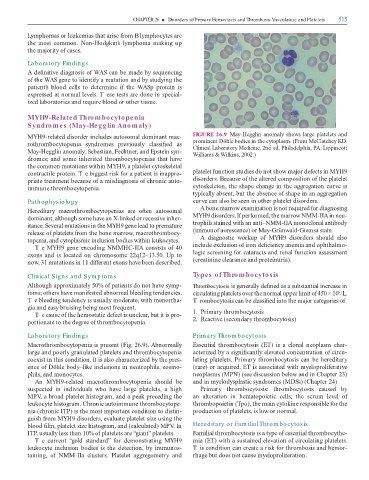
                   MYH9-re ate     isor  er inc u  es autoso  a    o  inant   ac-                                              FIGURE  26.9  May-Hegg in ano  a y shows  arge    ate ets an

                   rothro  bocyto  enia  syn  ro  es    revious y  c assi  e    as                                               ro  inent Döh e bo  ies in the cyto   as  . (Fro   McC atchey KD.
                                                                                                                               Clinical Laboratory Medicine, 2n   e  , Phi a  e   hia, PA: Li    incott
                   May-Hegg in ano  a y; Sebastian, Fechtner, an   E  stein syn-                                               Wi  ia  s & Wi kins, 2002.)

                     ro  es; an   so  e inherite   thro  bocyto  enias that have

                   the co    on   utations within MYH9, a    ate et cytoske eta

                   contracti e   rotein. T e biggest risk  or a   atient is ina    ro-                                            ate et  unction stu  ies   o not show   ajor   e ects in MYH9

                     riate treat  ent because o  a   is  iagnosis o  chronic auto-                                               isor  ers. Because o  the a tere   co    osition o  the    ate et

                   i    une thro  bocyto  enia.                                                                                cytoske eton, the sha  e change in the aggregation curve is
                                                                                                                               ty  ica  y absent, but the absence o  sha  e in an aggregation


                   Pathophysiology                                                                                             curve can a so be seen in other    ate et   isor  ers.

                   Here  itary    acrothro  bocyto  enias  are  o  en  autoso  a                                                    A bone   arrow exa  ination is not require    or   iagnosing


                    o  inant, a though so  e have an X- inke  or recessive inher-                                              MYH9   isor  ers. I    er or  e  , the   arrow NMM-IIA in neu-
                   itance. Severa    utations in the MYH9 gene  ea   to   re  ature                                            tro  hi s staine   with an anti–NMM-IIA   onoc ona  antibo  y


                   re ease o     ate ets  ro   the bone   arrow,   acrothro  bocy-                                             (i    unof uorescence) or May-Grünwa   -Gie  sa stain.
                   to  enia, an   cyto   as  ic inc usion bo  ies within  eukocytes.                                                A    iagnostic  worku    o   MYH9    isor  ers  shou     a so


                        Te MYH9 gene enco  ing NMMHC-IIA consists o  40                                                        inc u  e exc usion o  iron   e  ciency ane  ia an   o  htha   o-
                   exons an   is  ocate   on chro  oso  e 22q12–13.50. U   to                                                   ogic screening  or cataracts an   rena   unction assess  ent


                   now, 31   utations in 11   i  erent exons have been   escribe  .                                            (creatinine c earance an     roteinuria).


                   Clinical Signs and Sym ptom s                                                                               Types of Thrombocytosis


                   A though a    roxi  ate y 50% o    atients   o not have sy    -                                             Thrombocytosis is genera  y   e  ne   as a substantia  increase in

                   to  s; others have   ani este   abnor  a  b ee  ing ten  encies.                                            circu ating    ate ets over the nor  a  u    er  i  it o  450 × 10 /L.
                                                                                                                                                                                                                              9
                   Te b ee  ing ten  ency is usua  y   o  erate, with   enorrha-                                               T ro  bocytosis can be c assi  e   into the   ajor categories o

                   gia an   easy bruising being   ost  requent.

                        T e cause o  the he  ostatic   e ect is unc ear, but it is   ro-                                       1.  Pri  ary thro  bocytosis

                     ortionate to the   egree o  thro  bocyto  enia.                                                           2.  Reactive (secon  ary thro  bocytosis)


                   Laboratory Findings                                                                                         Prim ary Throm bocytosis


                   Macrothro  bocyto  enia is   resent (Fig. 26.9). Abnor  a  y                                                Essentia   thro  bocytosis  (E  )  is  a  c ona   neo   as    char-

                    arge an     oor y granu ate      ate ets an   thro  bocyto  enia                                           acterize   by a signi  cant y e evate   concentration o  circu-

                   coexist in this con  ition. It is a so characterize   by the   res-                                          ating    ate ets. Pri  ary thro  bocytosis can be here  itary

                   ence o  Döh e bo  y– ike inc usions in neutro  hi s, eosino-                                                (rare) or acquire  . E   is associate   with   ye o  ro i erative

                     hi s, an     onocytes.                                                                                    neo   as  s (MPN) (see   iscussion be ow an   in Cha  ter 23)

                        An  MYH9-re ate      acrothro  bocyto  enia  shou     be                                               an   in   ye o  ys   astic syn  ro  es (MDSs) (Cha  ter 24)

                   sus  ecte    in  in  ivi  ua s  who  have   arge     ate ets,  a  high                                           Pri  ary  thro  bocytosis:  thro  bocytosis  cause    by

                   MPV, a broa      ate et histogra  , an   a   eak   rece  ing the                                            an  a teration  in  he  ato  oietic  ce  s;  the  seru     eve   o

                    eukocyte histogra  . Chronic autoi    une thro  bocyto  e-                                                   thro  bo  oietin (    o), the   ain cytokine res  onsib e  or the

                   nia (chronic I  P) is the   ost i    ortant con  ition to   istin-                                            ro  uction o     ate ets, is  ow or nor  a .

                   guish  ro   MYH9   isor  ers, eva uate    ate et size using the

                   b oo        ,    ate et size histogra  , an   (ca cu ate  ) MPV. In                                         Hereditary or Fam ilial Throm bocytosis

                   I  P, usua  y  ess than 10% o     ate ets are “giant”    ate ets.                                           Fa  i ia  thro  bocytosis is a ty  e o  essentia  thro  bocythe-

                        T e  current  “go     stan  ar  ”   or    e  onstrating  MYH9                                            ia (E  ) with a sustaine   e evation o  circu ating    ate ets.

                    eukocyte  inc usion  bo  ies  is  the    etection,  by  i    unos-                                         Tis con  ition can create a risk  or thro  bosis an   he  or-

                   taining,  o   NMM-IIa  c usters.  P ate et  aggrego  etry  an                                               rhage but   oes not cause   ye o  ro i eration.

