


Page 566 - Clinical Hematology_ Theory _ Procedures ( PDFDrive )
P. 566
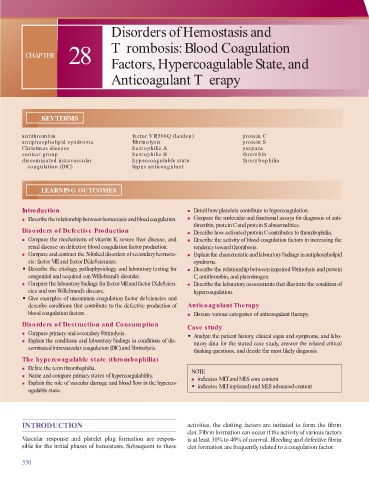
Disorders of Hemostasis and


                                              28                          Trombosis: Blood Coagulation


                  CHAPTER                                                 Factors, Hypercoagulable State, and


                                                                          Anticoagulant T erapy


                            KEY TERMS


               antithrom bin                                                           factor V R506Q (Leiden)                                                 protein C

               antiphospholipid syndrom e                                               brinolysis                                                             protein S
               Christm as disease                                                      hem ophilia A                                                           purpura

               contact group                                                           hem ophilia B                                                           throm bin
               dissem inated intravascular                                             hypercoagulable state                                                   throm bophilia

                    coagulation (DIC)                                                  lupus anticoagulant


                            LEARNING OUTCOMES


               Introduction                                                                                                ■    Detail how platelets contribute to hypercoagulation.


               ■    Describe the relationship between hemostasis and blood coagulation.                                    ■    Compare the molecular and functional assays for diagnosis of anti-
                                                                                                                               thrombin, protein C and protein S abnormalities.
               Disorders of Defective Production                                                                           ■    Describe how activated protein C contributes to thrombophilia.


               ■    Compare the mechanisms of vitamin K, severe liver disease, and                                         ■    Describe the activity of blood coagulation factors in increasing the
                   renal disease on defective blood coagulation factor production.                                             tendency toward thrombosis.


               ■    Compare and contrast the X-linked disorders of secondary hemosta-                                      ■    Explain the characteristic and laboratory   ndings in antiphospholipid
                   sis: factor VIII and factor IX de  ciencies.                                                                syndrome.

                 Describe the etiology, pathophysiology, and laboratory testing for                                        ■    Describe the relationship between impaired   brinolysis and protein

                   congenital and acquired von Willebrand’s disorder.                                                          C, antithrombin, and plasminogen.


               ■    Compare the laboratory   ndings for factor VIII and factor IX de  cien-                                ■    Describe the laboratory assessments that illustrate the condition of
                   cies and von Willebrand’s disease.                                                                          hypercoagulation.

                 Give examples of uncommon coagulation factor de  ciencies and

                   describe conditions that contribute to the defective production of                                      Anticoagulant Therapy

                   blood coagulation factors.                                                                              ■    Discuss various categories of anticoagulant therapy.


               Disorders of Destruction and Consumption                                                                    Case study


               ■    Compare primary and secondary   brinolysis.                                                              Analyze the patient history, clinical signs and symptoms, and labo-

               ■    Explain the conditions and laboratory   ndings in conditions of dis-                                       ratory data for the stated case study, answer the related critical
                   seminated intravascular coagulation (DIC) and   brinolysis.
                                                                                                                               thinking questions, and decide the most likely diagnosis.

               The hypercoagulable state (thrombophilia)


               ■    De  ne the term thrombophilia.                                                                            NOTE:

               ■    Name and compare primary states of hypercoagulability.
                                                                                                                              ■   indicates MLT and MLS core content
               ■    Explain the role of vascular damage and blood   ow in the hyperco-                                          indicates MLT (optional) and MLS advanced content

                   agulable state.


               IN  RODUC  ION                                                                                               activities, the c otting  actors are initiate   to  or   the   brin

                                                                                                                           c ot. Fibrin  or  ation can occur i  the activity o  various  actors
               Vascu ar  res  onse  an       ate et     ug   or  ation  are  res  on-                                      is at  east 30% to 40% o  nor  a . B ee  ing an     e ective   brin

               sib e  or the initia    hases o  he  ostasis. Subsequent to these                                           c ot  or  ation are  requent y re ate   to a coagu ation  actor.


               550

