


Page 705 - Clinical Hematology_ Theory _ Procedures ( PDFDrive )
P. 705
CHAPTER 32  ■  Laboratory Manual: Manual Procedures in Hematology                                         689


                             SPECIAL STAINS (continued)


                   Clinical Applications                                                                                       bloo  .  T ese  cells  shoul    appear  rarely.  T e  results  are

                   Heinz bo  ies are  orme   when the glycolytic enzymes in the                                                expresse   as a percentage. Normal a  ults have less than 1%

                   erythrocytes are unable to prevent the oxi  ation o  hemo-                                                  Hb F–containing cells. In ant values are higher, with new-

                   globin. As a result, the hemoglobin is eventually   enature                                                 born in ants having 70% to 90% Hb F–containing cells.

                   an   precipitate   to  orm Heinz bo  ies. Erythrocytic enzyme                                               Clinical Applications

                   systems   ecrease as the cell ages; there ore, occasional Heinz

                   bo  ies will be observe   in normal bloo  .                                                                 Increase   amounts o  Hb F are  oun   in various hemoglobin-

                        Increase   numbers o  Heinz bo  ies represent unstable                                                 opathies such as here  itary persistence o   etal hemoglobin,

                    orms o  hemoglobin that are present in a number o  hemo-                                                   sickle cell anemia, an   the thalassemias.

                   lytic   isor  ers. Heinz bo  ies occur in   isor  ers such as G6PD                                               T is proce  ure in CLSI  ormat is provi  e   on this book’s

                   or glutathione   ef ciencies, secon  ary to the action o  certain                                           companion Web site at thepoint.lww.com/  urgeon6e.

                   oxi  ant   rugs, an   in the presence o  unstable hemoglobins                                               PERIODIC ACID-SCHIFF (PAS) IN LEUKOCYTES:

                   such as Hb Zurich an   Hb H.                                                                                CYTOCHEMICAL OR HISTOCHEMICAL STAINING

                        T is proce  ure in CLSI  ormat is provi  e   on this book’s                                            METHOD

                   companion Web site at thepoint.lww.com/  urgeon6e.
                                                                                                                               Principle


                   HEMOGLOBIN F DETERMINATION BY ACID                                                                          When treate   with perio  ic aci  , glycols are oxi  ize   to

                   ELUTION: KLEIHAUER AND BETKE METHOD                                                                         al  ehy  es. A  er reaction with Schi  ’s reagent (a mixture o

                   MODIFIED BY SHEPARD, WEATHERALL, AND                                                                        pararosaniline an   so  ium metabisulf te), a pararosaniline

                   CONLEY                                                                                                      a    uct is release   that stains the glyco-containing cellular

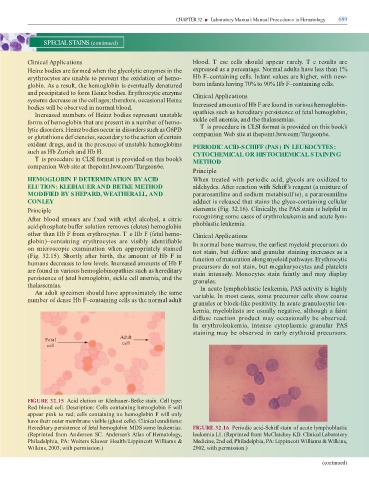
                   Principle                                                                                                   elements (Fig. 32.16). Clinically, the PAS stain is help ul in


                   A  er  bloo    smears  are  f xe    with  ethyl  alcohol,  a  citric                                        recognizing some cases o  erythroleukemia an   acute lym-

                   aci  ›phosphate bu  er solution removes (elutes) hemoglobin                                                 phoblastic leukemia.

                   other than Hb F  rom erythrocytes. T e Hb F ( etal hemo-                                                    Clinical Applications

                   globin)–containing  erythrocytes  are  visibly  i  enti iable                                               In normal bone marrow, the earliest myeloi   precursors   o

                   on  microscopic  examination  when  appropriately  staine                                                   not stain, but   i  use an   granular staining increases as a

                   (Fig.  32.15).  Shortly  a  er  birth,  the  amount  o   Hb  F  in                                           unction o  maturation along myeloi   pathways. Erythrocytic

                   humans   ecreases to low levels. Increase   amounts o  Hb F                                                 precursors   o not stain, but megakaryocytes an   platelets

                   are  oun   in  various hemoglobinopathies such as here  itary                                               stain  intensely.  Monocytes  stain   aintly  an    may    isplay

                   persistence o   etal hemoglobin, sickle cell anemia, an   the                                               granules.

                   thalassemias.                                                                                                    In acute lymphoblastic leukemia, PAS activity is highly

                        An a  ult specimen shoul   have approximately the same                                                 variable. In most cases, some precursor cells show coarse

                   number o    ense Hb F–containing cells as the normal a  ult
                                                                                                                               granules or block-like positivity. In acute granulocytic leu-

                                                                                                                               kemia, myeloblasts are usually negative, although a  aint

                                                                                                                                i  use  reaction  pro  uct  may  occasionally  be  observe  .

                                                                                                                               In   erythroleukemia,  intense  cytoplasmic  granular  PAS

                                                                                                                               staining may be observe   in early erythroi   precursors.
                                                                                Adult
                               Fetal

                                cell                                             cell


                   FIGURE 32.15  Aci   elution or Kleihauer-Betke stain. Cell type:

                   Re   bloo   cell. Description: Cells containing hemoglobin F will

                   appear pink to re  ; cells containing no hemoglobin F will only
                   have their outer membrane visible (ghost cells). Clinical conditions:

                   Here  itary persistence o   etal hemoglobin MDS some leukemias.                                             FIGURE 32.16  Perio  ic aci  -Schi   stain o  acute lymphoblastic

                   (Reprinte    rom An  erson SC. Anderson’s Atlas of Hematology,                                              leukemia L1. (Reprinte    rom McClatchey KD. Clinical Laboratory
                   Phila  elphia, PA: Wolters Kluwer Health/Lippincott Williams &                                              Medicine, 2n   e  , Phila  elphia, PA: Lippincott Williams & Wilkins,

                   Wilkins, 2003, with permission.)                                                                            2002, with permission.)


                                                                                                                                                                                                                    (continued)

