


Page 701 - Clinical Hematology_ Theory _ Procedures ( PDFDrive )
P. 701
CHAPTER 32  ■  Laboratory Manual: Manual Procedures in Hematology                                         685


                             SPECIAL HEMATOLOGY PROCEDURES (continued)


                   Clinical Applications                                                                                       type. T e basic principle o  the absorption steps in this proce-

                   It is important to recognize an     istinguish between the vari-                                             ure is comparable to that originally   escribe   by Davi  sohn

                   ous types o  malaria to properly treat the patient.   reatment is                                           in his sheep agglutinin test. Serum or plasma is absorbe   with

                   important because plasmo  ia in ect an     estroy erythrocytes.                                             both guinea pig ki  ney an   bee  erythrocyte stroma. Guinea

                                                                                                                               pig  ki  ney contains only the Forssman antigen, an   bee  eryth-
                   Limitations                                                                                                 rocytes contain only the antigen associate   with in ectious


                   T e proce  ure is te  ious, an   it is  requently very   i  cult to                                         mononucleosis. Guinea pig ki  ney will absorb only heterophile

                   locate in ecte   erythrocytes.                                                                              antibo  ies o  the Forssman type, an   bee  erythrocytes will

                                                                                                                               absorb only the heterophile antibo  y o  in ectious mononucleo-


                   BIBLIOGRAPHY                                                                                                sis. Agglutination o  horse RBCs by the absorbe   patient speci-
                                                                                                                               men is in  icative o  a positive reaction  or heterophile antibo  y.


                   Provi  e   on this book’s companion Web site at http://thepoint.                                                 Tis proce  ure, in CLSI  ormat, is provi  e   on this book’s

                   lww.com/  urgeon6e.                                                                                         companion Web site at http://thepoint.lww.com/  urgeon6e.

                                                                                                                               OSMOTIC FRAGILITY OF ERYTHROCYTES:

                   MONOSPOT TEST (ORTHO DIAGNOSTICS,                                                                           DACIE METHOD

                   RARITAN, NJ)                                                                                                Principle


                   Principle                                                                                                   In the osmotic  ragility test, whole bloo   is a    e   to varying


                   T is proce  ure is base   on agglutination o  horse erythrocytes                                            concentrations o  so  ium chlori  e solution an   allowe   to

                   by heterophile antibo  y present in in ectious mononucleosis.                                               incubate at room temperature. T e amount o  hemolysis is

                   Because horse RBCs exhibit antigens   irecte   against both                                                 then   etermine   by examining the supernatant   ui   either

                   Forssman an   in ectious mononucleosis antibo  ies, a   i  eren-                                            visually or with a spectrophotometer.

                   tial absorption o  the patient’s serum is necessary to   istinguish                                              I  erythrocytes are place   in an isotonic solution (0.85%)

                   the specif c heterophile antibo  y  rom those o  the Forssman                                               o  so  ium chlori  e, water molecules will pass in an   out o


                                                                    Incubated Os motic Fragility


                                                              100
                                                                        Positive osmotic
                                                               90             fragility


                                                               80


                                                               70

                                                                                                                                                Normal
                                                              %   60

                                                              s                                                                                 Control
                                                              i
                                                              ys  50
                                                              l
                                                              o
                                                              m
                                                              e  40
                                                              H

                                                               30


                                                               20


                                                               10


                                                                 0

                                                                  0.15      0.14     0.13      0.12     0.11       0.1     0.09      0.08      0.07     0.06      0.05     0.04      0.03

                                                                                                                        NaCl (M)

                                                                                                   Control                                  Patient

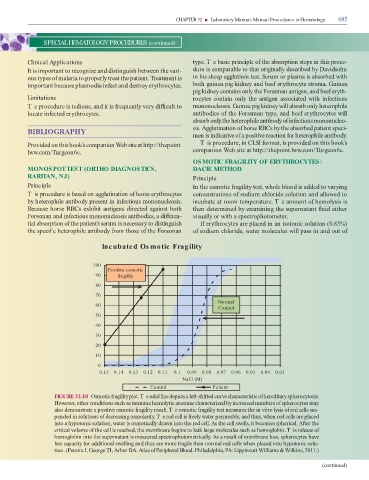
                                     FIGURE 32.10  Osmotic  ragility plot. T e solid line   epicts a le  -shi  e   curve characteristic o  here  itary spherocytosis.

                                     However, other con  itions such as immune hemolytic anemias characterize   by increase   numbers o  spherocytes may

                                     also   emonstrate a positive osmotic  ragility result. T e osmotic  ragility test measures the in vitro lysis o  re   cells sus-
                                     pen  e   in solutions o    ecreasing osmolarity. T e re   cell is  reely water permeable, an   thus, when re   cells are place

                                     into a hypotonic solution, water is osmotically   rawn into the re   cell. As the cell swells, it becomes spherical. A  er the

                                     critical volume o  the cell is reache  , the membrane begins to leak large molecules such as hemoglobin. T is release o

                                     hemoglobin into the supernatant is measure   spectrophotometrically. As a result o  membrane loss, spherocytes have

                                     less capacity  or a    itional swelling an   thus are more  ragile than normal re   cells when place   into hypotonic solu-
                                     tion. (Pereira I, George   I, Arber DA. Atlas of Peripheral Blood. Phila  elphia, PA: Lippincott Williams & Wilkins, 2011.)


                                                                                                                                                                                                                    (continued)

