


Page 702 - Clinical Hematology_ Theory _ Procedures ( PDFDrive )
P. 702
686            PART 8  ■  Fundamentals of Hematological Analysis


                       SPECIAL HEMATOLOGY PROCEDURES (continued)


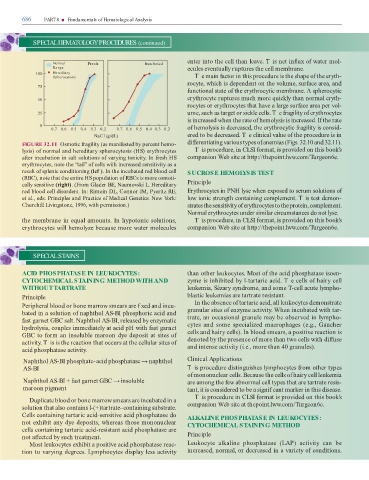
                                                                                                                           enter into the cell than leave. T is net in  ux o  water mol-
                                    Normal                Fresh                                Incubated
                                    Range                                                                                  ecules eventually ruptures the cell membrane.
                        100         Hereditary
                      s             Spherocytosis                                                                               Te main  actor in this proce  ure is the shape o  the eryth-
                      i
                      ys
                      l                                                                                                    rocyte, which is   epen  ent on the volume, sur ace area, an
                      o   75
                      m
                      e                                                                                                     unctional state o  the erythrocytic membrane. A spherocytic
                      h

                      t                                                                                                    erythrocyte ruptures much more quickly than normal eryth-
                      n   50
                      e
                      c
                      r                                                                                                    rocytes or erythrocytes that have a large sur ace area per vol-
                      e
                      P
                          25                                                                                               ume, such as target or sickle cells. T e  ragility o   erythrocytes
                                                                                                                           is increase   when the rate o  hemolysis is increase  . I  the rate
                           0
                                   0.7 0.6 0.5 0.4          0.3 0.2          0.7 0.6      0.5 0.4 0.3 0.2                  o  hemolysis is   ecrease  , the erythrocytic  ragility is consi  -
                                                               NaCI (g/dL)                                                 ere   to be   ecrease  . T e clinical value o  the proce  ure is in


               FIGURE 32.11  Osmotic  ragility (as mani este   by percent hemo-                                             i  erentiating various types o  anemias (Figs. 32.10 an  32.11).
               lysis) o  normal an   here  itary spherocytosis (HS) erythrocytes                                                T is proce  ure, in CLSI  ormat, is provi  e   on this book’s

               a  er incubation in salt solutions o  varying tonicity. In  resh HS                                         companion Web site at http://thepoint.lww.com/  urgeon6e.

               erythrocytes, note the “tail” o  cells with increase   sensitivity as a
               result o  splenic con  itioning (lef ). In the incubate   re   bloo   cell                                  SUCROSE HEMOLYSIS TEST

               (RBC), note that the entire HS population o  RBCs is more osmoti-

               cally sensitive (right). (From Gla  er BE, Naumovski L. Here  itary                                         Principle

               re   bloo   cell   isor  ers. In: Rimoin DL, Connor JM, Pyeritz RE,                                         Erythrocytes in PNH lyse when expose   to serum solutions o

               et al., e  s. Principles and Practice of Medical Genetics. New York:                                        low ionic strength containing complement. T is test   emon-
               Churchill Livingstone, 1996, with permission.)                                                              strates the sensitivity o  erythrocytes to the protein, complement.

                                                                                                                           Normal erythrocytes un  er similar circumstances   o not lyse.

               the membrane in equal amounts. In hypotonic solutions,                                                           T is proce  ure, in CLSI  ormat, is provi  e   on this book’s

               erythrocytes will hemolyze because more water molecules                                                     companion Web site at http://thepoint.lww.com/  urgeon6e.


                       SPECIAL STAINS


               ACID PHOSPHATASE IN LEUKOCYTES:                                                                             than other leukocytes. Most o  the aci   phosphatase isoen-

               CYTOCHEMICAL STAINING METHOD WITH AND                                                                       zyme is inhibite   by l-tartaric aci  . T e cells o  hairy cell

               WITHOUT TARTRATE                                                                                            leukemia, Sézary syn  rome, an   some   -cell acute lympho-


               Principle                                                                                                   blastic leukemias are tartrate resistant.

               Peripheral bloo   or bone marrow smears are f xe   an   incu-                                                    In the absence o  tartaric aci  , all leukocytes   emonstrate

               bate   in a solution o  naphthol AS-BI phosphoric aci   an                                                  granular sites o  enzyme activity. When incubate   with tar-

                ast garnet GBC salt. Naphthol AS-BI, release   by enzymatic                                                trate, an occasional granule may be observe   in lympho-

               hy  rolysis, couples imme  iately at aci   pH with  ast garnet                                              cytes an    some specialize   macrophages (e.g., Gaucher

               GBC to  orm an insoluble maroon   ye   eposit at sites o                                                    cells an   hairy cells). In bloo   smears, a positive reaction is

               activity. T is is the reaction that occurs at the cellular sites o                                            enote   by the presence o  more than two cells with   i  use

               aci   phosphatase activity.                                                                                 an   intense activity (i.e., more than 40 granules).


                                      -
                                                              -
                Naphthol AS BI phosphate aci  phosphatase →                                       naphthol                 Clinical Applications
                AS BI                                                                                                      T is proce  ure   istinguishes lymphocytes  rom other types
                     -
                                                                                                                           o  mononuclear cells. Because the cells o  hairy cell leukemia

                                            +
                Naphthol AS-BI  ast garnet GBC                             →    insoluble                                  are among the  ew abnormal cell types that are tartrate resis-
                maroon pigment                                                                                             tant, it is consi  ere   to be a signif cant marker in this   isease.

                                                                                                                                T is proce  ure in CLSI  ormat is provi  e   on this book’s
                    Duplicate bloo   or bone marrow smears are incubate   in a

               solution that also contains l-(+)tartrate–containing substrate.                                             companion Web site at thepoint.lww.com/  urgeon6e.

               Cells containing tartaric aci  -sensitive aci   phosphatase   o                                             ALKALINE PHOSPHATASE IN LEUKOCYTES:

               not exhibit any   ye   eposits, whereas those mononuclear                                                   CYTOCHEMICAL STAINING METHOD

               cells containing tartaric aci  -resistant aci   phosphatase are

               not a  ecte   by such treatment.                                                                            Principle

                    Most leukocytes exhibit a positive aci   phosphatase reac-                                             Leukocyte  alkaline  phosphatase  (LAP)  activity  can  be

               tion to varying   egrees. Lymphocytes   isplay less activity                                                increase  , normal, or   ecrease   in a variety o  con  itions.

