


Page 100 - Review of Medical Microbiology and Immunology ( PDFDrive )
P. 100
mebooksfree.com
mebooksfree.com
mebooksfree.com
mebooksfree.com
mebooksfree.com
mebooksfree.com
mebooksfree.com
mebooksfree.com
mebooksfree.com mebooksfree.com Resistance transfer genes independently of the bacterial chromosome; therefore, a 89 mebooksfree.com
mebooksfree.com
CHAPTER 11 Antimicrobial Drugs: Resistance
cell can contain many copies; and (2) they can be trans-
ferred not only to cells of the same species, but also to other
species and genera. Note that this conjugal transfer is under
the control of the genes of the R plasmid and not of the
terial chromosome (see Chapter 4).
R factors exist in two broad size categories: large plasmids,
with molecular weights of about 60 million, and small ones,
Tet Strep Erythro F (fertility) plasmid, which governs the transfer of the bac-
Gent
mebooksfree.com
with molecular weights of about 10 million. The large plas-
mebooksfree.com
mebooksfree.com mebooksfree.com Drug resistance genes not conjugative and contain only the resistance genes. mebooksfree.com
mebooksfree.com
mids are conjugative R factors, which contain the extra DNA
to code for the conjugation process. The small R factors are
Pen
Chloro
In addition to conveying antibiotic resistance, R factors
impart two other traits: (1) resistance to metal ions (e.g.,
they code for an enzyme that reduces mercuric ions to
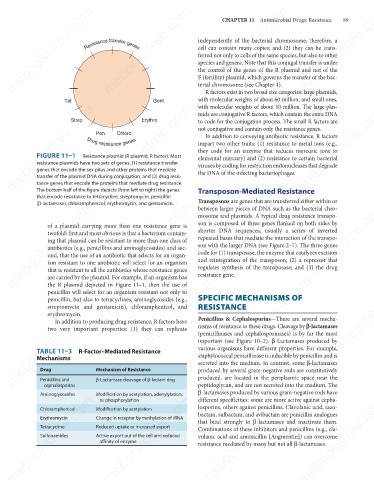
FIGURE 11–1
Resistance plasmid (R plasmid, R factor). Most
elemental mercury) and (2) resistance to certain bacterial
resistance plasmids have two sets of genes: (1) resistance transfer
viruses by coding for restriction endonucleases that degrade
genes that encode the sex pilus and other proteins that mediate
the DNA of the infecting bacteriophages.
transfer of the plasmid DNA during conjugation, and (2) drug resis-
tance genes that encode the proteins that mediate drug resistance.
The bottom half of the figure depicts (from left to right) the genes
that encode resistance to tetracycline, streptomycin, penicillin Transposon-Mediated Resistance
Transposons are genes that are transferred either within or
mebooksfree.com
(β-lactamase), chloramphenicol, erythromycin, and gentamicin.
mebooksfree.com
mebooksfree.com mebooksfree.com mebooksfree.com son is composed of three genes flanked on both sides by mebooksfree.com
between larger pieces of DNA such as the bacterial chro-
mosome and plasmids. A typical drug resistance transpo-
of a plasmid carrying more than one resistance gene is
shorter DNA sequences, usually a series of inverted
twofold: first and most obvious is that a bacterium contain-
repeated bases that mediate the interaction of the transpo-
ing that plasmid can be resistant to more than one class of
son with the larger DNA (see Figure 2–7). The three genes
antibiotics (e.g., penicillins and aminoglycosides) and sec-
code for (1) transposase, the enzyme that catalyzes excision
ond, that the use of an antibiotic that selects for an organ-
and reintegration of the transposon; (2) a repressor that
ism resistant to one antibiotic will select for an organism
regulates synthesis of the transposase; and (3) the drug
that is resistant to all the antibiotics whose resistance genes
are carried by the plasmid. For example, if an organism has
the R plasmid depicted in Figure 11–1, then the use of
penicillin will select for an organism resistant not only to resistance gene.
SPECIFIC MECHANISMS OF
penicillin, but also to tetracyclines, aminoglycosides (e.g.,
mebooksfree.com
mebooksfree.com mebooksfree.com mebooksfree.com Penicillins & Cephalosporins—There are several mecha- mebooksfree.com
mebooksfree.com
RESISTANCE
streptomycin and gentamicin), chloramphenicol, and
erythromycin.
In addition to producing drug resistance, R factors have
nisms of resistance to these drugs. Cleavage by a-lactamases
two very important properties: (1) they can replicate
(penicillinases and cephalosporinases) is by far the most
important (see Figure 10–2). β-Lactamases produced by
various organisms have different properties. For example,
TABLE 11–3 R-Factor–Mediated Resistance
staphylococcal penicillinase is inducible by penicillin and is
Mechanisms
secreted into the medium. In contrast, some β-lactamases
Drug
produced, are located in the periplasmic space near the
β-Lactamase cleavage of β-lactam ring
Penicillins and
peptidoglycan, and are not secreted into the medium. The
cephalosporins
β-lactamases produced by various gram-negative rods have
Modification by acetylation, adenylylation,
Aminoglycosides Mechanism of Resistance produced by several gram-negative rods are constitutively
mebooksfree.com
mebooksfree.com
mebooksfree.com mebooksfree.com Change in receptor by methylation of rRNA that bind strongly to β-lactamases and inactivate them. mebooksfree.com
mebooksfree.com
different specificities: some are more active against cepha-
or phosphorylation
losporins, others against penicillins. Clavulanic acid, tazo-
Modification by acetylation
Chloramphenicol
bactam, sulbactam, and avibactam are penicillin analogues
Erythromycin
Tetracycline
Reduced uptake or increased export
Combinations of these inhibitors and penicillins (e.g., cla-
vulanic acid and amoxicillin [Augmentin]) can overcome
Active export out of the cell and reduced
Sulfonamides
affinity of enzyme
resistance mediated by many but not all β-lactamases.
mebooksfree.com mebooksfree.com mebooksfree.com mebooksfree.com mebooksfree.com mebooksfree.com

