


Page 98 - Review of Medical Microbiology and Immunology ( PDFDrive )
P. 98
mebooksfree.com
mebooksfree.com
mebooksfree.com
mebooksfree.com
mebooksfree.com
mebooksfree.com
mebooksfree.com mebooksfree.com mebooksfree.com mebooksfree.com C 11 mebooksfree.com
mebooksfree.com
A
E
R
H
T
P
Antimicrobial Drugs:
Resistance
mebooksfree.com mebooksfree.com mebooksfree.com Antibiotic Sensitivity Testing mebooksfree.com mebooksfree.com
mebooksfree.com
CHAPTER C ONTENT S
Principles of Antibiotic Resistance
Antibiogram
Genetic Basis of Resistance
Chromosome-Mediated Resistance
Minimal Inhibitory Concentration
Plasmid-Mediated Resistance
Minimal Bactericidal Concentration
Serum Bactericidal Activity
Transposon-Mediated Resistance
Specific Mechanisms of Resistance Use of Antibiotic Combinations
β-Lactamase Production
mebooksfree.com
mebooksfree.com mebooksfree.com mebooksfree.com Self-Assessment Questions mebooksfree.com mebooksfree.com
Nongenetic Basis of Resistance
Selection of Resistant Bacteria by Overuse & Misuse
Pearls
of Antibiotics
Practice Questions: USMLE & Course Examinations
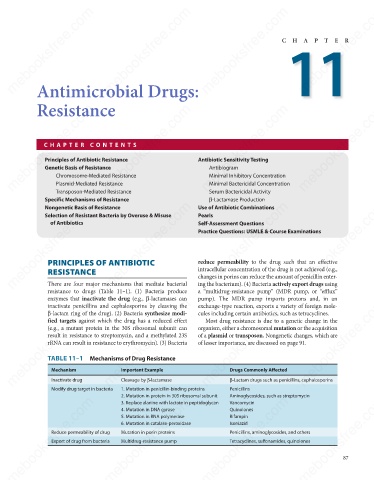
reduce permeability to the drug such that an effective
PRINCIPLES OF ANTIBIOTIC
intracellular concentration of the drug is not achieved (e.g.,
RESISTANCE
changes in porins can reduce the amount of penicillin enter-
ing the bacterium). (4) Bacteria actively export drugs using
There are four major mechanisms that mediate bacterial
resistance to drugs (Table 11–1). (1) Bacteria produce
a “multidrug-resistance pump” (MDR pump, or “efflux”
enzymes that inactivate the drug (e.g., β-lactamases can
mebooksfree.com
mebooksfree.com
mebooksfree.com mebooksfree.com mebooksfree.com pump). The MDR pump imports protons and, in an mebooksfree.com
exchange-type reaction, exports a variety of foreign mole-
inactivate penicillins and cephalosporins by cleaving the
β-lactam ring of the drug). (2) Bacteria synthesize modi-
cules including certain antibiotics, such as tetracyclines.
fied targets against which the drug has a reduced effect
Most drug resistance is due to a genetic change in the
(e.g., a mutant protein in the 30S ribosomal subunit can
organism, either a chromosomal mutation or the acquisition
of a plasmid or transposon. Nongenetic changes, which are
result in resistance to streptomycin, and a methylated 23S
of lesser importance, are discussed on page 91.
rRNA can result in resistance to erythromycin). (3) Bacteria
TABLE 11–1 Mechanisms of Drug Resistance
Mechanism
Inactivate drug
β-Lactam drugs such as penicillins, cephalosporins
Cleavage by β-lactamase
Penicillins
1. Mutation in penicillin-binding proteins
Modify drug target in bacteria Important Example Drugs Commonly Affected
2. Mutation in protein in 30S ribosomal subunit
Aminoglycosides, such as streptomycin
mebooksfree.com mebooksfree.com mebooksfree.com mebooksfree.com mebooksfree.com mebooksfree.com
Vancomycin
3. Replace alanine with lactate in peptidoglycan
4. Mutation in DNA gyrase
Quinolones
5. Mutation in RNA polymerase
Rifampin
6. Mutation in catalase-peroxidase
Isoniazid
Reduce permeability of drug
Penicillins, aminoglycosides, and others
Mutation in porin proteins
Multidrug-resistance pump
Tetracyclines, sulfonamides, quinolones
Export of drug from bacteria
87
mebooksfree.com mebooksfree.com mebooksfree.com mebooksfree.com mebooksfree.com mebooksfree.com

