Page 99 - Review of Medical Microbiology and Immunology ( PDFDrive )
P. 99
mebooksfree.com
                                                                            mebooksfree.com
 mebooksfree.com

            mebooksfree.com
                                            mebooksfree.com
                                                                                                            mebooksfree.com
                                                                            mebooksfree.com
 mebooksfree.com  mebooksfree.com           mebooksfree.com          Note that although these bacteria are resistant to other              mebooksfree.com
                                                                                                                                           mebooksfree.com
                      PART I  Basic Bacteriology
                 88
                       The term high-level resistance refers to resistance that
                    cannot be overcome by increasing the dose of the antibi-
                                                                     drugs as well, for simplicity, only the most characteristic
                                                                     drugs are listed. Some strains of the bacteria listed in
                    otic. A different antibiotic, usually from another class of
                                                                     Table  11–2 are highly resistant to multiple antibiotics,
                    drugs, is used. Resistance mediated  by enzymes such as
                    β-lactamases often result in high-level resistance, as all the
                                                                     namely methicillin-resistant  S. aureus (MRSA; see
                    drug is destroyed. Low-level resistance refers to resistance
                                                                     (VRE; see Chapter 15), multidrug-resistant  Streptococcus
                    that can be overcome by increasing the dose of the antibi-
                    otic. Resistance mediated by mutations in the gene encod-
                                                                     pneumoniae (MDR-SP; see Chapter 15), P. aeruginosa (see
                    ing a drug target is often low level, as the altered target can     Chapter  15),  vancomycin-resistant  Enterococcus faecium
                                                                     Chapter 18), and multidrug-resistant  Mycobacterium
                    still bind some of the drug but with reduced strength.
 mebooksfree.com  mebooksfree.com           mebooksfree.com          GENETIC BASIS OF RESISTANCE                                           mebooksfree.com
                                                                                                            mebooksfree.com
                                                                            mebooksfree.com
                                                                       tuberculosis (MDR-MTB; see Chapter 21).
                       To illustrate the use of these terms, strains of Neisseria
                    gonorrhoeae that produce penicillinase cannot be treated
                    successfully with penicillin G. They exhibit high-level resis-
                    tance, and a different drug such as ceftriaxone must be used.
                                                                     Chromosome-Mediated Resistance
                    However, strains of N. gonorrhoeae that synthesize altered
                    penicillin-binding proteins exhibit low-level resistance and
                                                                     Chromosomal resistance is due to a mutation in the gene
                    can be treated successfully with high-dose penicillin G.
                                                                     that codes for either the target of the drug or the transport
                       Hospital-acquired infections are significantly more likely
                                                                     system  in  the  membrane  that  controls  the  uptake  of  the
                    to be caused by antibiotic-resistant organisms than are
                      community-acquired infections. This is especially true for
                                                                                        –9
                                                                                  –7
                                                                     ranges from 10  to 10 , which is much lower than the
                    hospital infections caused by Staphylococcus aureus and enteric
                                                                     frequency of acquisition of resistance plasmids. Therefore,
                    gram-negative rods such as Escherichia coli and Pseudomonas   drug. The frequency of spontaneous mutations usually
                                                                     chromosomal resistance is less of a clinical problem than is
                    aeruginosa. Antibiotic-resistant organisms are common in the
                                                                     plasmid-mediated resistance.
                                                                            mebooksfree.com
 mebooksfree.com  mebooksfree.com           mebooksfree.com          that a bacterium mutates to become resistant to antibiotic            mebooksfree.com
                                                                                                            mebooksfree.com
                    hospital setting because widespread antibiotic use in hospitals
                                                                        The treatment of certain infections with two or more
                    selects for these organisms. Furthermore, hospital strains are
                                                                     drugs is based on the following principle. If the frequency
                    often resistant to multiple antibiotics. This resistance is usually
                    due to the acquisition of plasmids carrying several genes that
                                                                           –7
                                                                     A is 10  (1 in 10 million) and the frequency that the same
                    encode the enzymes that mediate resistance.
                                                                     bacterium mutates to become resistant to antibiotic B
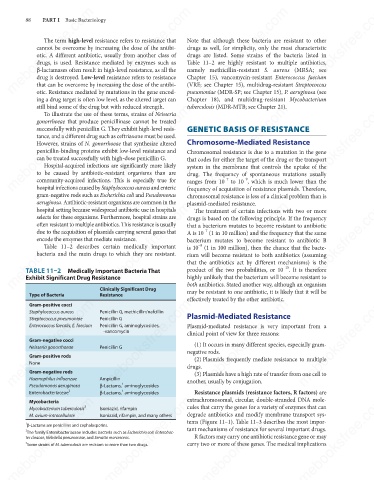
                       Table 11–2 describes certain medically important
                                                                         –8
                                                                     is 10  (1 in 100 million), then the chance that the bacte-
                      bacteria and the main drugs to which they are resistant.
                                                                     rium will become resistant to both antibiotics (assuming
                                                                     that the antibiotics act by different mechanisms) is the
                                                                                                     –15
                                                                     product of the two probabilities, or 10 . It is therefore
                 TABLE 11–2  Medically Important Bacteria That
                 Exhibit Significant Drug Resistance
                                                                     both antibiotics. Stated another way, although an organism
                                                                     may be resistant to one antibiotic, it is likely that it will be
                  Type of Bacteria       Clinically Significant Drug   highly unlikely that the bacterium will become resistant to
                                         Resistance
                                                                     effectively treated by the other antibiotic.
                                                                            mebooksfree.com
 mebooksfree.com  mebooksfree.com        Penicillin G, aminoglycosides,   Plasmid-mediated resistance is very important from a             mebooksfree.com
                                                                                                            mebooksfree.com
                                            mebooksfree.com
                                          
                  Gram-positive cocci
                  Staphylococcus aureus
                                         Penicillin G, methicillin/nafcillin
                                                                     Plasmid-Mediated Resistance
                  Streptococcus pneumoniae
                                         Penicillin G
                  Enterococcus faecalis, E. faecium
                                          -vancomycin
                                                                     clinical point of view for three reasons:
                                          
                  Gram-negative cocci
                                                                        (1) It occurs in many different species, especially gram-
                                         Penicillin G
                  Neisseria gonorrhoeae
                                                                     negative rods.
                  Gram-positive rods
                                          
                                                                        (2) Plasmids frequently mediate resistance to multiple
                                          
                  None
                                                                     drugs.
                  Gram-negative rods
                                                                        (3) Plasmids have a high rate of transfer from one cell to
                  Haemophilus influenzae
                                         β-Lactams,  aminoglycosides
                  Pseudomonas aeruginosa
                                                                        Resistance plasmids (resistance factors, R factors) are
                  Enterobacteriaceae 2  3    Ampicillin  1 1         another, usually by conjugation.
                                         β-Lactams,  aminoglycosides
 mebooksfree.com  mebooksfree.com           mebooksfree.com          tems (Figure 11–1). Table 11–3 describes the most impor-              mebooksfree.com
                                                                                                            mebooksfree.com
                                                                            mebooksfree.com
                                                                     extrachromosomal, circular, double-stranded DNA mole-
                  Mycobacteria
                                          
                                                                     cules that carry the genes for a variety of enzymes that can
                                         Isoniazid, rifampin
                  Mycobacterium tuberculosis
                                                                     degrade antibiotics and modify membrane transport sys-
                                         Isoniazid, rifampin, and many others
                  M. avium-intracellulare
                 1
                 β-Lactams are penicillins and cephalosporins.
                                                                     tant mechanisms of resistance for several important drugs.
                 2
                 The family Enterobacteriaceae includes bacteria such as Escherichia coli, Enterobac-
                                                                        R factors may carry one antibiotic resistance gene or may
                 ter cloacae, Klebsiella pneumoniae, and Serratia marcescens.
                                                                     carry two or more of these genes. The medical implications
                 3
                 Some strains of M. tuberculosis are resistant to more than two drugs.
 mebooksfree.com  mebooksfree.com           mebooksfree.com                 mebooksfree.com                 mebooksfree.com                mebooksfree.com
   94   95   96   97   98   99   100   101   102   103   104