


Page 103 - Review of Medical Microbiology and Immunology ( PDFDrive )
P. 103
mebooksfree.com


                                                                                                                                           mebooksfree.com
                                                                                                            mebooksfree.com
            mebooksfree.com
                                            mebooksfree.com
 mebooksfree.com  mebooksfree.com           mebooksfree.com                 mebooksfree.com                 mebooksfree.com                mebooksfree.com
                                                                            mebooksfree.com
                      PART I  Basic Bacteriology
                 92


                                                                                            No
                                                             6.2
                                                                                      No
                                     Drug
                                                25
                                                      12.5
                                          50
                                    (µg/mL)
                                                               0.1 mL 3.1  3.1  1.5  0.75  drug  bacteria
                                                  Control
 mebooksfree.com  mebooksfree.com           mebooksfree.com           6.2   mebooksfree.com                 mebooksfree.com                mebooksfree.com
                                             No bacteria


                                                  12.5

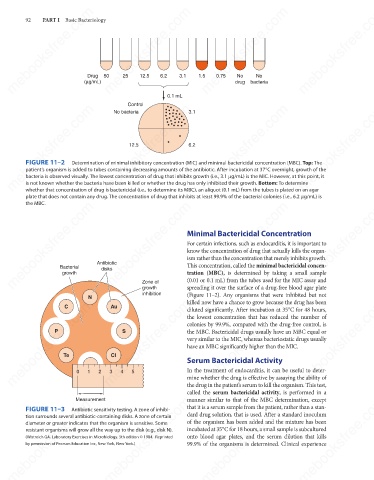
                 FIGURE 11–2
                                Determination of minimal inhibitory concentration (MIC) and minimal bactericidal concentration (MBC). Top: The
                 patient’s organism is added to tubes containing decreasing amounts of the antibiotic. After incubation at 37°C overnight, growth of the
                 bacteria is observed visually. The lowest concentration of drug that inhibits growth (i.e., 3.1 μg/mL) is the MIC. However, at this point, it
                 is not known whether the bacteria have been killed or whether the drug has only inhibited their growth. Bottom: To determine
                 whether that concentration of drug is bactericidal (i.e., to determine its MBC), an aliquot (0.1 mL) from the tubes is plated on an agar
                 plate that does not contain any drug. The concentration of drug that inhibits at least 99.9% of the bacterial colonies (i.e., 6.2 μg/mL) is
                                            mebooksfree.com
                                                                            mebooksfree.com
                                                                                                            mebooksfree.com
 mebooksfree.com  mebooksfree.com       Antibiotic                   Minimal Bactericidal Concentration                                    mebooksfree.com
                 the MBC.


                                                                     For certain infections, such as endocarditis, it is important to
                                                                     know the concentration of drug that actually kills the organ-
                                                                     ism rather than the concentration that merely inhibits growth.
                                                                     This concentration, called the minimal bactericidal concen-
                            Bacterial
                                         disks
                             growth
                                                                     (0.01 or 0.1 mL) from the tubes used for the MIC assay and
                                                       Zone of
                                                                     spreading it over the surface of a drug-free blood agar plate
                                                       growth
                                                       inhibition    tration (MBC), is determined by taking a small sample
                                                                     (Figure 11–2). Any organisms that were inhibited but not
                                     N      Au                       killed now have a chance to grow because the drug has been
 mebooksfree.com  mebooksfree.com           mebooksfree.com          colonies by 99.9%, compared with the drug-free control, is            mebooksfree.com
                                                                            mebooksfree.com
                                                                                                            mebooksfree.com
                             C
                                                                     diluted significantly. After incubation at 35°C for 48 hours,
                                                                     the  lowest  concentration  that  has  reduced  the  number  of
                                                                     the MBC. Bactericidal drugs usually have an MBC equal or
                                                S
                          P
                                                                     very similar to the MIC, whereas bacteriostatic drugs usually
                                                                     have an MBC significantly higher than the MIC.
                                             Cl
                             Te
                                                                     Serum Bactericidal Activity
                                                                     In the treatment of endocarditis, it can be useful to deter-
                                        2
                                     1
                                 0
                                                   5
                                                4
                                            3
                                                                     mine whether the drug is effective by assaying the ability of
                                                                     the drug in the patient’s serum to kill the organism. This test,
                                                                     called the  serum bactericidal activity, is performed in a
 mebooksfree.com  mebooksfree.com           mebooksfree.com          of the organism has been added and the mixture has been               mebooksfree.com
                                                                                                            mebooksfree.com
                                                                            mebooksfree.com
                                                                     manner similar to that of the MBC determination, except
                                 Measurement
                                                                     that it is a serum sample from the patient, rather than a stan-
                 FIGURE 11–3
                                Antibiotic sensitivity testing. A zone of inhibi-
                                                                     dard drug solution, that is used. After a standard inoculum
                 tion surrounds several antibiotic-containing disks. A zone of certain
                 diameter or greater indicates that the organism is sensitive. Some
                                                                     incubated at 35°C for 18 hours, a small sample is subcultured
                 resistant organisms will grow all the way up to the disk (e.g., disk N).
                                                                     onto blood agar plates, and the serum dilution that kills
                 (Wistreich GA. Laboratory Exercises in Microbiology. 5th edition © 1984.  Reprinted
                                                                     99.9% of the organisms is determined. Clinical experience
                 by permission of Pearson Education Inc, New York, New York.)
 mebooksfree.com  mebooksfree.com           mebooksfree.com                 mebooksfree.com                 mebooksfree.com                mebooksfree.com

