Page 112 - Review of Medical Microbiology and Immunology ( PDFDrive )
P. 112
mebooksfree.com
                                                                            mebooksfree.com
 mebooksfree.com

            mebooksfree.com
                                                                            mebooksfree.com
                                            mebooksfree.com
 mebooksfree.com  mebooksfree.com           mebooksfree.com              TABLE 13–2  Clinical Use of Disinfection and   101                mebooksfree.com
                                                                                                                                           mebooksfree.com
                                                                                                            mebooksfree.com
                                                                                    CHAPTER 13  Sterilization & Disinfection
                    TABLE 13–1  Infection Control Precautions and
                    Practices
                                                                         Sterilization
                               Example of Type of
                                                                                                     Commonly Used
                     Type of
                                                                                                     Disinfectant or Method of
                                                   Important Precaution
                               Patient or Type of
                                                   Practice Employed
                                                                          Clinical Use
                     Precaution
                                                                                                     Sterilization
                               Infection
                                                   1.  Hand hygiene
                               All patients
                     Standard
                                                   2.   Respiratory hygiene
                                                                           surgery
                                                     and cough etiquette
                                                                          Disinfect surgical site prior to surgery
                                                                                                     Iodophor
                                                   3.   Safe injection practices  Disinfect surgeon’s hands prior to   Chlorhexidine
                                                   4.   Proper disposal of nee-
                                                                          Disinfect skin prior to venipuncture
                                                                                                     70% ethanol
                                                                            mebooksfree.com
                                                                                                            mebooksfree.com
 mebooksfree.com  mebooksfree.com           mebooksfree.com               Cleanse wounds             Thimerosal, chlorhexidine,            mebooksfree.com
                                                     dles and scalpels
                                                                           or immunization
                     Standard
                               If exposure to blood,
                                                   Personal protective equip-
                                                                                                     Tincture of iodine followed by
                                                                          Disinfect skin prior to blood culture
                                 secretions, or body flu-
                                                                           or inserting vascular catheter
                                                                                                       70% ethanol, or iodophor,
                                                    ment (PPE) such as
                                                    mask, face shield, gog-
                                 ids is likely to occur
                                                                                                       or chlorhexidine
                                                    gles, gloves, or gown
                                                   1.   Wear gloves and gown
                               1.   Stool incontinence,
                     Contact
                                                                                                       hydrogen peroxide
                                                   2.  Disinfect room
                                 e.g., Clostridium dif-
                                                                                                     Silver sulfadiazine
                                                                          Cleanse burn wounds
                                 ficile, norovirus
                               2.   Generalized rash,
                                                                                                     Hypochlorite (bleach, Clorox)
                                                                          Cleanup of blood spill from a patient
                                 e.g., varicella
                                                                           with hepatitis B or C (disinfect area)
                                 (chickenpox)
                               3.  Draining wounds
                                                                           heat-sensitive materials (e.g.,
                                                                                                       glutaraldehyde
                     Droplet
                               1.   Respiratory viruses,
                                                                             endoscopes, respiratory therapy
                                 e.g., influenza   1.   Face mask or face   Sterilize surgical instruments and   Ethylene oxide or
                                                     shield for patient and
                                                                           equipment)
                                                     provider
                               2.  Bordetella pertussis
                                                                            mebooksfree.com
                                                                                                            mebooksfree.com
 mebooksfree.com  mebooksfree.com           mebooksfree.com               Disinfect air in operating room   Ultraviolet light              mebooksfree.com
                                                                          Sterilize non–heat-sensitive materials
                                                                                                     Autoclave
                                                   2.  Disinfect room
                               3.   Early infection with
                                                                           (e.g., surgical gowns, drapes)
                                 Neisseria meningitidis
                                                                                                     Filtration
                                                                          Sterilize intravenous solutions
                               1.  Tuberculosis
                     Airborne
                                                   1.   Isolation room; nega-
                                                     tive pressure room
                               2.  Measles
                               3.   Varicella (chickenpox)
                                                   2.   Face mask or face
                                                                           (when not in use)
                                 when patient is
                                                     shield for patient and
                                                                                                     Benzalkonium chloride (Lysol)
                                                                          Disinfect floor of operating room
                                 coughing
                                                     provider. N-95 respira-
                                                     tor, if available.
                                                                          Disinfect stethoscope
                                                                                                     70% ethanol
                                                   3.  Disinfect room
                                                                          Preservative in vaccines
                                                                                                     Thimerosal
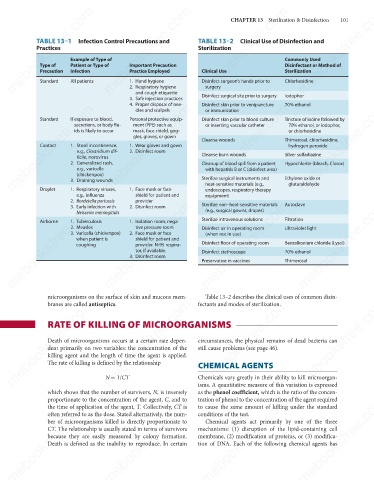
                        microorganisms on the surface of skin and mucous mem-  fectants and modes of sterilization.
                                                                           Table 13–2 describes the clinical uses of common disin-
                                                                            mebooksfree.com
                                                                                                            mebooksfree.com
 mebooksfree.com  mebooksfree.com           mebooksfree.com              circumstances, the physical remains of dead bacteria can          mebooksfree.com
                        branes are called antiseptics.
                        RATE OF KILLING OF MICROORGANISMS
                        Death of microorganisms occurs at a certain rate depen-
                                                                         still cause problems (see page 46).
                        dent primarily on two variables: the concentration of the
                        killing agent and the length of time the agent is applied.
                        The rate of killing is defined by the relationship
                                                                         CHEMICAL AGENTS
                                           N ∝ 1/CT
                                                                         isms. A quantitative measure of this variation is expressed
                        which shows that the number of survivors, N, is inversely   Chemicals vary greatly in their ability to kill microorgan-
                                                                         as the phenol coefficient, which is the ratio of the concen-
                                                                            mebooksfree.com
                                                                                                            mebooksfree.com
 mebooksfree.com  mebooksfree.com           mebooksfree.com              mechanisms: (1) disruption of the lipid-containing cell           mebooksfree.com
                        proportionate to the concentration of the agent, C, and to
                                                                         tration of phenol to the concentration of the agent required
                                                                         to  cause  the  same  amount  of  killing  under  the  standard
                        the time of application of the agent, T. Collectively, CT is
                                                                         conditions of the test.
                        often referred to as the dose. Stated alternatively, the num-
                                                                           Chemical agents act primarily by one of the three
                        ber of microorganisms killed is directly proportionate to
                        CT. The relationship is usually stated in terms of survivors
                                                                         membrane, (2) modification of proteins, or (3) modifica-
                        because  they  are  easily  measured  by  colony  formation.
                        Death is defined as the inability to reproduce. In certain
                                                                         tion  of DNA.  Each  of  the  following  chemical  agents  has
 mebooksfree.com  mebooksfree.com           mebooksfree.com                 mebooksfree.com                 mebooksfree.com                mebooksfree.com
   107   108   109   110   111   112   113   114   115   116   117