


Page 117 - Review of Medical Microbiology and Immunology ( PDFDrive )
P. 117
mebooksfree.com
mebooksfree.com
mebooksfree.com
mebooksfree.com
mebooksfree.com mebooksfree.com mebooksfree.com mebooksfree.com mebooksfree.com mebooksfree.com
mebooksfree.com
mebooksfree.com
106
PART II Clinical Bacteriology
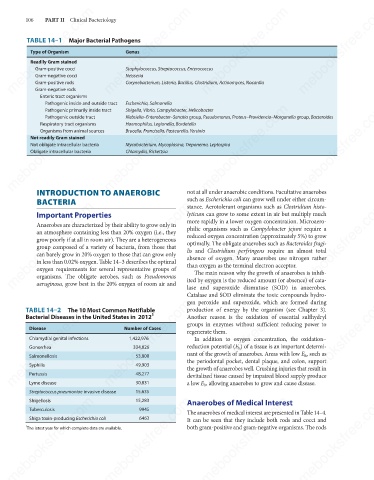
TABLE 14–1 Major Bacterial Pathogens
Genus
Type of Organism
Readily Gram stained
Gram-positive cocci
Staphylococcus, Streptococcus, Enterococcus
Gram-negative cocci
Corynebacterium, Listeria, Bacillus, Clostridium, Actinomyces, Nocardia
Gram-positive rods
Gram-negative rods
Enteric tract organisms Neisseria
Escherichia, Salmonella
Pathogenic inside and outside tract
mebooksfree.com
mebooksfree.com
mebooksfree.com mebooksfree.com mebooksfree.com not at all under anaerobic conditions. Facultative anaerobes mebooksfree.com
Pathogenic primarily inside tract
Shigella, Vibrio, Campylobacter, Helicobacter
Klebsiella–Enterobacter–Serratia group, Pseudomonas, Proteus–Providencia–Morganella group, Bacteroides
Pathogenic outside tract
Respiratory tract organisms
Haemophilus, Legionella, Bordetella
Brucella, Francisella, Pasteurella, Yersinia
Organisms from animal sources
Not readily Gram stained
Mycobacterium, Mycoplasma, Treponema, Leptospira
Not obligate intracellular bacteria
Chlamydia, Rickettsia
Obligate intracellular bacteria
INTRODUCTION TO ANAEROBIC
BACTERIA
mebooksfree.com
mebooksfree.com
mebooksfree.com mebooksfree.com mebooksfree.com such as Escherichia coli can grow well under either circum- mebooksfree.com
stance. Aerotolerant organisms such as Clostridium histo-
lyticum can grow to some extent in air but multiply much
Important Properties
more rapidly in a lower oxygen concentration. Microaero-
Anaerobes are characterized by their ability to grow only in
philic organisms such as Campylobacter jejuni require a
an atmosphere containing less than 20% oxygen (i.e., they
reduced oxygen concentration (approximately 5%) to grow
grow poorly if at all in room air). They are a heterogeneous
optimally. The obligate anaerobes such as Bacteroides fragi-
group composed of a variety of bacteria, from those that
lis and Clostridium perfringens require an almost total
can barely grow in 20% oxygen to those that can grow only
absence of oxygen. Many anaerobes use nitrogen rather
in less than 0.02% oxygen. Table 14–3 describes the optimal
than oxygen as the terminal electron acceptor.
oxygen requirements for several representative groups of
The main reason why the growth of anaerobes is inhib-
organisms. The obligate aerobes, such as Pseudomonas
ited by oxygen is the reduced amount (or absence) of cata-
aeruginosa, grow best in the 20% oxygen of room air and
lase and superoxide dismutase (SOD) in anaerobes.
Catalase and SOD eliminate the toxic compounds hydro-
mebooksfree.com
mebooksfree.com mebooksfree.com mebooksfree.com groups in enzymes without sufficient reducing power to mebooksfree.com
hmebooksfree.com
gen peroxide and superoxide, which are formed during
production of energy by the organism (see Chapter 3).
TABLE 14–2 The 10 Most Common Notifiable
1
Another reason is the oxidation of essential sulfhydryl
Bacterial Diseases in the United States in 2012
Number of Cases
Disease
regenerate them.
In addition to oxygen concentration, the oxidation–
1,422,976
Chlamydial genital infections
reduction potential (E ) of a tissue is an important determi-
Gonorrhea
334,826
h
nant of the growth of anaerobes. Areas with low E , such as
Salmonellosis
53,800
h
the periodontal pocket, dental plaque, and colon, support
49,903
Syphilis
Pertussis
devitalized tissue caused by impaired blood supply produce
a low E , allowing anaerobes to grow and cause disease.
Lyme disease
30,831
15,635
Streptococcus pneumoniae invasive disease 48,277 the growth of anaerobes well. Crushing injuries that result in
mebooksfree.com mebooksfree.com mebooksfree.com It can be seen that they include both rods and cocci and mebooksfree.com
mebooksfree.com
mebooksfree.com
Shigellosis
Anaerobes of Medical Interest
15,283
9945
Tuberculosis
The anaerobes of medical interest are presented in Table 14–4.
Shiga toxin-producing Escherichia coli
6463
both gram-positive and gram-negative organisms. The rods
1
The latest year for which complete data are available.
mebooksfree.com mebooksfree.com mebooksfree.com mebooksfree.com mebooksfree.com mebooksfree.com

